ECB warns digital euro launch could slip past 2029
By The Daily Byte
·11 Nov 2026
·4 min read
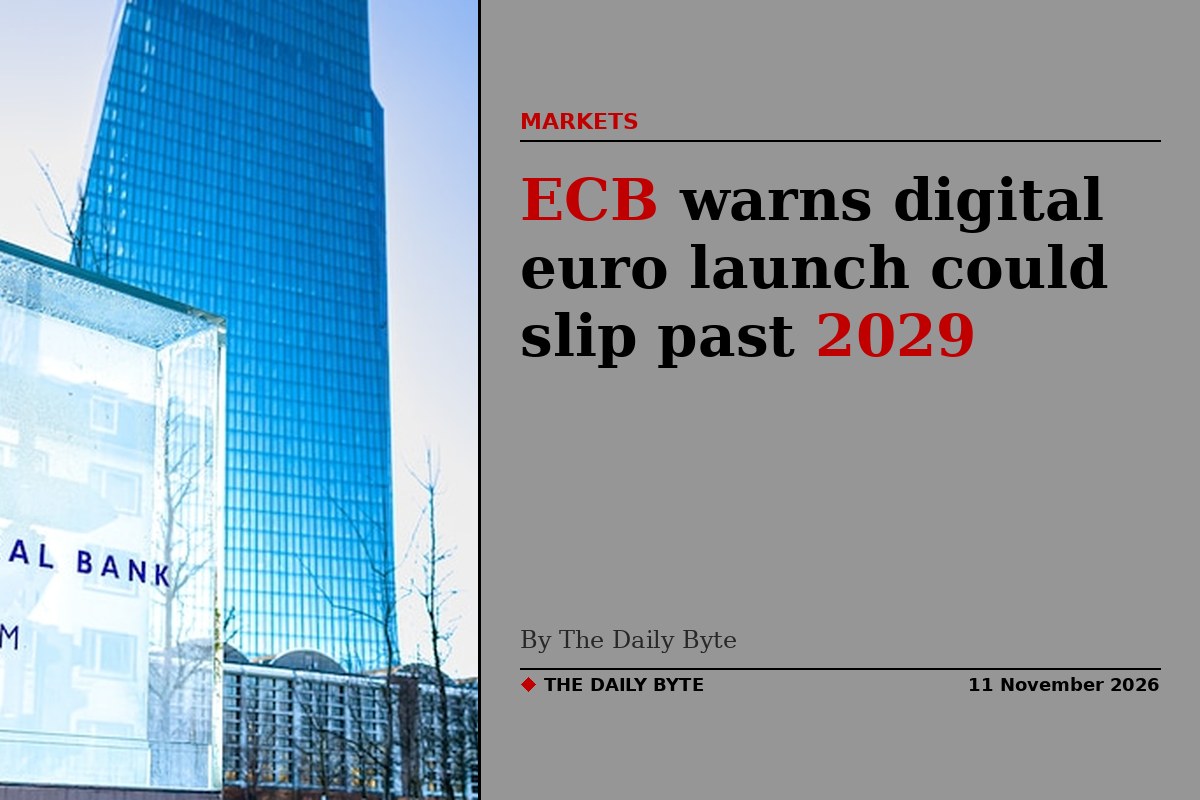
The European Central Bank has warned that delays in approving European Union legislation could push the digital euro's possible launch beyond 2029, even as preparations for a pilot programme continue. ECB Executive Board member Piero Cipollone told the European Parliament's Committee on Economic and Monetary Affairs on 10 November that negotiators should conclude talks on the Single Currency Package by the end of the year.
"A delay in adoption could instead postpone the introduction of the digital euro," Cipollone said in his [introductory statement](https://www.ecb.europa.eu/press/key/date/2026/html/ecb.sp261110~9422461bad.en.html), warning that a later launch would further entrench Europe's dependence on foreign payment providers and make it more difficult for European companies to innovate and compete.
## What Cipollone told MEPs
Cipollone said a swift conclusion to the trilogue negotiations between the European Parliament, the Council of the EU and the European Commission would pave the way for adoption of the Single Currency Package by the end of the year, as foreseen in the One Europe, One Market Roadmap. That, he said, would give the ECB the legal certainty needed to complete its preparations for the digital euro.
The legislation matters because the ECB cannot issue a digital euro without it. As [Cointelegraph reported](https://cointelegraph.com/news/ecb-warns-legislative-delays-digital-euro-launch) on 11 November, adoption of the regulation would give the ECB the legal certainty it needs to complete preparations, and the ECB's Governing Council will decide whether and when to issue the digital currency only after the legislation passes.
The European Parliament's economic affairs committee approved its position on the digital euro legislation in June in a 43-14 vote, and Parliament adopted its negotiating position in July. The Council of the EU agreed its own position in December 2025, and trilogue negotiations are now under way.
## The 2029 timetable and the pilot
The ECB aims to be ready for a possible first issuance in 2029 if the EU adopts the regulation this year. That date is a target for readiness, not a promise: the Governing Council will determine whether and when to issue the digital euro once the law is in place.
Before any launch, the ECB is preparing a 12-month pilot set to begin in the second half of 2027. The pilot will test the digital euro's technical functionality, operational processes and user experience using a beta version without legal tender status. It will involve Eurosystem staff, participating payment service providers and selected merchants offering everyday services, for example in canteens, at the ECB and participating national central banks.
Market interest in the pilot has been strong. In July the ECB announced the 36 payment service providers selected to join from more than 50 applicants, covering banks and non-bank providers and a broad range of business models, sizes and geographical locations. In September it opened a further call for online and mobile merchants to join the pilot to test remote payments, with the final selection of merchants to be announced early next year.
## Why the ECB says the deadline matters
Cipollone framed the issue as one of European autonomy in payments. In his statement he said timely progress on the digital euro was essential to strengthen Europe's autonomy in payments in an uncertain geopolitical environment, and that the ECB was doing its part by progressing with the technical preparations.
The warning also comes as the ECB prepares for a leadership change. President Christine Lagarde announced in October that she would step down on 7 February 2027, ahead of the planned pilot. The Governing Council's decision on whether to issue a digital euro will therefore fall to her successor's tenure, but the legislative timetable is set now.
## Cash stays alongside a digital euro
Cipollone stressed that the digital euro is designed to sit alongside cash, not replace it. In two months' time the euro area will mark the 25th anniversary of euro banknotes and coins entering circulation, and the ECB is also redesigning its banknotes, with almost 10 million responses received to a public survey on ten shortlisted design proposals. First denominations of the new banknote series are expected to enter circulation in the early 2030s.
The ECB also supports strong legislative provisions on mandatory cash acceptance, access to cash across the euro area and the resilience of cash infrastructure. The message from Frankfurt is that Europeans should have a digital form of cash alongside physical cash, and that the law to make that possible needs to be agreed before the end of 2026.
Source
European Central Bank — https://www.ecb.europa.eu/press/key/date/2026/html/ecb.sp261110~9422461bad.en.html