ECP Not Yet Told of Any Referendum Plan on New Provinces
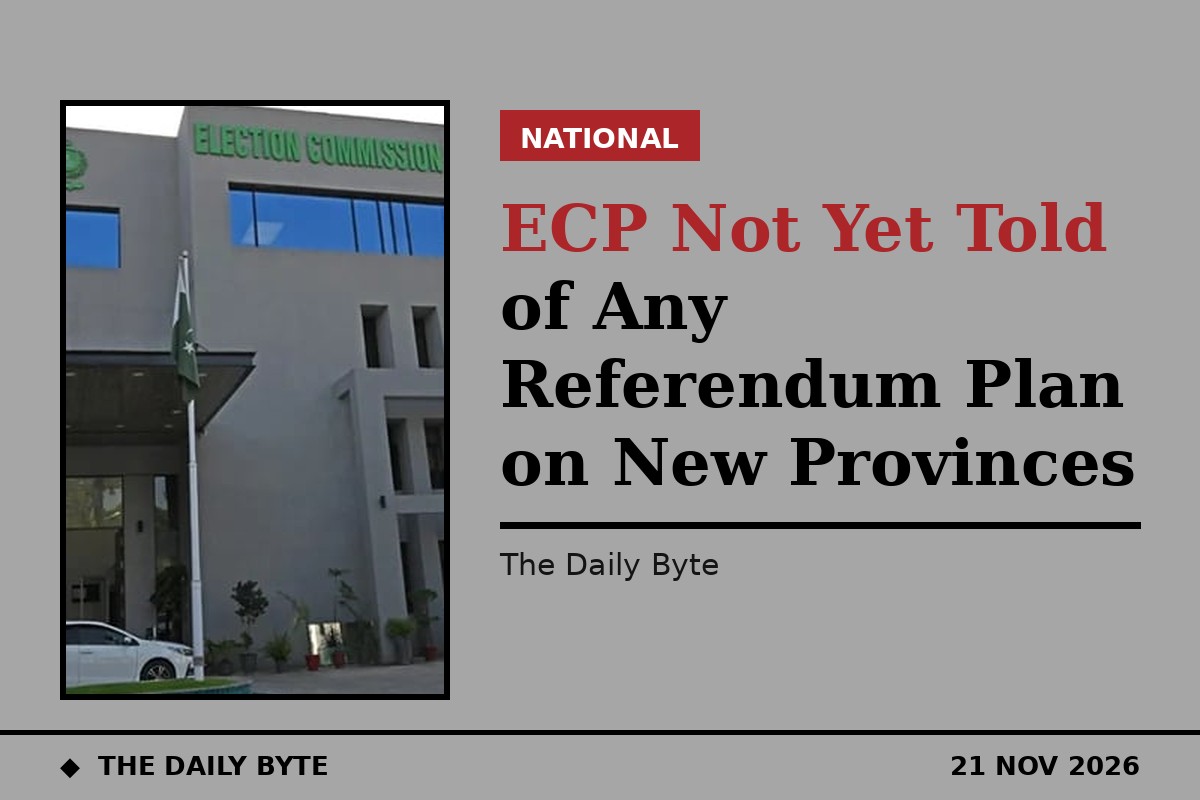
Talk of a referendum on new provinces is everywhere in Pakistan, and ministers are now openly backing the idea. But the Election Commission of Pakistan, the body that would have to hold the vote, has not been told whether it will happen, or when.
“The ECP has not been contacted yet,” an Election Commission source told The News. The source said the Commission would need at least two months to prepare once it receives a formal request. The Commission is not the only institution kept in the dark: even the federal cabinet has not formally discussed the plan.
Federal Health Minister Mustafa Kamal, of the Muttahida Qaumi Movement-Pakistan, admitted as much in a television interview this week. “I am also hearing all these things, watching everything, but officially I do not know at all,” he said. Pakistan Peoples Party Chairman Bilawal Bhutto Zardari, whose party is a key coalition partner, says the matter has not been discussed with him either.
That sits awkwardly with the public statements of other ministers. Information Minister Attaullah Tarar said earlier this week that a referendum is a constitutional and legal way to find out what people want, and that there is no harm in holding one. Defence Minister Khawaja Asif went further a few days earlier, telling Geo News that he expects the new provinces by the New Year. “My own view is that New Year will see this, the new system also, God willing,” he said.
Parliamentary Affairs Minister Tariq Fazal Chaudhry reaffirmed on Friday that a referendum on the creation of new provinces would take place, and said the ruling Pakistan Muslim League-Nawaz would make every possible effort to persuade the PPP to support it. He stressed that consensus among coalition partners should come first, but argued that one party’s opposition should not stop public consultation.
The calendar is already tight
Kamal pointed to the political calendar. “December is a very important month. There are Senate elections ahead. After that, the budget will come in June, so whatever has to happen has to happen before that,” he said. Political analysts believe the new provinces will be created before the Senate elections, which are expected in the first week of March. If that is the plan, the Election Commission should already know about it. It does not.
The legal route is also far from straightforward. Under Article 48(6) of the Constitution, only the prime minister can propose a referendum, and a joint sitting of Parliament must approve it. Neither step has happened yet. Once the Commission is formally told, it will ask the federal and provincial governments for lists of their officers, from which it will choose district returning officers, returning officers and presiding officers, notify their names, ban transfers and postings until the vote is over, and arrange their training.
It will also have to choose government buildings as polling stations, carry out field surveys to fix their locations, and put in place software connecting polling stations, district returning officers and Election Commission offices so results can be counted and compiled. Pakistan has about 136.6 million registered voters; in 2024, the Free and Fair Election Network ranked it the fifth-largest electorate in the world, after India, Indonesia, the United States and Brazil.
A referendum cannot change borders on its own
It is not even clear how the vote would be counted. It could produce one national result, or a separate result for each province, and recent reports suggest each province will have its own say on new provinces, with results counted province by province. An initial plan reported this week envisages new administrative provinces, rather than linguistic ones, each with its own assembly, chief minister and cabinet, with voters deciding district by district.
There is a bigger legal question too. Under Article 239(4) of the Constitution, any change to a province’s borders needs a two-thirds vote in that province’s own assembly. A referendum cannot replace that vote. The Sindh Assembly has passed resolutions against dividing the province several times, most recently in February 2026.
Pakistan has held three referendums so far, all under military rulers: in 1960, General Ayub Khan won a vote of confidence from 80,000 Basic Democrats; in 1984, General Zia-ul-Haq counted a “yes” to his Islamisation programme as five more years in office; and in 2002, General Pervez Musharraf used one to secure a five-year presidential term. A referendum on new provinces would be the first held by a civilian government, but for now it remains a proposal argued about in public, with the body that must run it still waiting to be told.