Egypt sees path to US-Iran deal as Suez losses hit $20bn
Egypt believes the United States and Iran can still reach an agreement to end their confrontation, and it is working with regional partners to rebuild the trust needed to get both sides back to the negotiating table. Foreign Minister Badr Abdelatty set out Cairo's position on CNN's Fareed Zakaria GPS on Sunday, saying Egypt was coordinating daily with Qatar on the diplomatic effort.
Asked directly whether he saw a path to a deal, Abdelatty replied: "Yes. And we are hopeful for that." He added: "I believe that there is a possibility for dialog, for reaching a deal, for reaching a compromise." He said a lack of mutual trust remained an obstacle, and that the countries involved were working on confidence-building measures to move negotiations forward.
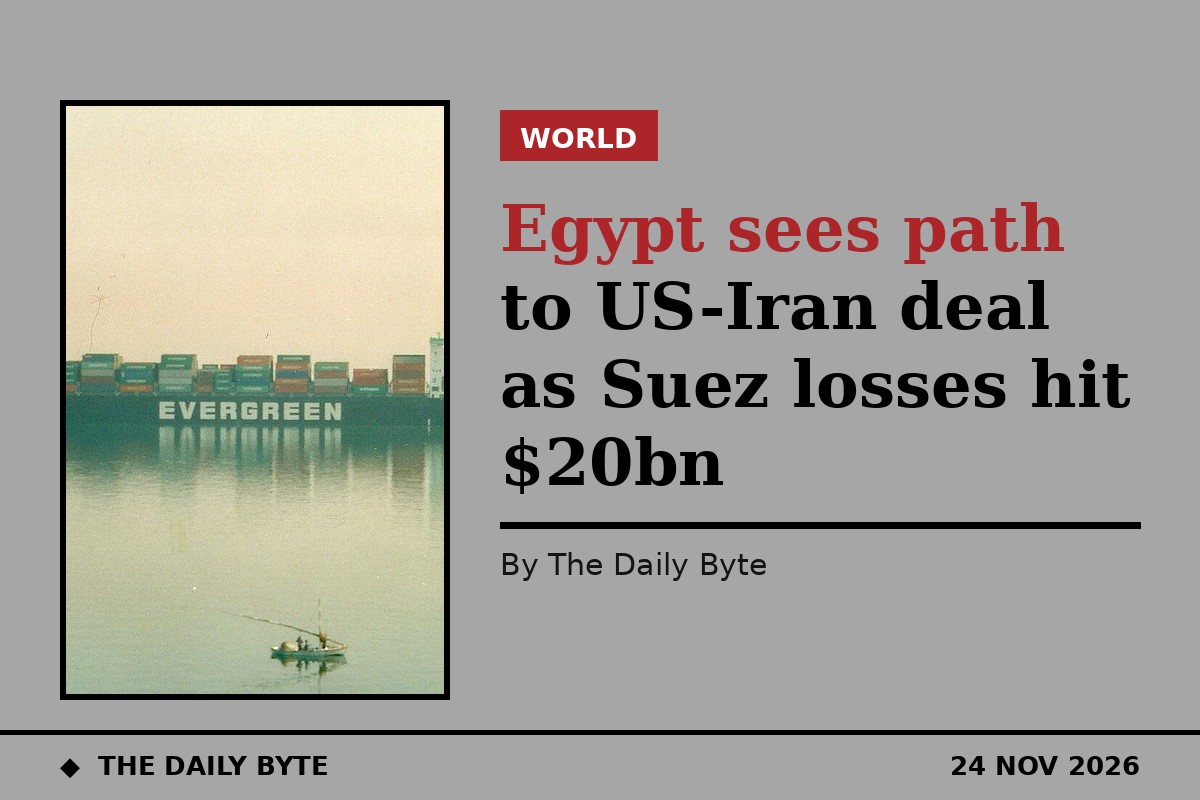
The minister was blunt about what the standoff is costing his country. He said regional tensions had cost the Suez Canal 20 billion dollars in revenue, while also driving up the prices of oil, gas and wheat. "Egypt is paying a heavy price," he said. He argued that the consequences extended beyond the Gulf states to other economies in the region, and that for Egypt the problem was not simply whether essential goods were available, but whether people could afford them.
The urgency reflects a conflict that has already disrupted the region for most of the year. The war between the United States, Israel and Iran began in late February, and Washington has since imposed a naval blockade on Iranian ports, while attacks on shipping in the Strait of Hormuz have continued. Against that background, Cairo is presenting diplomacy as the only route that avoids further damage to economies already under strain.
Egypt's mediation role
Cairo has spent months positioning itself as a go-between for Washington and Tehran. Abdelatty has held repeated telephone calls with his Iranian counterpart, Abbas Araghchi, and with Rafael Grossi, the director general of the International Atomic Energy Agency, as part of an effort to keep a diplomatic route open and prevent another round of fighting.
Egypt also hosted the meeting in September at which Iran and the atomic agency agreed practical arrangements for resuming inspections, an understanding reached in the Egyptian capital after the bombing of Iranian nuclear facilities. That agreement later unravelled, but Cairo has continued to press both sides to return to talks, arguing that each has an interest in reaching an accommodation.
Abdelatty warned that a military approach could bring further devastation to countries across the region. His comments pointed to continued diplomatic activity, but he announced no agreement, no date for renewed talks and no commitments accepted by either side.
Gaza also discussed
In a separate exchange on Gaza, Abdelatty urged a return to President Donald Trump's peace plan, calling it "the only game in town now." He said Egypt, Turkey and Qatar had persuaded Palestinian factions, including Hamas, to agree to hand over heavy and light weapons, and he accused Israel of failing to respond positively.
He also accused Israel of obstructing humanitarian assistance, saying the first phase of the peace plan had not been fully implemented and that the stated minimum of 600 aid trucks entering Gaza each day had not been achieved. He did not say the weapons handover had been completed.
For now, Cairo's message is that diplomacy remains possible, even as the costs of failure keep rising. Whether Washington and Tehran are willing to test that proposition is a question Abdelatty's remarks leave open. Read the original report on BizzBuzz, and the same IANS wire report on Hi India.