Eisenkot Plans Lebanon Withdrawal, Report Claims
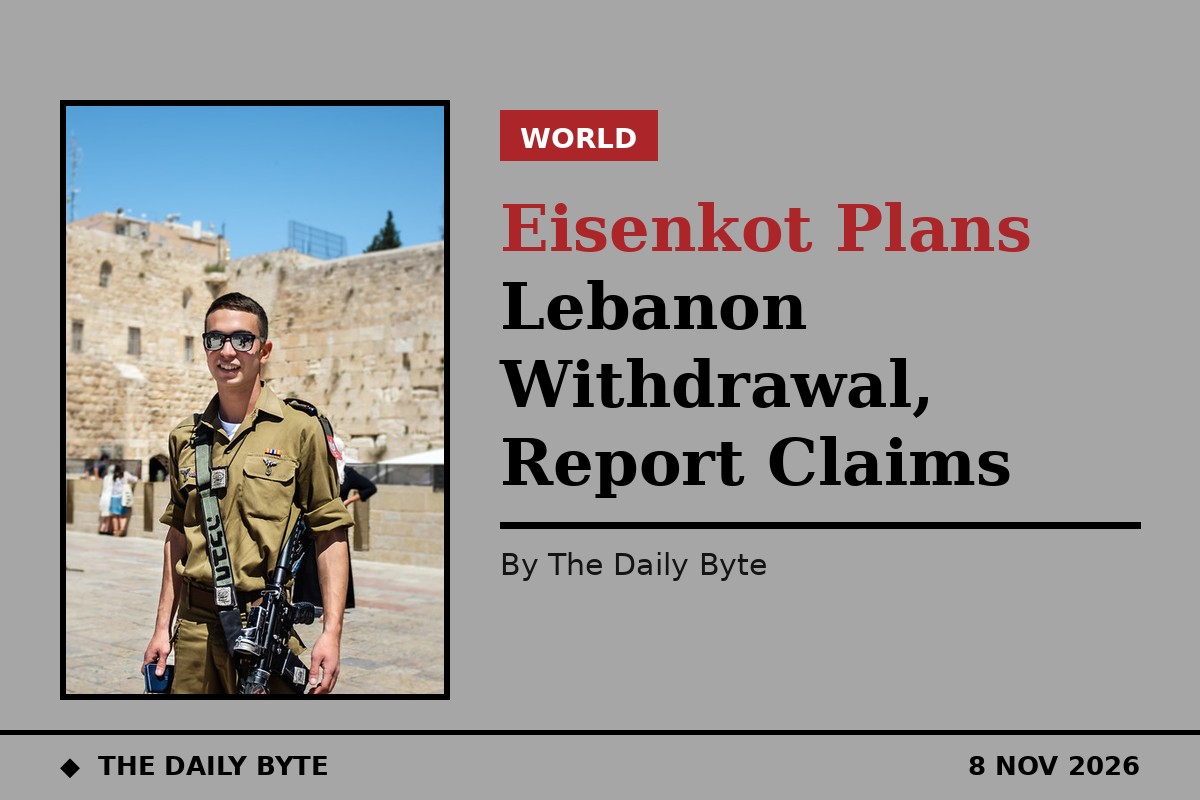
Israeli radio station Kol Hai reported on Sunday that Gadi Eisenkot, the former military chief tasked with forming Israel's next government, is planning a withdrawal of Israeli forces from southern Lebanon even before a new government is in place.
According to the report, Eisenkot has begun negotiations with foreign parties about an Israeli withdrawal and is making arrangements for what the station's political correspondent described as the "day after" on the northern front. "Even before Eisenkot forms a government, he is planning what will happen afterward," the correspondent told listeners.
The report went further, presenting a withdrawal from Lebanon as a prelude to withdrawals from Gaza and Syria and to the dismantling of settlement outposts in the West Bank. That wider claim was presented as the radio station's own reading of Eisenkot's intentions, rather than as a statement from Eisenkot himself.
Eisenkot's Yashar party has denied the report. According to reports of its statement, the party described the claim that Eisenkot is negotiating a withdrawal with foreign officials as without factual basis, and demanded that the report be removed and an apology issued. The withdrawal plan therefore remains unconfirmed and contested, and Eisenkot himself has not publicly confirmed it.
The report comes at the start of Eisenkot's attempt to build a government. President Isaac Herzog announced on Saturday, 7 November, that he would task the former general with forming a new government after the election on 27 October produced no parliamentary majority. Eisenkot's opposition coalition holds only 48 of the Knesset's 120 seats, so he will have to broaden it considerably, and he has 28 days to win a vote of confidence, with a possible 14-day extension.
Lebanon is watching the political change in Tel Aviv closely because of the continuing Israeli military presence in the south of the country. Israel launched its latest offensive in Lebanon on 2 March 2026, and on 26 June the two sides reached a US-mediated framework agreement providing for a gradual Israeli withdrawal in exchange for the deployment of the Lebanese Army and its assumption of security responsibility. Attacks have nevertheless continued. Lebanon's Health Ministry said on 5 November that Israeli attacks since 2 March had killed 4,390 people and wounded 12,429 others.
On Sunday itself, Israeli artillery shelled the outskirts of Majdal Silm and Wadi al-Salouqi in southern Lebanon, while machine-gun fire was directed towards Wadi al-Hujayr and the outskirts of Qubriha, and a blast was heard in al-Qantara. Earlier, Israeli forces announced a siren in northern Israel after a suspected drone infiltration, which the army later said was a false alarm.
Lebanese commentators quoted in the coverage cautioned that a change of prime minister in Israel might change the method of negotiating with Lebanon without altering the substance of Israeli demands, with the Hezbollah weapons file and border security arrangements still central. Any new escalation in the wider confrontation between the United States, Israel and Iran could also reverberate in southern Lebanon regardless of who leads the next Israeli government.
Eisenkot, 66, served as Israel's chief of the General Staff from 2015 to 2019 and entered politics in 2022. He has committed to following the Trump peace plan for Gaza and is not expected to make immediate changes there, although analysts expect him to move more quickly on Syria and to take a sharper line against violent settlers in the West Bank. Whether the reported Lebanon plan is real, and whether it survives coalition talks, should become clearer as his 28-day mandate runs.


