England restores Key Stage 3 and ends early GCSE teaching
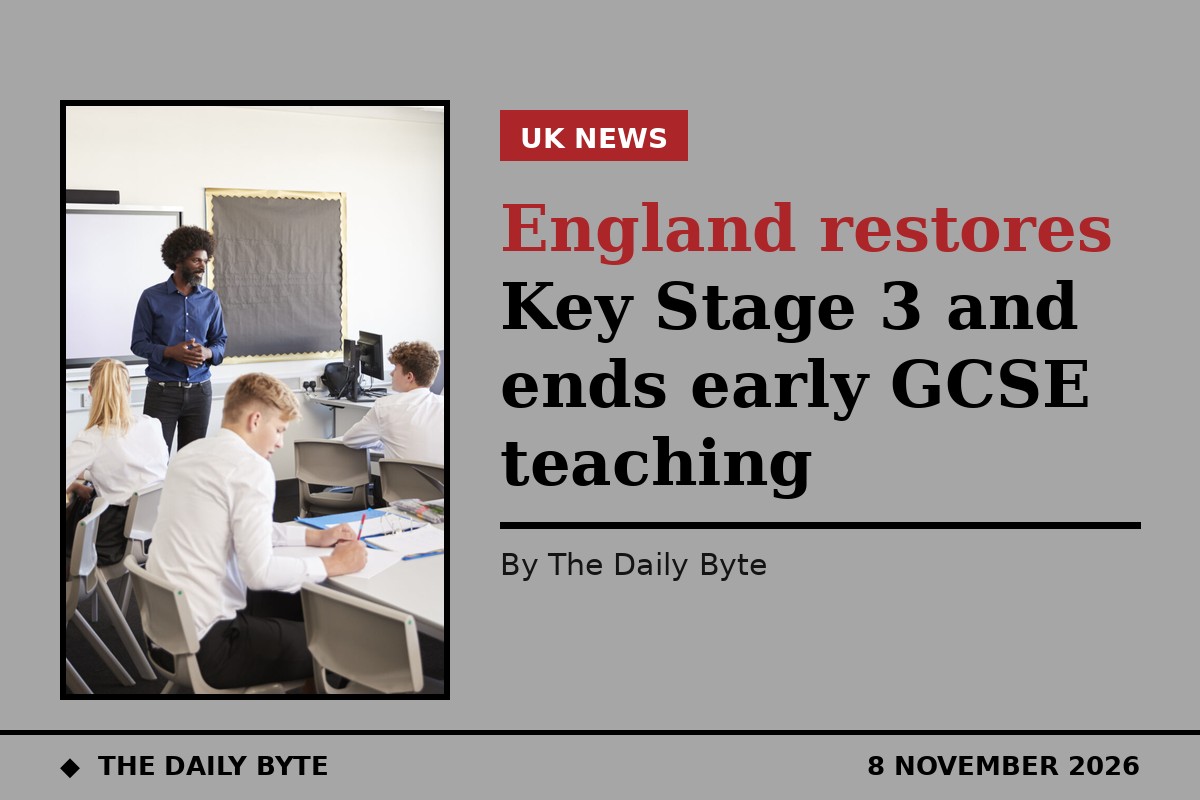
England's first three years of secondary school are to be restored as a distinct phase of education in their own right, with schools told to stop dragging GCSE teaching into them, under the biggest shake-up of the national curriculum in a generation.
The government announced on Sunday that Key Stage 3, covering Years 7 to 9 for pupils aged 11 to 14, will once again count as a three-year phase, as part of a new National Curriculum due to be published in full later this year and first taught from September 2028.
The move is aimed at pupils who switch off from school in their early teens. Ministers say too many children are being rushed through content before they have grasped the fundamentals, while others miss out on the broad specialist teaching secondary school should offer.
GCSE teaching to wait until Year 10
Under the new curriculum, schools will be told they should not start GCSE specifications early for large cohorts, or routinely require children to narrow their options earlier or sit exams early. GCSE content is not intended to begin until Year 10, when pupils are 14, but the government says the practice of pulling it forward has become widespread.
More than half of teachers say GCSE courses are now dominating the first three years of secondary school, according to the Department for Education, with some schools starting GCSE teaching as early as Year 7. Education Secretary Lucy Powell said she was opposed to what she called early exam factories, and that GCSE content had been dragged into Key Stage 3.
Teachers will still keep the flexibility to stretch high-achieving pupils who are ready to go further, without narrowing their options. The guidance telling schools not to teach GCSEs early will not itself be mandatory, so schools could legally ignore it, but Powell said schools are expected to adhere to the national curriculum.
The change also closes a long-standing gap: academies, which account for 84 per cent of secondary schools in England, are currently exempt from following the national curriculum, but from September 2028 they will have to follow it alongside maintained schools.
Disengagement and absence in the early teen years
The overhaul responds to evidence from the Becky Francis Curriculum and Assessment Review, the Milburn Review and the Independent Inquiry into White Working-Class Educational Outcomes, all of which found the move into secondary school to be a critical point where pupils disengage.
The proportion of pupils persistently absent from school almost doubles between Years 7 and 9, reaching one in four children, the government said. Persistent absence is one of the strongest predictors of a young person becoming not in education, employment or training. For white working-class children, persistent absence rates are 75 per cent higher in secondary school than in primary school.
Powell said the early years of secondary school should be a time when children are excited to go to school and find a love of learning, adding that she was putting a stop to pupils being rushed towards exams without grasping the fundamentals.
What else changes in the new curriculum
The new curriculum, developed by subject experts, will slim down over-crowded content and sequence it better across all school stages, the government said. There will be higher expectations on core knowledge and skills, including confident speaking, reading fluently and reading for pleasure, and numeracy.
Pupils should also get a more engaging offer in drama, physical education, music and modern foreign languages, alongside technical and digital skills. Drama will become a distinct module in English at Key Stage 3 for the first time, and modern foreign languages will be taught in a more conversational and engaging way.
A new enrichment framework will help schools make more space for richer experiences beyond the classroom, from practical experiments to debate, as part of the effort to tackle the sharp drop-off in engagement and attendance during the early secondary years.
Sir Hamid Patel, co-chair of the inquiry into white working-class educational outcomes, welcomed the commitment to renewing Key Stage 3, saying too many white working-class children were switching off and opting out at exactly the point when a love of learning should be developed.