Erdogan Signs Mecca Defence Pact Law
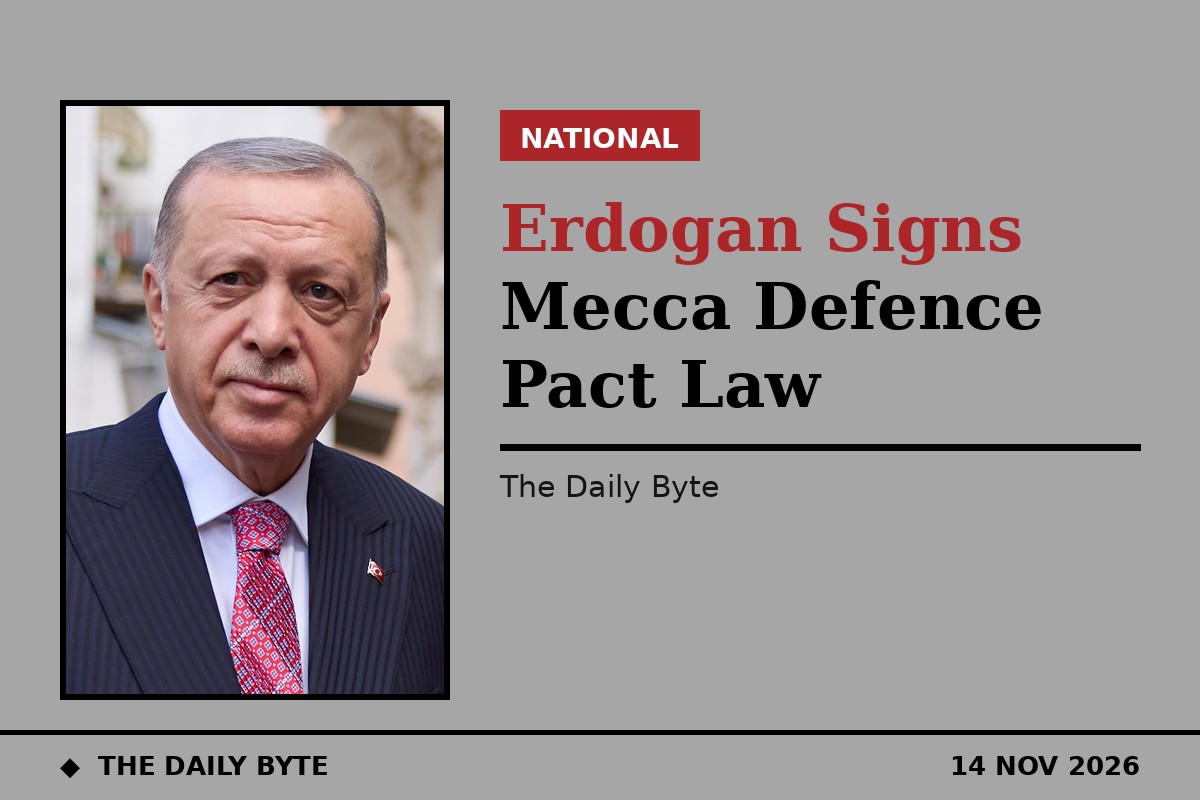
Turkish President Recep Tayyip Erdogan has signed the law approving Türkiye’s ratification of the Mecca Agreement for Joint Defense, the trilateral pact with Pakistan and Saudi Arabia, completing Ankara’s domestic legislative process for the deal.
The law, numbered 7597, was published in Türkiye’s Official Gazette on Saturday, 14 November, in issue 33430, and is dated 13 November, the day Mr Erdogan signed it. Its three articles approve ratification of the 16-article agreement, which Mr Erdogan signed in Mecca on 7 August alongside Saudi Crown Prince Mohammed bin Salman and Pakistan’s Prime Minister Shehbaz Sharif. The law takes effect on publication, with its execution assigned to the president, Clash Report reported.
Parliament backed the pact last week
Türkiye’s Grand National Assembly adopted the enabling bill on 5 November and forwarded it to the presidency the following day. The main opposition CHP voted in favour, while the DEM Party, the IYI Party and Yeni Parti opposed the pact. Publication in the gazette now closes the parliamentary and promulgation stages on the Turkish side.
The step does not, by itself, bring the international treaty into force. The agreement enters into force only when the last instrument of ratification is deposited with the secretariat of the Strategic Political and Defence Committee, which is based in Saudi Arabia. Pakistan’s foreign ministry confirmed its ratification in late October, and Turkish officials have said Saudi Arabia has also completed its process, leaving Ankara’s deposit as the remaining step.
What the pact requires
At the heart of the agreement is Article 2, which treats an externally originating armed attack on any party as an attack on all three. The others must provide immediate assistance within their available means, under Article 51 of the UN Charter. That assistance is not automatic: its nature and scope are decided by consensus after consultations, and each government acts under its own constitution and national law.
Turkish officials have stressed that any overseas combat deployment of the Turkish Armed Forces would still need a separate parliamentary mandate under Article 92 of the constitution. Turkish Defence Minister Yasar Guler has also said Ankara has ruled out deploying troops to fight the Iran-backed Houthis under the pact, according to EuropeSays.
Beyond collective defence, the pact covers counterterrorism, intelligence sharing, joint military exercises, defence-industry cooperation and logistical support. No party may withdraw during the first 10 years after entry into force; after that, withdrawal requires at least three months’ written notice. New members may join only with the unanimous consent of the three founding parties, and Syria has expressed interest in accession.
A wider web of defence deals
The gazette publication came a day after Ankara signed a separate mutual defence agreement with Qatar in Istanbul on Friday, 13 November, during a meeting between Mr Erdogan and Qatari Emir Sheikh Tamim bin Hamad Al Thani. The two sides pledged a unified stance against any external armed attack and agreed to expand joint exercises, personnel training and defence-industry cooperation.
The Mecca pact was signed in August amid rising regional tensions, and its implementation has come under scrutiny as Houthi attacks on Saudi Arabia have intensified in recent weeks, including strikes on airports that have disrupted air travel and led to the cancellation or postponement of conferences, summits and sporting events in the kingdom. Pakistan has publicly condemned the Houthi attacks and backed Saudi security, while the three signatories describe the pact as defensive.
With Türkiye’s approval law now in effect, attention turns to the deposit of its ratification instrument, the final formal step before the pact becomes binding on all three states.