Eritrea Reinforces Assab Border as War Fears Grow
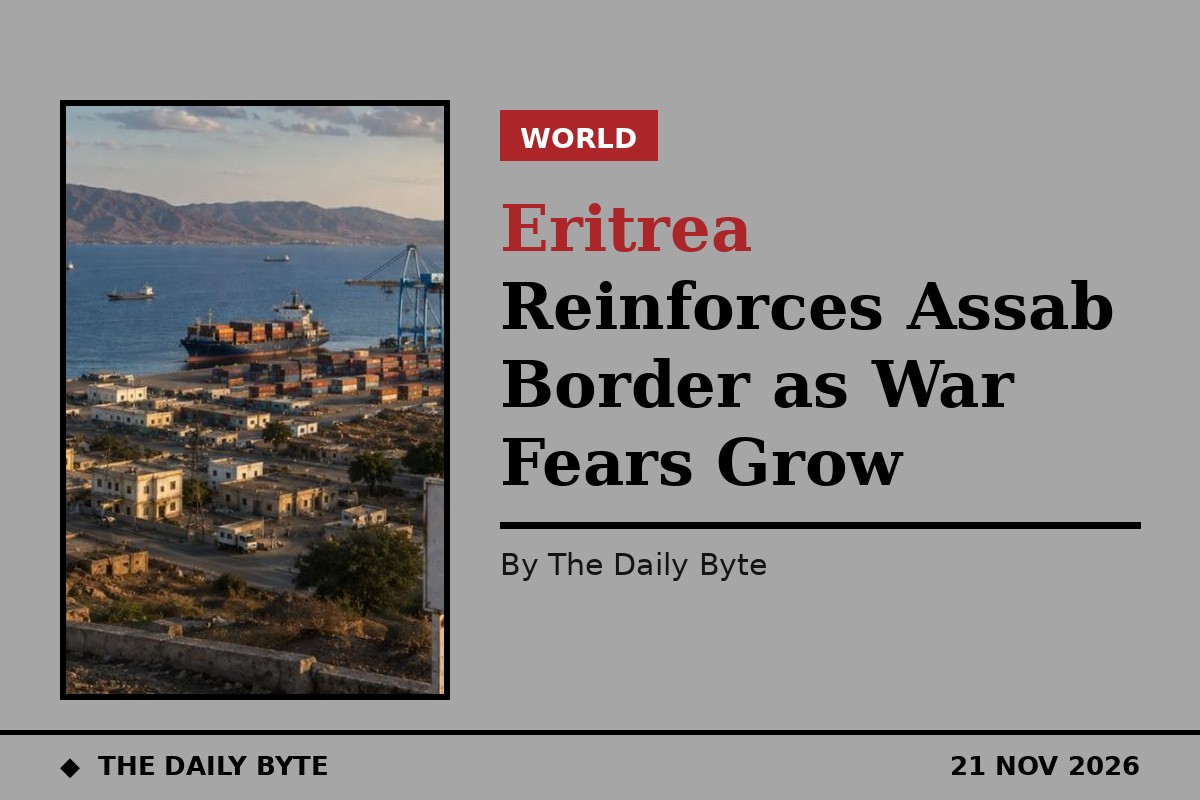
Eritrea has reinforced its military positions near the highway leading to its Red Sea port of Assab, according to conflict trackers and satellite imagery, in the latest sign that the confrontation between Eritrea and Ethiopia is widening beyond the fighting around the border town of Badme.
The Critical Threats Project and the Institute for the Study of War, in their Ethiopia War Security Review dated 20 November 2026, said two conflict trackers and satellite imagery indicated that the Eritrean military had reinforced its positions along the Ethiopia-Eritrea border near the road linking the Ethiopian border town of Bure to Assab.
Conflict tracker Sajid Nadeem reported on 14 November that Eritrean forces were deploying towards Assab, about 45 miles north-east of Bure. The Ethiopian Conflict Map reported on 19 November that Eritrean forces had reinforced their positions on the Eritrean side of the border less than five miles from Bure. The review said satellite imagery showed increased clusters of vehicle tracks in the area just off the Bure-Assab highway since early November 2026.
Build-up on both sides of the border
The review also observed increased activity at the Eritrean military's Sawa base, which it has previously used as a conscription facility, between 14 and 16 November. Horn of Africa researcher Mohamed Kheir Omer, the mapper behind The Ethiopian Conflict Map, and Nadeem had previously reported that Eritrea was carrying out a widespread military mobilisation.
Satellite imagery also showed increased ground disturbances on the Ethiopian side of the border, less than five miles south of Bure, on 19 November compared with 2 October, although the review said it could not confirm what caused them.
The eastern build-up is unfolding alongside renewed fighting in the west. The review said the Ethiopian military had reportedly resumed fighting with Eritrean and Tigray People's Liberation Front forces around Badme. The Armed Conflict Location and Event Data project, known as ACLED, reported that Eritrean forces had regained control of Badme by 15 November after several days of fighting, and that no fighting between the two sides was recorded around the town between 15 and 17 November.
Ethiopian and Tigray Defence Force fighters then reportedly clashed west of Adi Hageray, about 30 miles south-east of Badme, on 18 November, and Ethiopian forces carried out artillery and drone strikes around Badme on the night of 18 to 19 November. ACLED warned that the risk of a full-scale military confrontation along the Badme front was now high.
Curfew and movement controls in Tigray
Inside Ethiopia, the authorities in the North Western zone of Tigray announced on 17 November a curfew, a ban on gatherings of more than four people, a suspension of gold mining and a requirement for residents to register weapons by 23 November. The authorities said the measures would restore peace and security and regulate the use of natural resources.
The review covers the period from 17 November at 9am Eastern time to 20 November at 9am Eastern time, and draws on tracker reports, satellite imagery and open-source reporting. Several of the claims it records, including the cause of the ground disturbances near Bure and some of the reported troop movements, could not be independently confirmed.
Diplomacy runs alongside the build-up
United States officials have continued to engage both governments. The US ambassador to Ethiopia, Ervin Massinga, met the head of Tigray's interim regional government and other local leaders in Mekele on 17 November, stressing stability, inclusivity and strong institutions. The US senior adviser for Africa at the United Nations, Melanie Higgins, met Eritrea's permanent representative to the UN, Sophia Tesfamariam, on 18 November to discuss the tensions.
On 19 November, US Congressman Jim Baird introduced two draft bills, the Ethiopia SPARK Act and the Eritrea PILLAR Act, which would offer closer American economic ties, including access to agricultural exports, farm equipment and cooperation on critical minerals and port infrastructure, if the two countries pursue de-escalation and dialogue. The bills remain at the draft stage and their full texts have not been made public.
A delegation including the British, Danish and Swedish ambassadors visited a disarmament, demobilisation and reintegration facility on 18 November and voiced support for the process for former Tigray Defence Force fighters. Ethiopia's prime ministerial adviser Getachew Reda has said 7,240 former fighters had completed the process since mid-October 2026.
The two countries fought a border war from 1998 to 2000 in which tens of thousands of people were killed, signed a peace deal in 2018 and fought on the same side in the 2020-2022 war in Tigray. Relations have since deteriorated sharply, breaking down on 1 October when Ethiopia closed its embassy in Asmara and expelled Eritrean diplomats, a move Eritrea reciprocated.