EU consults on AI deepfake rules to protect elections
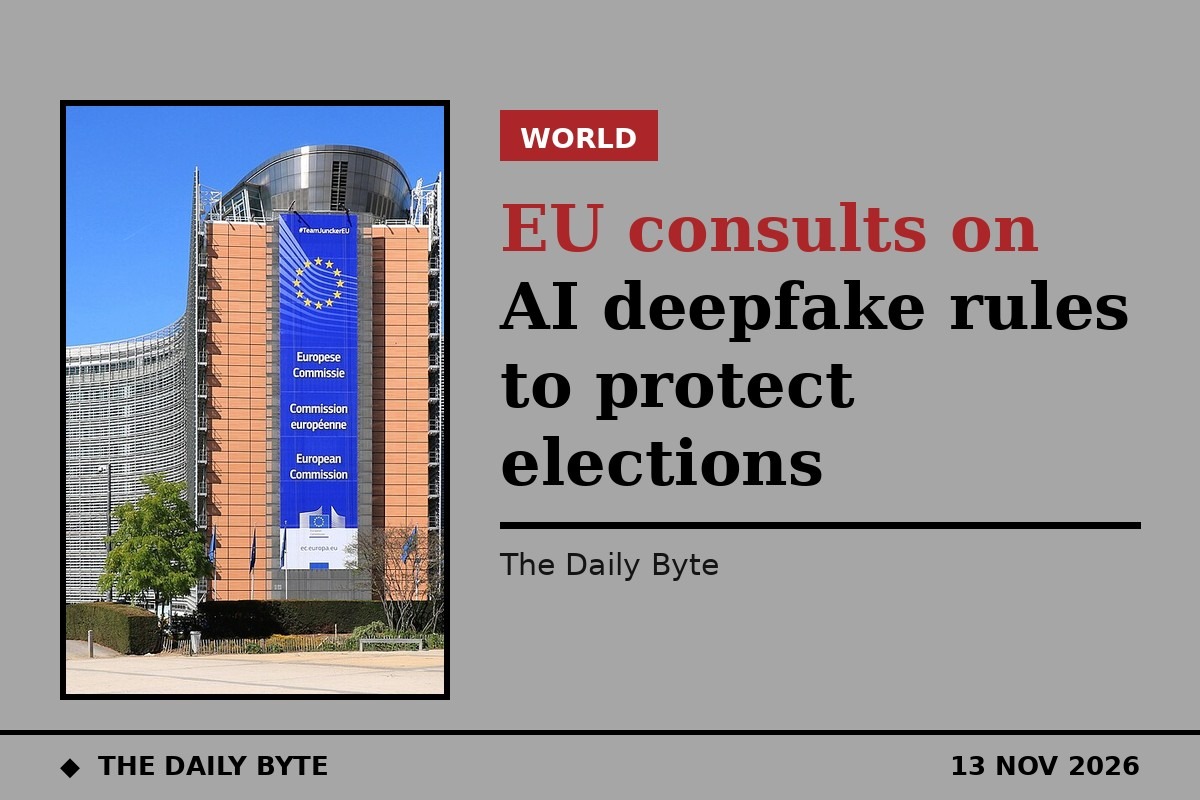
The European Commission has opened a consultation on draft rules that would require the largest online platforms to label AI-generated deepfakes, test their recommendation systems before elections, and report back to regulators after each vote.
The targeted consultation, which opened on 10 November 2026, covers draft revised election guidelines under the Digital Services Act (DSA). Responses can be submitted until 23 November 2026 through an EU Survey form. The Commission says the update responds to the rapid development of generative artificial intelligence and increasingly sophisticated manipulation risks around elections.
What the draft rules would require
The draft guidelines are aimed at very large online platforms and very large online search engines, the biggest services regulated under the DSA. They set out measures those services should take to assess and reduce systemic risks to electoral processes, as required by Article 35 of the Act.
Under the draft, AI-generated deepfakes should be clearly labelled, and the label should stay attached when the content is shared. Illegal deepfakes of candidates should be removed quickly. Platforms should also detect coordinated inauthentic behaviour early, including automated or AI-agent activity, and dismantle the networks behind it.
Recommendation systems would face new checks. The draft proposes that platforms test, or red-team, their recommender systems every year and before every national vote, and keep a record of the main changes made in the six months before polling day. Within 30 days of each election, platforms should send the Commission and the relevant national Digital Services Coordinator a confidential report covering incidents, response times, enforcement and AI labelling data.
Why the rules are being updated
The Commission first adopted election guidelines in April 2024, ahead of that year's European Parliament vote. It says the update builds on two years of experience under the DSA and the Code of Conduct on Disinformation, including its Rapid Response System, and takes account of monitoring by European Digital Media Observatory hubs during votes in 2026 in Hungary, Bulgaria and Malta.
The revision also ties the DSA rules to the EU's AI Act, whose transparency obligations for AI-generated content have applied since 2 August 2026. The European Council called on 15 and 16 October 2026 for the revision to be finalised swiftly, and the Commission says the work forms part of the European Democracy Shield, its wider programme to protect democratic processes.
What the guidelines would not do
The Commission describes the draft as content-neutral. It says the guidelines do not ask platforms to delete lawful content or single out any viewpoint. That distinction matters because the guidelines are guidance for platforms on managing risks, rather than a new law banning particular content.
No date has been set for adopting the final version. The Commission adopts such guidance itself, without a vote in the European Parliament or the Council, and the consultation page gives no timetable for when the revised guidelines will apply. Once published in the Official Journal, the revised text will replace the version adopted in 2024.
Frequently asked questions
What is the Digital Services Act? The DSA is the EU law that sets duties for online platforms, including a requirement in Article 35 for the largest services to assess and reduce systemic risks to election integrity while safeguarding freedom of expression and information.
Which platforms are covered? The guidelines apply to very large online platforms and very large online search engines, the biggest services designated under the DSA.
What happens after 23 November? The consultation closes on 23 November 2026. The Commission will then consider the responses before adopting final revised guidelines, although it has not given a date for that decision.
Sources: European Commission; Agence Europe.