EU Court Dismisses Poland Fit for 55 Challenges
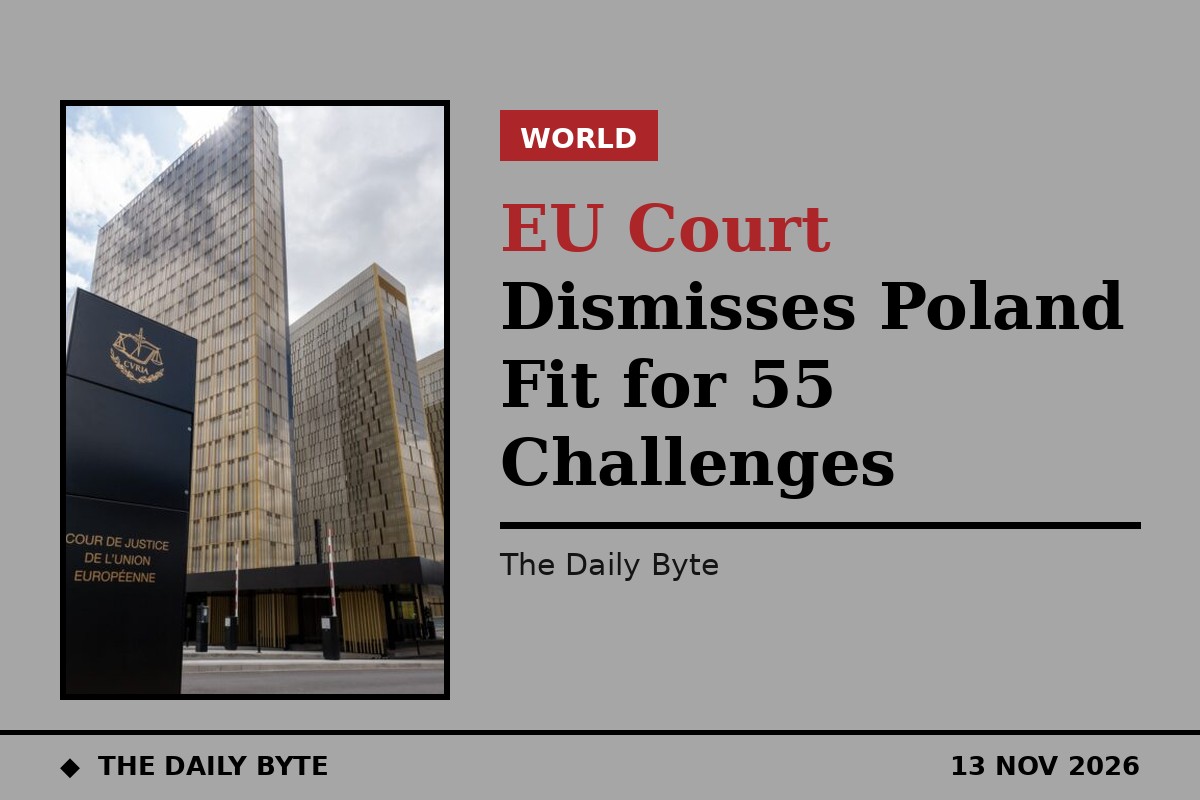
The Court of Justice of the European Union has dismissed all seven legal challenges brought by Poland against the bloc's Fit for 55 climate package, in judgments delivered on Thursday, 12 November 2026.
Poland had asked the court to annul seven laws forming part of the package, which sets the European Union's plan to cut net greenhouse gas emissions by at least 55 per cent by 2030, compared with 1990 levels, and to reach climate neutrality by 2050. The measures were adopted by the EU in 2023.
The Polish challenges targeted stricter emissions standards for cars and vans, the EU's carbon border tariff, national emissions reduction targets, the expansion of the bloc's emissions trading system, and greenhouse gas requirements for forestry and land use. The cases also covered energy efficiency rules and the market stability reserve, which manages the supply of emissions allowances.
Poland argued the laws needed unanimous approval
Poland's main argument was that the legislation should have required unanimous approval by EU member states, which would have given Warsaw the power to veto the measures. It argued that the rules were mainly fiscal in nature or affected the structure of its energy supply, and therefore could not be adopted by a qualified majority vote.
Warsaw also argued that some of the rules undermined the welfare of EU citizens by driving up energy prices and threatening jobs. The cases were brought under Poland's previous government, led by the national-conservative Law and Justice party.
The court rejected those arguments. It said that exceptions to the principle of qualified majority voting must be interpreted strictly, and that the legal basis of a measure is determined by its aim and content, rather than by its possible economic or social effects.
Six measures classed as environmental policy
According to the court, six of the seven contested measures fall under European environmental policy, while the energy efficiency directive falls under the Union's energy policy. On that basis, the court held that the laws had been adopted on the correct legal basis and did not require unanimity.
The judges also said that the welfare of EU citizens was not the bloc's only objective, and that sustainable development and environmental protection carried equal weight. The court added that EU legislation may negatively affect individual member states, but that such consequences had been taken into account when the climate package was drawn up.
It pointed to compensatory measures built into the package, including the multibillion-euro Social Climate Fund, which is designed to cushion the impact of the transition for households and businesses most exposed to higher energy and transport costs.
Climate rules stay in force
The rulings leave the contested measures in place as EU law. They do not create a new climate programme, but they remove a significant legal threat to the Fit for 55 framework, which underpins the EU's 2030 emissions target and its 2050 climate neutrality goal.
For businesses in energy-intensive industries, the decision reinforces the need to plan around the existing European regulatory framework, including carbon pricing and the phase-out of new combustion-engine cars. The debate over how to protect industrial competitiveness will continue, especially where energy costs differ across European economies, but the legal foundation of the package is now settled by the EU's highest court.