EU Launches Crypto Task Force to Stop Sanctions Evasion
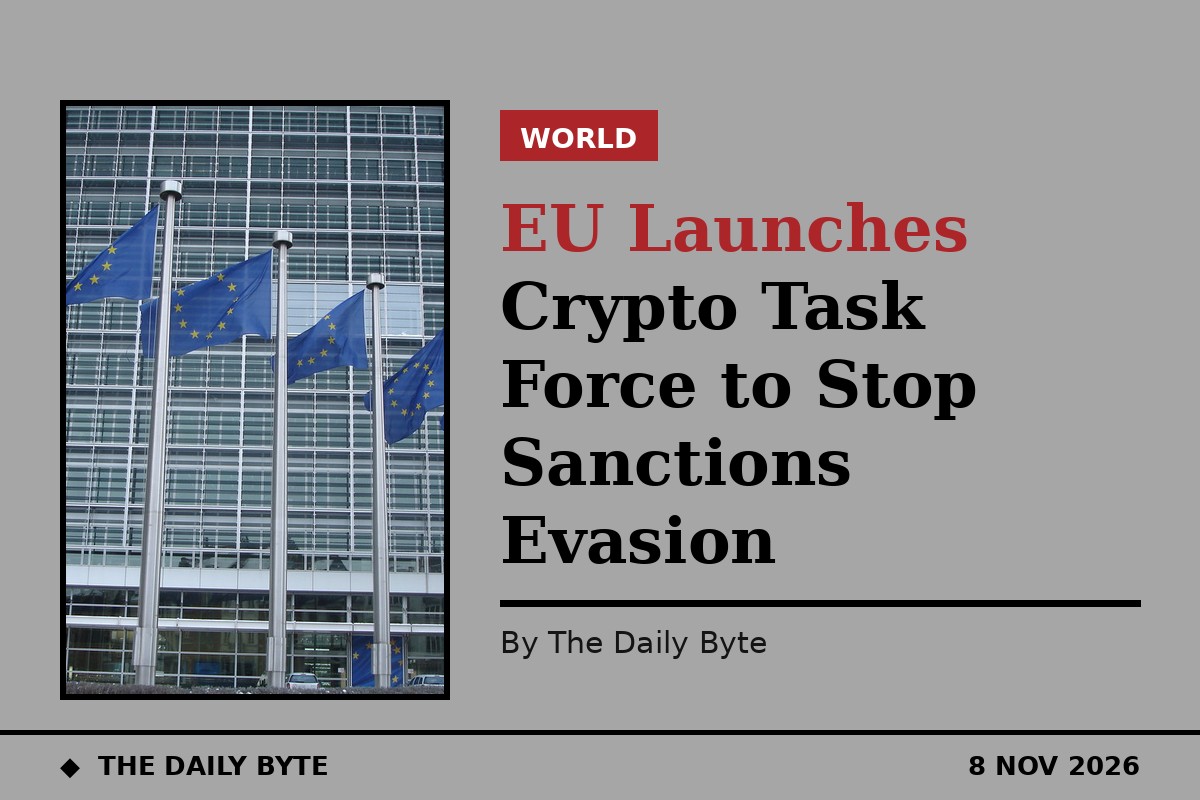
The European Commission has launched a dedicated EU Crypto Sanctions Task Force to stop digital assets being used to get around the bloc's financial sanctions, above all those imposed on Russia over its war in Ukraine. The move was announced by Financial Services Commissioner Maria Luís Albuquerque after she chaired the tenth meeting of the High-Level Expert Group on Union Restrictive Measures in Brussels on 5 November.
The task force is an informal body bringing together experts from the Commission and EU member states. Its job is to improve the design of sanctions and to develop measures that address crypto assets as a route around them. According to an EU diplomat quoted by the Kyiv Independent, it is initially set to run for 12 months and will draw on expertise from Ukraine and the United Kingdom. Commission spokesperson Siobhan McGarry confirmed the details at a press briefing on 6 November.
Announcing the launch, Albuquerque said sanctions were working and putting significant pressure on Russia's economy, but warned that their impact depended on how effectively they were enforced. "We will not allow new technologies or third-country jurisdictions to become safe havens for sanctions evasion," she said. She added that uneven enforcement across member states could weaken the restrictions and reduce their impact.
The meeting that produced the announcement brought together senior sanctions officials from all member states, alongside the Commission and the EU's External Action Service. Participants looked at emerging threats in the financial sphere, including the use of crypto assets, the role of the European Anti-Fraud Office (OLAF) in investigating and tackling circumvention, and member states' efforts to apply the measures consistently. EU sanctions envoy David O'Sullivan also convened a separate Sanctions Coordinators Forum with partners including the United States, the United Kingdom, Canada, Japan and Ukraine.
The task force arrives alongside a second new instrument: a dedicated sanctions office inside the Commission that will cover the whole lifecycle of economic sanctions, from policy design and outreach to implementation and work to counter circumvention. McGarry said national authorities would gain faster guidance, shared information and economic and technical analysis through the new office. The Commission is also working on a 22nd package of sanctions against Russia.
The crypto crackdown builds on restrictions already adopted under successive sanctions packages. An earlier package introduced a sector-wide ban involving Russian crypto service providers and decentralised trading platforms. The 21st package, adopted on 23 July, created an instrument allowing restrictions on crypto services across designated third-country jurisdictions and added transaction bans covering 14 crypto-related platforms operating in Georgia, Panama, the United Arab Emirates, the Marshall Islands, Kyrgyzstan and Belarus.
One of the networks under scrutiny is the A7A5 stablecoin, issued by Kyrgyzstan-based Old Vector and linked to the Russian ruble. The analytics firm Elliptic reported that the token moved more than $100 billion during its first year, although average daily transaction volume had fallen 96 percent from its July 2025 peak by June 2026, a decline it linked to sanctions, tighter Russian payment access and disrupted exchange services.
The United States moved in parallel on 6 November, when the Treasury announced action against the MEXC Global exchange, alleging it had facilitated at least $16 billion in illicit transactions, including nearly $1.5 billion linked to Russian sanctions evasion and almost $200 million connected to the A7A5 stablecoin. The US Financial Crimes Enforcement Network issued an order barring American financial institutions from processing transfers involving MEXC, taking effect 30 days after publication in the Federal Register.
For Brussels, the task force is an acknowledgement that sanctions enforcement is now a technical race as much as a political one. Russia's payment networks adapt quickly, and the Commission's answer is to pool expertise across borders before the loopholes harden. No mandate, budget or start date for the task force's first working session has been published, and its success will be judged on whether the next wave of evasion routes is spotted and closed faster than the last.


