EU extends crisis state aid framework to June 2027
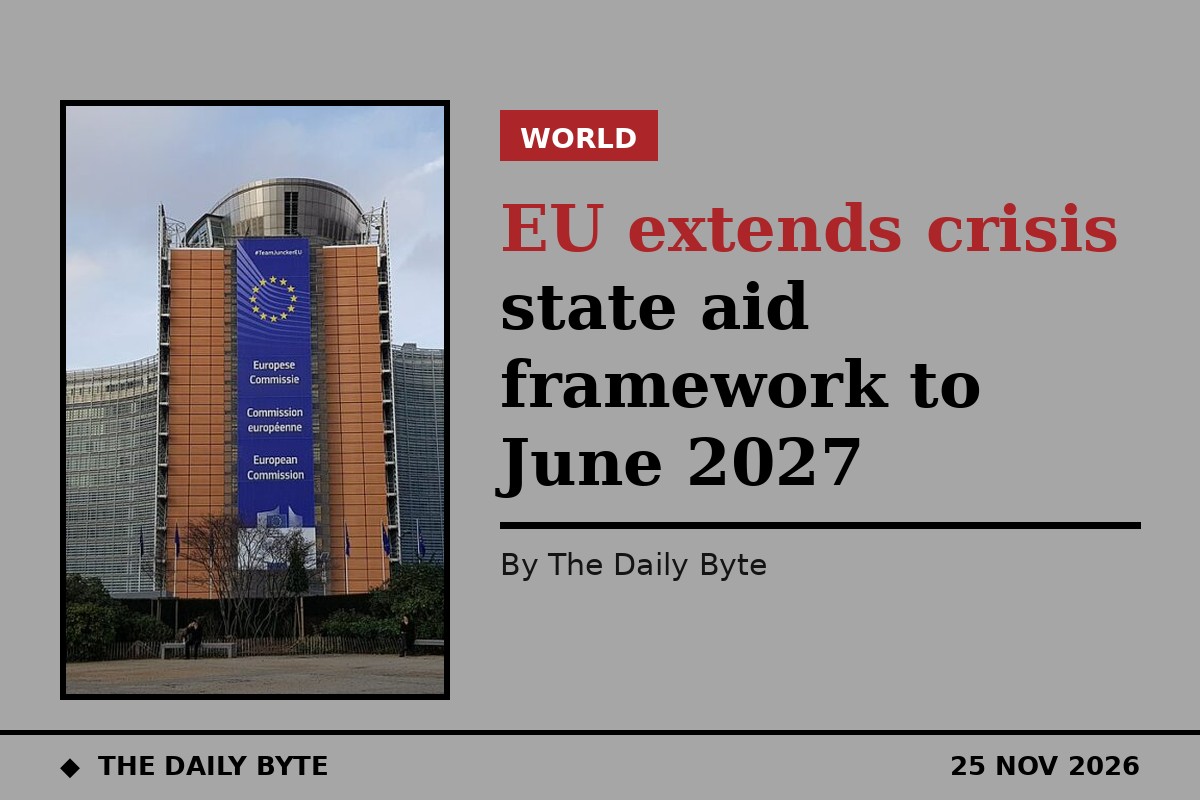
The European Commission has extended its temporary state aid framework for sectors hit by the Middle East crisis until 30 June 2027, giving EU governments six more months to support businesses facing high fuel, fertiliser and electricity prices.
The Middle East Crisis Temporary State aid Framework, known as METSAF, was due to expire on 31 December 2026. The Commission announced the six-month prolongation on Wednesday 25 November, after consulting member states, and said it would review conditions again in spring 2027 and could extend the framework further if needed.
The framework was adopted on 29 April 2026 to help member states support the EU economy in the context of the Middle East crisis. It covers the sectors most exposed to the crisis: agriculture, fisheries, transport and energy-intensive industries. The European Council had already backed an extension at its meeting on 15 and 16 October.
What support is available
Under the scheme, governments can compensate businesses in agriculture, fisheries, land transport and intra-EU short sea shipping for up to 70 percent of the extra costs linked to fuel and fertiliser price increases. For energy-intensive industries already eligible for temporary electricity price relief, governments can raise aid intensity from 50 percent to as much as 70 percent for eligible electricity costs, covering up to half of a beneficiary's total consumption.
The revised framework adds a new allowance of up to 50,000 euros per beneficiary for the period from 1 January to 30 June 2027, under a simplified method for calculating aid amounts. Companies that received this form of support in 2026 remain eligible to apply again in 2027. Governments can also keep using simplified proxies, such as business size, activity type or estimated sector fuel consumption, instead of requiring detailed proof from each applicant. Measures still have to be notified to the Commission, but the framework is designed to allow faster approvals.
Commission Vice-President Teresa Ribera said: "The crisis in the Middle East continues to affect particularly vulnerable sectors across Europe." The Commission argues that temporary and targeted intervention remains justified while energy markets stay volatile, with persistent swings in fuel, fertiliser and wholesale electricity prices still weighing on vulnerable businesses.
More than 3.7 billion euros approved so far
Since the framework was adopted in April, the Commission has approved 36 measures and 11 amendments to existing schemes from 14 member states, with a combined estimated budget of more than 3.7 billion euros. Recent approvals include additional French support for agricultural and aquaculture companies facing higher fuel prices, and Luxembourgish electricity price relief for energy-intensive companies.
Industry groups had pressed for a longer extension. The International Road Transport Union had called for the framework to run until the end of 2027, warning that sustained high diesel prices were putting growing pressure on Europe's haulage industry. The Commission has opted for six months, with a review in spring 2027, keeping the door open to a further prolongation if energy prices remain high.
The extension does not itself pay money to any business. It sets the rules under which national governments may design their own support schemes, and each government must still decide whether to introduce a scheme, how much to spend and who qualifies. For farmers, hauliers and energy-intensive firms, the decision means the support window stays open into the middle of next year rather than closing at the end of December.