Euclid maps a billion objects in first major data haul
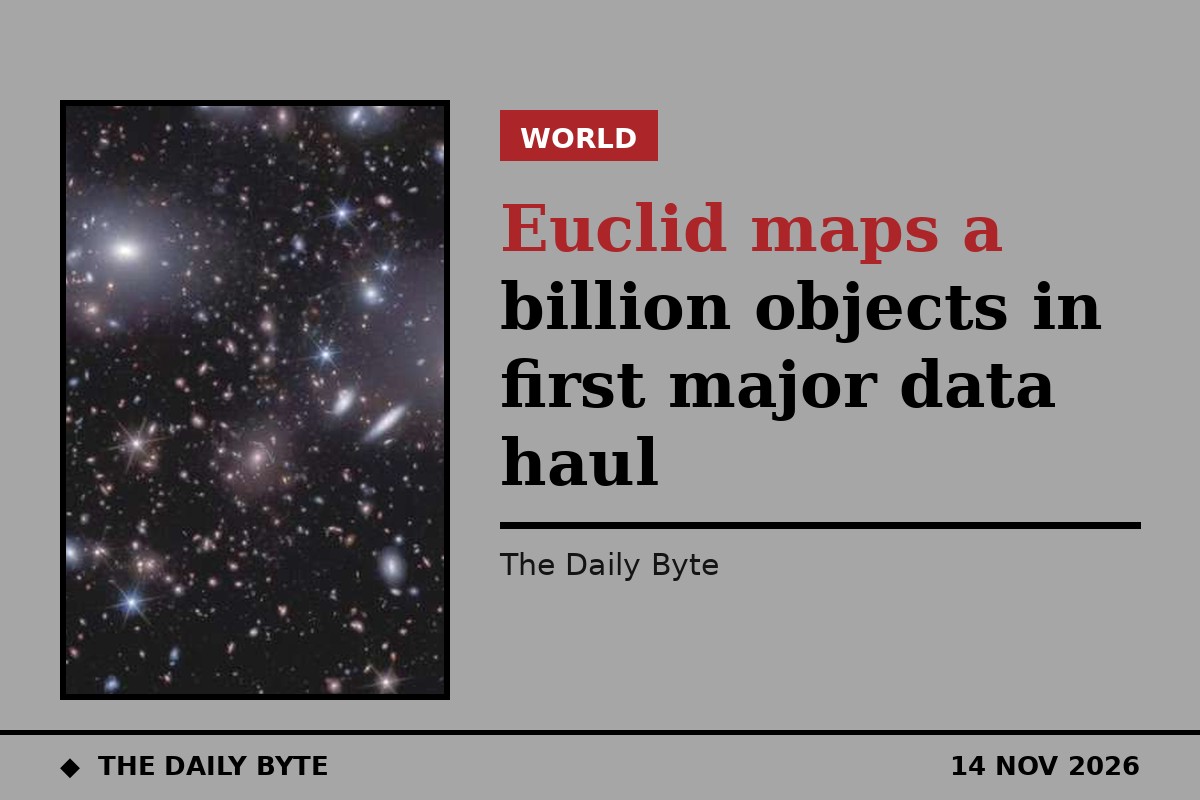
The European Space Agency's Euclid space telescope has released its first major batch of data, capturing the light of more than a billion objects and laying the foundation for the largest ever three-dimensional map of the universe.
The release, named DR1 Foundation, was published on Thursday, 12 November 2026. It draws on around 13 months of observations collected from spring 2024 to spring 2025 and marks the first major release of mission data since the telescope launched in mid-2023. Previous releases had covered only a few days of observations over around 60 square degrees of sky. The new release covers 1,900 square degrees — an area equivalent to about 9,500 full moons, and around 14 per cent of the sky area Euclid is ultimately due to survey.
More than 900 million galaxies
Analysis of about 10,000 science images from the release reveals unprecedented numbers of cosmic objects, including more than 900 million galaxies, around 15,000 strong gravitational lensing candidates, more than 60 million quasar candidates, and spectra from more than 160 million sources. The data totals 1.7 million gigabytes — 1.7 petabytes — making it the largest space-based survey of its kind, according to the agency.
"These are far more than beautiful pictures; today marks a scientific milestone in our study of the cosmos," said Carole Mundell, ESA's director of science. She described the collection of optical and near-infrared observations as the largest map of the sky of its kind ever produced from space.
"This is a change in scale from Euclid's previous releases," said Valeria Pettorino, ESA's Euclid project scientist. "We're now releasing more than a year of data covering a significantly larger area. This unlocks groundbreaking science."
Mapping dark matter and dark energy
Euclid's mission is to investigate the puzzling cosmic components known as dark matter and dark energy by mapping the large-scale structure of the universe and how it has expanded over time. The telescope observes from the L2 Lagrange point, about 1.5 million kilometres from Earth, using a 600-megapixel visible-light camera and a near-infrared spectrometer and photometer.
The new data includes images of the Abell 3128 cluster, a group of hundreds of galaxies located about 800 million light-years away, and of NGC 1291, a ring galaxy about 33 million light-years from Earth. It also includes a vast sky mosaic measuring 500 gigapixels. The data is public and is distributed through ESA's Euclid Data Space platform, where scientists at more than 300 research institutions around the world can use it.
German research facilities play a central role in the mission. The Max Planck Institute for Astronomy in Heidelberg and the Max Planck Institute for Extraterrestrial Physics in Garching near Munich contributed critical optical components, and German scientists coordinate much of the calibration of the telescope's instruments. More than 2,500 researchers use Euclid data.
A machine for discovering rare objects
Because it observes from space, above the Earth's image-blurring atmosphere, Euclid can survey deep and wide areas of sky in a way ground-based telescopes cannot. The release contains the largest catalogue of strong gravitational lenses ever assembled — larger than all previous catalogues combined. These rare phenomena, in which light from distant galaxies is distorted by a foreground galaxy, allow scientists to weigh individual galaxies, including their invisible dark matter, and to explore how the universe is expanding.
Galaxy clusters in the data reveal how matter clumps together and how cosmic structure grows across the universe. Scientists can now mine the data set to determine distances to individual galaxies and place them within the universe's three-dimensional structure, linking them to the vast, invisible mesh of the cosmic web.
The full Data Release 1, due in mid-2027, will build on this foundation and add further observations, including measurements of weak gravitational lensing and calculations of how galaxies and galaxy clusters fit into the cosmic web. The mission's goal is to complete the largest ever three-dimensional atlas of the cosmos, spanning more than a third of the sky, by 2031.