Euro at 19-month low as Fed hike bets lift dollar
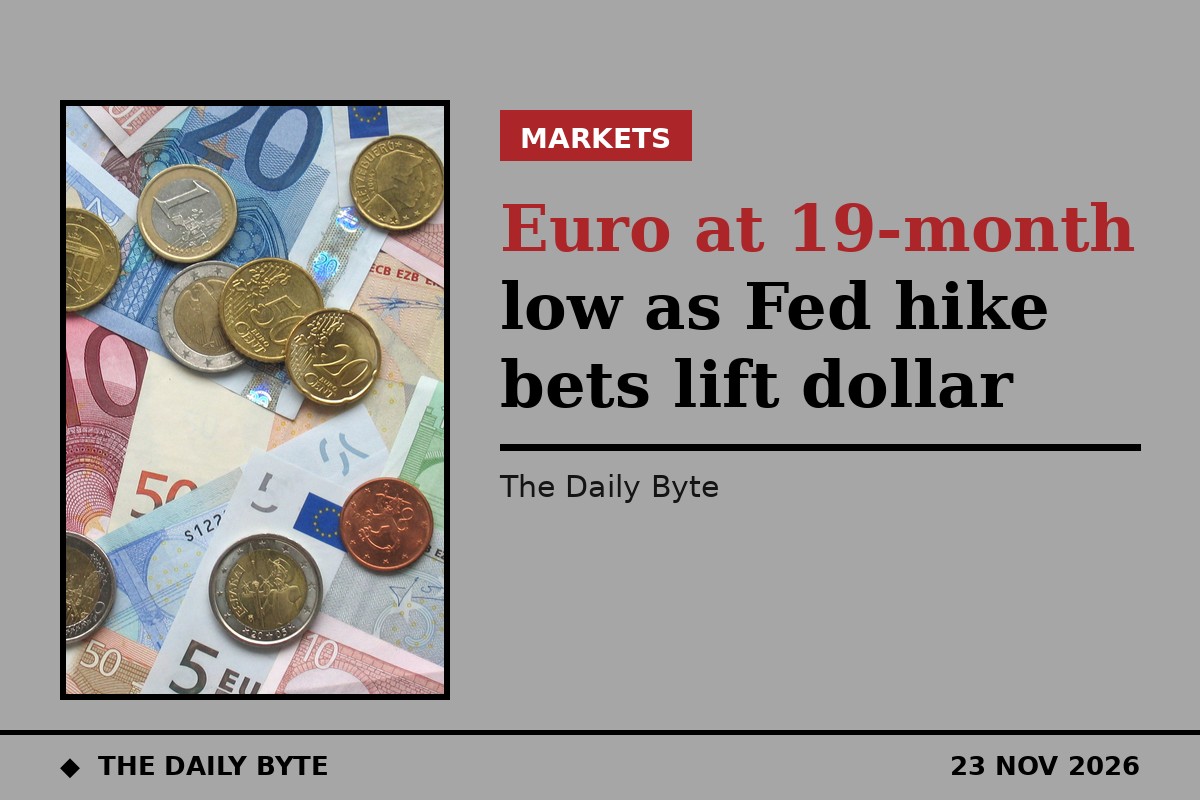
The euro starts Monday 23 November 2026 at its weakest level against the US dollar since April 2025. EUR/USD closed on Friday 20 November at 1.0968, down 0.5% on the week, after spending the whole week below the 1.1000 mark. The next test comes on Monday morning, when flash purchasing managers' index (PMI) surveys for France, Germany, the eurozone and the UK are published, followed by a speech from European Central Bank chief economist Philip Lane.
Friday's close was the euro's lowest daily close since April 2025, ForexTraders reported, with the last lower close at 1.0949 on 9 April 2025. The pair first closed below 1.10 on Monday 16 November, at 1.0998, and has not closed above that level since. Its lowest point of the week came on Wednesday 18 November, when it touched 1.0953, a 19-month low.
Why the euro is falling
The main driver is the dollar, not the euro. The US dollar index closed the week at 103.84, up 0.4% for a fourth straight weekly gain, as traders put a December Federal Reserve rate hike at near certainty. A stronger dollar and higher expected US rates make the euro less attractive by comparison, and safe-haven demand for the dollar has added to the pressure during the sell-off in technology shares.
What makes the move striking is that it happened despite hot eurozone inflation. Eurostat confirmed euro area inflation at 4.0% in October, a level that would normally support the case for higher European Central Bank rates and a firmer euro. Instead, the market read the energy-led price rise as a squeeze on growth, and the euro fell anyway. The ECB's own reference rate dropped from 1.1214 on 10 November to 1.0968 on 18 November, a fall of 2.2% in eight days.
How far the euro has fallen in 2026
The scale of the decline this year is large. EUR/USD opened 2026 at 1.1721 and set its yearly high at 1.2067 in January. At Friday's close of 1.0968, the pair sits 9.1% below that high and 6.4% below where it started the year. The current leg lower began at 1.1711 on 21 August and has now run for three months.
For UK readers, the contrast with sterling is sharp. The pound has also had a poor run against the dollar, hitting a 12-month low last week, but it has held up far better against the euro, trading near a 20-month high versus the single currency.
What to watch on Monday
Monday brings the first hard test of whether the euro can steady. Flash PMIs are due from France at 08:15 GMT, Germany at 08:30 GMT and the eurozone at 09:00 GMT, with the UK figures at 09:30 GMT. Consensus expects the eurozone composite PMI to hold just above 51, in expansion territory but softer than October. A clear upside surprise, especially in services prices, could ease fears about growth and give the euro some support. A soft set would do the opposite.
Later in the day, ECB chief economist Philip Lane speaks at 14:30 GMT. Traders will listen for any signal about the ECB's 17 December decision, when the bank must weigh 4% inflation against weakening activity. For now, the market's message is clear: the euro is trading on the Federal Reserve's rate path, and European data barely registers.
Frequently asked questions
What is the EUR/USD rate today, 23 November 2026? EUR/USD closed on Friday 20 November at 1.0968, its lowest since April 2025, and starts Monday below the 1.1000 level.
Why is the euro falling against the dollar? The dollar is strengthening as traders price in a December Federal Reserve rate hike at near certainty, while safe-haven flows during the technology share sell-off have added to dollar demand.
When is the ECB's next interest rate decision? The European Central Bank decides on interest rates on 17 December 2026.
What could move the euro on Monday? Flash PMI surveys for France, Germany and the eurozone in the morning, and a speech by ECB chief economist Philip Lane at 14:30 GMT.