Euro Falls Below $1.12 After Hot US CPI
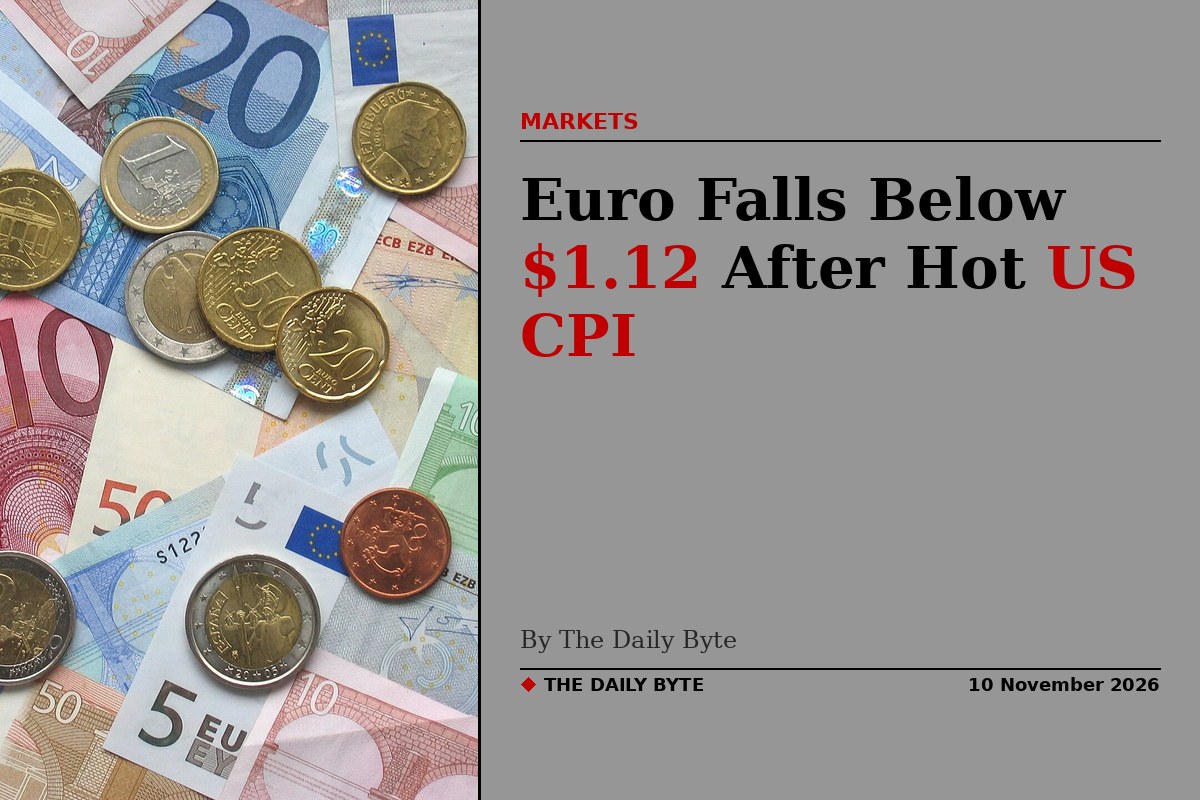
The euro fell below $1.12 against the US dollar on Tuesday, 10 November, after hotter-than-expected American inflation data strengthened the dollar and raised expectations of another interest rate rise from the Federal Reserve.
The single currency was trading at about $1.1190 in the afternoon, down 0.28% on the day, after slipping through the $1.1200 level following the release of the US consumer price figures. It later extended its decline to trade near $1.1150 in late European hours, down about 0.6% on the day, according to market reports.
Hot US inflation lifts the dollar
The US Bureau of Labor Statistics reported that consumer prices rose 0.4% month on month in October. That was above the 0.3% rise economists had expected, although it was slower than the 0.6% increase recorded in September.
Core inflation, which excludes food and energy prices, rose 0.3% in October, matching the increases in September and August but coming in above the 0.2% forecast. The figures suggested that the Federal Reserve still has work to do on inflation, and traders moved quickly to price in tighter US monetary policy.
Federal Reserve Governor Christopher Waller had said before the release that a 50-basis-point rate rise would be warranted if core inflation came in at 0.3% month on month, which is exactly what the data showed. According to the CME FedWatch tool, markets put a 99% chance on a 25-basis-point rise at the Federal Reserve's December meeting, up from 84% a day earlier.
The dollar index, which measures the greenback against a basket of six major currencies, gained about 0.3% to trade near 102.00. The yield on the two-year US Treasury note, which closely follows expectations for interest rates, jumped about 12 basis points to 4.68%.
Euro and sterling both weaker
The euro was not the only European currency under pressure. Sterling also fell, quoted at $1.3323 late on Tuesday afternoon, down from $1.3415 at the same time on Monday. Against the euro, sterling declined to €1.1949 from €1.1974.
The euro was quoted at $1.1150 late on Tuesday, down from $1.1203 late on Monday. The move left the single currency close to its lowest levels in several weeks, with traders noting that the pair had also slipped below its 100-period and 200-period moving averages on short-term charts.
European share markets were mixed on the day. The CAC 40 in Paris rose 0.6%, while the DAX 40 in Frankfurt climbed 0.3%, even as London's FTSE 100 gave up earlier gains to close 0.29% lower at 10,751.59 after the US inflation figures were published.
What traders watch next
Attention now turns to the Federal Reserve's meeting on 9 December, where a quarter-point rise is now seen as near certain. A survey of 101 economists conducted between 6 and 10 November found all of them expecting a quarter-point increase in December.
Traders will also watch inflation figures from Germany and Ireland due on Wednesday, and UK gross domestic product data due on Thursday, for further clues about the outlook for European currencies and interest rates.
For now, the euro remains under pressure while it trades below $1.12, with the next support seen by analysts at around $1.1152 to $1.1160, the level the currency tested during Tuesday's session.