Europe rejects Trump Russia security deal
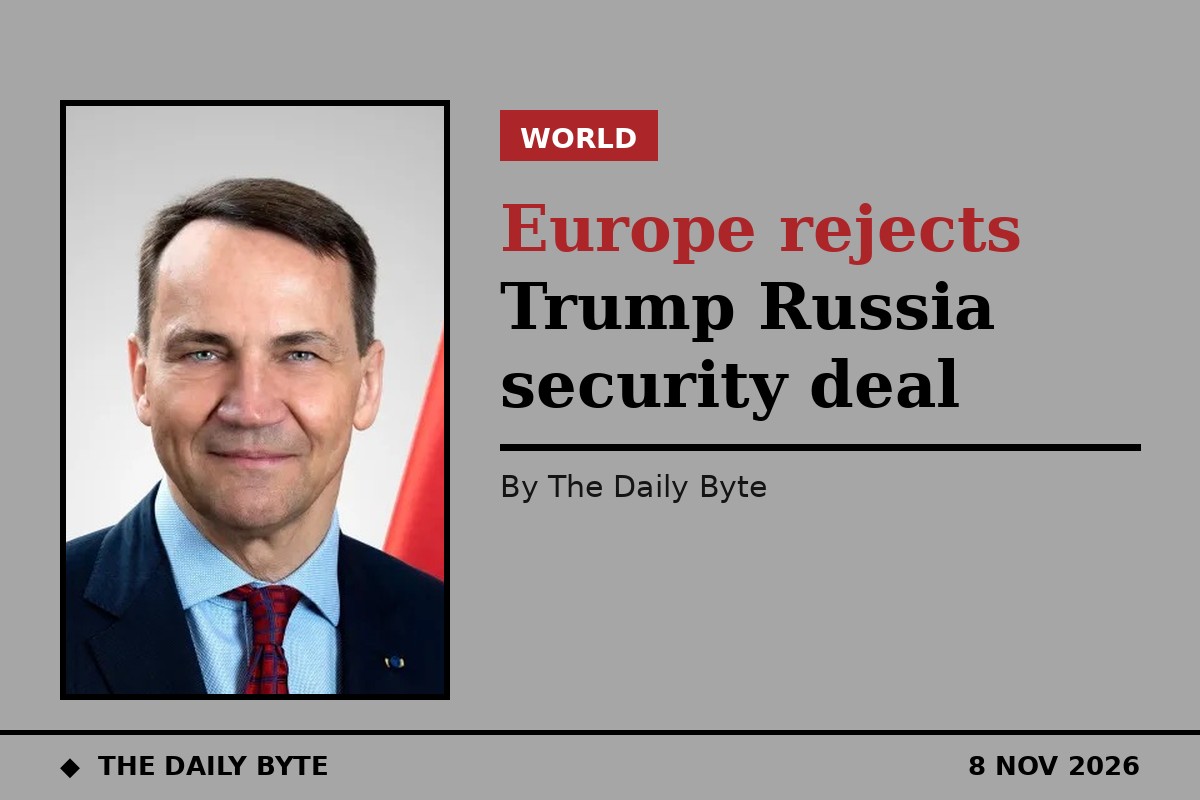
European leaders have firmly rejected any deal between the United States and Russia on the future of Europe's security that is negotiated without them, warning that a ceasefire in Ukraine must come before any talks on reshaping the continent's security order.
The pushback follows President Donald Trump's suggestion that a settlement with Moscow could extend beyond Ukraine to cover the security of Europe as a whole. Mr Trump raised the idea after meeting Kirill Dmitriev, the Russian president's special envoy, at the White House on Thursday, 5 November. His envoy Jared Kushner has said Washington is developing a broader European security framework alongside guarantees intended to protect Ukraine after a peace agreement.
Speaking in Warsaw on Friday, 6 November, the EU's foreign policy chief, Kaja Kallas, said Europe's existing security arrangements did not need to be renegotiated with Moscow. "We already have a European security architecture in place," she said, referring to NATO and the European Union, adding: "Putin does not have a veto over European security."
Her comments came during discussions with Polish Foreign Minister Radosław Sikorski and Ukrainian Foreign Minister Andrii Sybiha. Mr Sikorski set out a strict sequence for ending Russia's war. "First, a ceasefire, then negotiations on lasting peace, and only afterward possible discussions on restoring Europe's security architecture and arms control arrangements," he said.
"No solution can be imposed on Ukraine without its consent and participation at the table. Likewise, Europe's security cannot be discussed without our involvement."
Zelenskyy warns against a 'Yalta 2.0'
President Volodymyr Zelenskyy gave the sharpest warning in an interview with CNN on Friday, saying that discussing a new European security framework before ending Russia's war against Ukraine could be dangerous. "We don't want to have Yalta 2.0," he said, referring to the 1945 conference at which Allied leaders discussed Europe's post-war order.
Mr Zelenskyy said Ukraine supported a ceasefire and de-escalation but had seen no sign that Russia was ready to act. Mr Sybiha, speaking after meeting Ms Kallas in Warsaw, said Moscow could not be regarded as a guarantor of European security while it continued its war.
The Financial Times reported on 6 November that European capitals were alarmed at the prospect of negotiations reviving longstanding Russian demands for restrictions on NATO's presence in Eastern Europe. Moscow advanced those demands in December 2021, weeks before launching its full-scale invasion of Ukraine in February 2022, and they were rejected at the time.
Poland presses for tougher measures
Mr Sikorski used the Warsaw meeting to press for tougher measures against Moscow, including an end to Schengen tourist visas for Russian citizens. He said Russians received 623,000 Schengen visas in 2025, with 84 per cent issued for tourism, while Poland issued just 100 visas to Russians in the same period, mainly to political dissidents on humanitarian grounds.
"Russia, which is trying to destroy the European Union from within, should not enjoy the privileges of free movement across Europe," he said.
He also called for tougher sanctions against Russia's shadow fleet and companies supporting its operations, and for technology firms and social media platforms to cooperate more closely against Russian cyberattacks and information warfare. Poland also announced an additional 8 million zlotys (about $2 million) through the Energy Community to buy generators for Ukraine before winter, as Russia continues to strike Ukrainian energy infrastructure.
No comprehensive agreement has been announced, and the details of Washington's proposals remain incomplete. US-mediated talks involving Ukraine and Russia are expected to resume in Abu Dhabi on 10 and 11 November. The immediate challenge for European governments is to ensure those talks distinguish between ending the war and renegotiating the wider European security order — and to agree a common position before any wider framework is put to them.