European gas rallies for third day as winter storage hits decade low
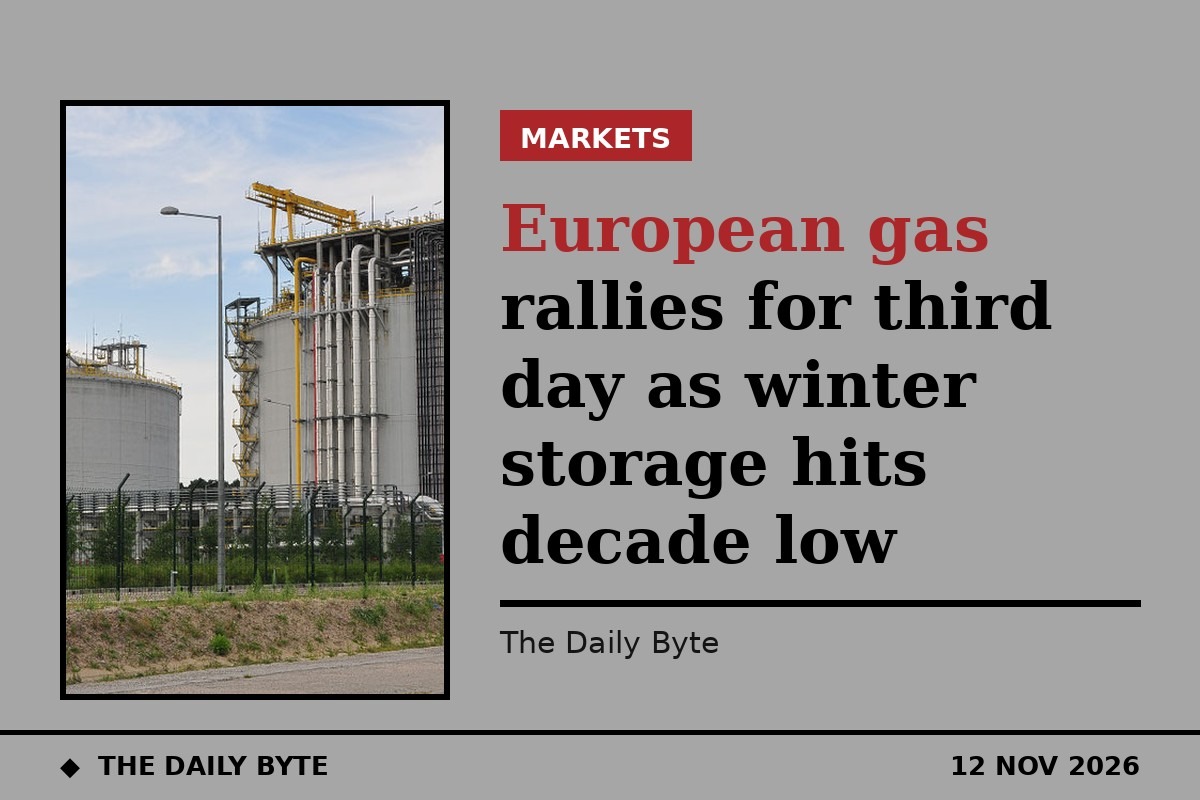
European natural gas prices rose for a third consecutive session on Thursday, 12 November, as traders weighed thin winter storage against hopes of easing tensions in the Middle East. The Dutch Title Transfer Facility (TTF) front-month contract, Europe's benchmark gas price, rose 2% to €88.42 per megawatt-hour, while Britain's National Balancing Point contract advanced 1.7% to 219 pence per therm, according to Investing.com.
The rally has carried TTF back from a low of €82.33 on Monday, a recovery of roughly 6% in three sessions, although prices remain below the €92.07 high reached on 3 November. The move ran against the direction of crude oil earlier in the day, with gas traders focused on local supply anxiety rather than the wider geopolitical picture.
Storage far below the five-year average
The structural worry is storage. European Union gas storage sites were 71.6% full in Gas Infrastructure Europe's update of 11 November, about 18.5 percentage points below the five-year average of 90.1% for this time of year, according to GasRadar. Germany, Europe's largest gas consumer, was at 58%. That leaves Europe entering winter with its lowest gas inventory of the 2020s, OilPrice.com reported, citing consultancy Rystad Energy.
Withdrawals from storage have also picked up sharply. Net storage withdrawals increased nearly sixfold from the previous week as colder conditions raised demand, according to Bloomberg reporting cited by Energy Connects. Colder weather and weak wind generation have lifted heating and power demand, while liquefied natural gas (LNG) cargoes are in strong demand in Asia, where spot prices are trading above $30 per million British thermal units.
A wide range of winter outcomes
Rystad Energy, in its winter LNG outlook published this week, stopped short of predicting a further rally, laying out as many ways for prices to fall as to rise and telling buyers to plan for a wide range of outcomes rather than a single base case. Much will depend on the weather. Current forecasts broadly favour mild conditions, but significant colder periods remain possible, and a cold snap would draw storage down fast from an already low base.
Supply risks have not gone away either. QatarEnergy has extended force majeure on some deliveries until at least the end of December 2026, and shipping through the Strait of Hormuz remains disrupted. At the same time, the United States has refrained from launching new attacks on Iran, and hopes of a diplomatic route have kept a lid on prices.
What it means for energy bills
For households, wholesale gas prices feed into energy bills with a lag, and suppliers buy much of their gas months in advance, so a few days of gains do not by themselves set what consumers pay. But the direction matters: with storage low and winter ahead, any sustained cold weather or supply disruption would push wholesale costs higher and make further bill increases more likely. GasRadar's winter stress monitor puts the median projected EU storage level on 1 April 2027 at 24.7%, with a 73% probability of finishing below 30%.
Traders will now watch the weather forecasts, LNG arrivals and the weekly storage data for signs of whether Europe can rebuild its buffer before the coldest months arrive.
Sources: Investing.com; OilPrice.com; GasRadar