European shares seen lower as rate worries return
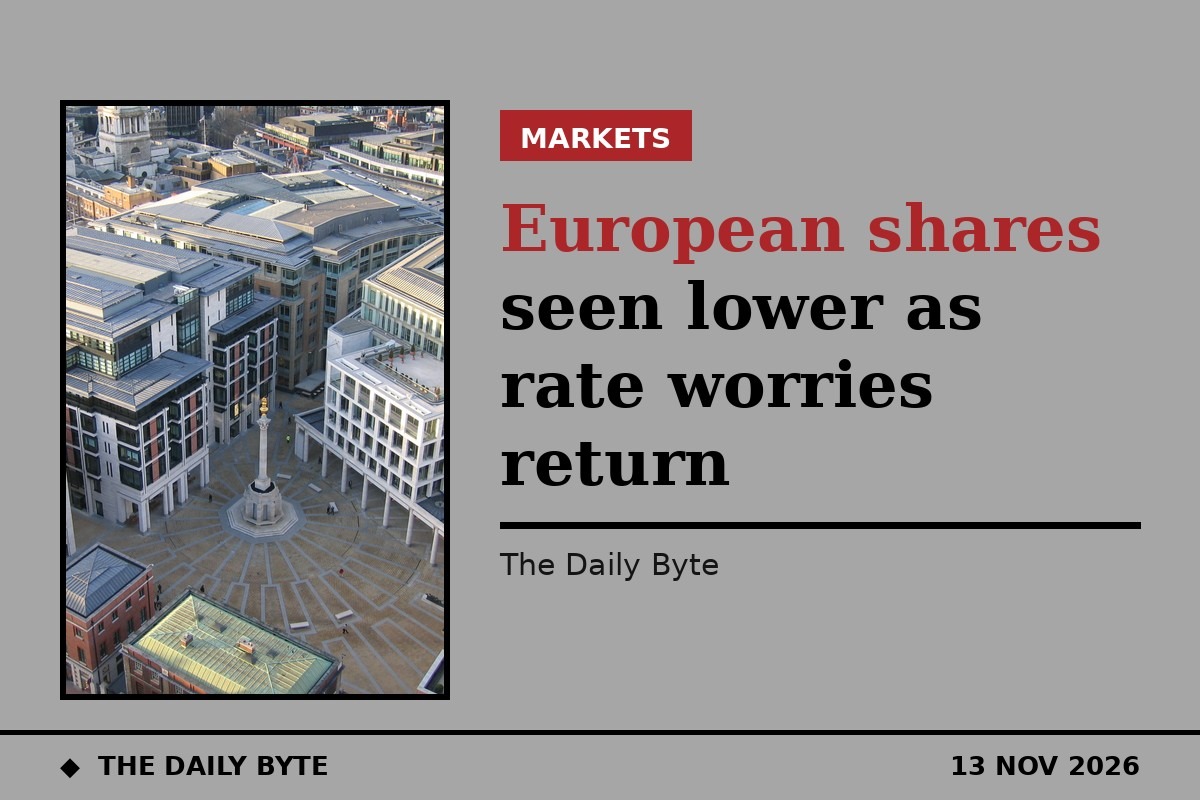
European shares were set for a sluggish start on Friday, 13 November 2026, as rising oil prices, renewed tension over Iran and fresh worries about interest rates combined to cool the mood before the London open.
RTTNews reported early on Friday that European stocks may open on a sluggish note, after US President Donald Trump played down the prospects of a comprehensive diplomatic solution with Iran and halted the negotiation process that Vice President J.D. Vance had been advancing. Trump instead accepted a stalemate described as "no war, no talks", and indicated he may use military force against Iran if US allies and ships are threatened.
The comments brought Middle East supply risks back to the front of investors' minds. Iranian officials reported an attack on Sirik in Hormozgan province, and four oil tankers were hit by explosions in the Strait of Hormuz after the vessels had ignored warnings and entered what Iran's military considers restricted areas of the strategic waterway.
Rate worries build before US inflation data
As inflation and rate-hike worries mount, investors will scrutinise the US October producer price inflation report later on Friday for further clues on the Federal Reserve's rate trajectory. RTTNews reported that headline producer price inflation is seen rising 6.6 percent year on year, while core producer prices are expected to show an increase of 5.0 percent.
Federal Reserve Bank of New York President John Williams said on Thursday that US inflation remains high and policymakers need to take action over time to get it back to the 2 percent goal. Separately, San Francisco Federal Reserve President Mary Daly indicated that additional tightening will be necessary as price pressures broaden beyond energy and goods into services.
The hawkish signals pushed Treasury yields sharply higher. The two-year Treasury note yield rose to 4.867 percent, the highest since 14 October, and the yield on 10-year notes reached 5.1169 percent, the highest since 21 October. Reuters reported that the two-year yield peaked at 4.8920 percent in the early Asian session, while the benchmark 10-year yield rose to a three-week high of 5.1433 percent.
Investors now see a 14.5 percent chance of a jumbo 50-basis-point Federal Reserve hike in December, up from zero a week ago, according to the CME FedWatch tool cited by Reuters. The US dollar rose to its highest level in about 19 months as Treasury yields climbed on the back of inflation concerns and hawkish Fed signals.
Asia lower and futures point down in Europe
Asian markets were mostly lower on Friday, giving up early gains, while US equity futures were mixed, with Nasdaq futures declining. Reuters reported that EUROSTOXX 50 futures fell 0.37 percent, while Nasdaq futures and S&P 500 futures rose more than 0.2 percent each in the Asian session.
US stocks closed lower overnight, with the Dow, the S&P 500 and the Nasdaq Composite all falling around 0.4 percent. Nvidia was at the centre of the selling after chief executive Jensen Huang resigned amid revelations about extramarital affairs and allegations of Chinese espionage. Nvidia shares fell in extended trading, raising questions about the future of the artificial intelligence boom and US-China technology ties.
Applied Materials forecast fiscal first-quarter revenue above Wall Street expectations, and SpaceX announced plans to invest more than $74 billion across two artificial intelligence supercomputing campuses in Texas and Arizona, but neither was enough to lift the wider mood in early trading.
European stocks had pared early gains to end mostly higher on Thursday, and Brent crude prices were little changed at $95.60 a barrel in Asian trading on Friday after settling around $96 a barrel on Thursday. Gold rallied nearly 1 percent to $3,915 an ounce in a likely technical rebound after falling for three straight sessions to its lowest level in more than a year.
With the US producer price report still to come, Friday's European session is likely to be driven less by company news and more by whether that inflation reading eases or deepens the market's new fear: that interest rates stay higher for longer.