Eurozone GDP confirmed at 0.4% as jobs steady
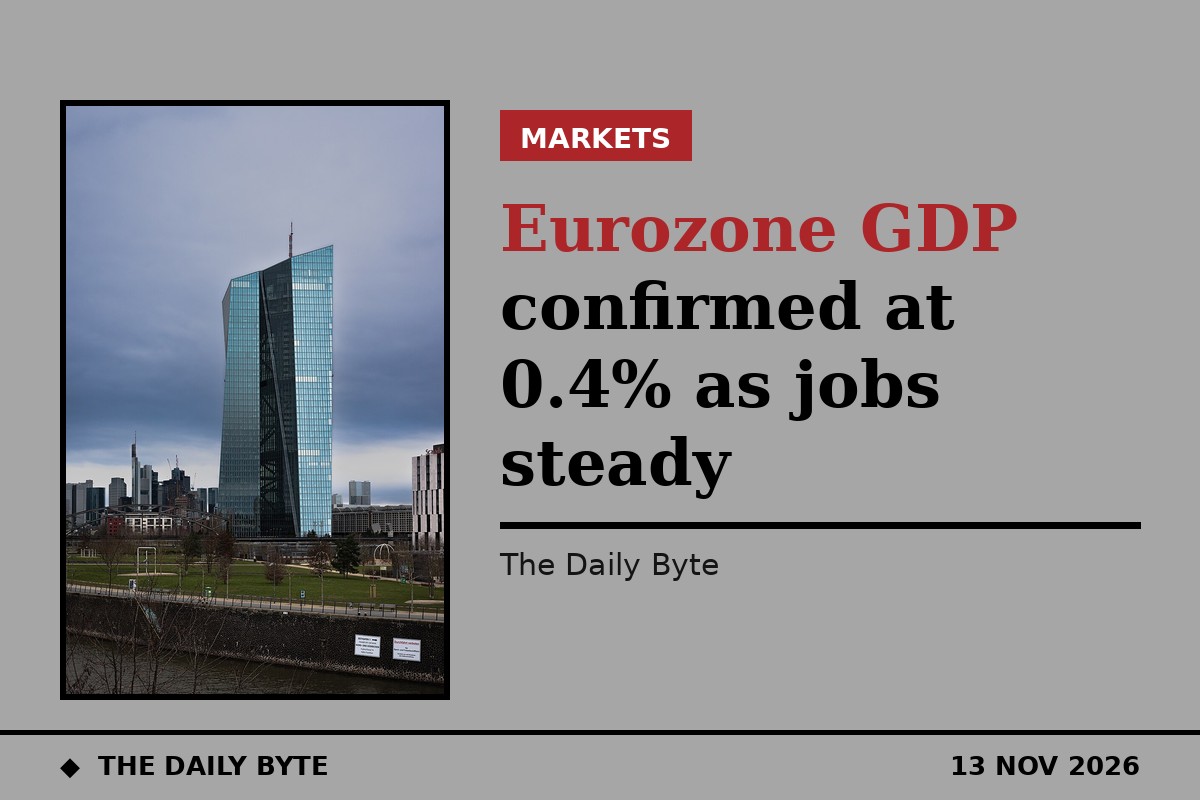
Euro area growth was confirmed at 0.4% in the third quarter of 2026, with employment stable across the bloc, in an updated estimate published by Eurostat on Friday 13 November.
The figures were unchanged from the preliminary flash estimate issued on 30 October. Seasonally adjusted GDP rose 0.4% in the euro area and 0.5% in the wider European Union compared with the previous quarter, after growth of 0.6% and 0.7% respectively in the second quarter.
Compared with the same quarter a year earlier, GDP increased by 1.3% in the euro area and 1.5% in the EU, after rises of 1.2% and 1.4% in the second quarter.
Employment holds steady
The number of people in work remained stable in both the euro area and the EU in the third quarter, compared with the previous quarter, after rising 0.1% in both areas in the second quarter. Compared with a year earlier, employment increased by 0.4% in both the euro area and the EU.
The flash estimates are based on member states' data covering 97% of euro area and EU GDP, and 95% of euro area employment. Eurostat said the figures for earlier quarters were not revised in this release, and that fuller estimates will follow on 7 December 2026 and 19 January 2027.
Ireland distorts the headline again
As in recent quarters, Ireland's volatile figures flattered the bloc-wide total. Irish GDP jumped 5.5% in the quarter, but Eurostat flags the Irish estimate as experimental and urges particular care in interpreting it, because it is based on incomplete sources and predominantly output data.
Excluding Ireland, euro area GDP grew by 0.2% quarter on quarter, against 0.3% in the previous quarter, according to analysis of the figures. Among the large economies, Spain again led growth at 0.6%, Germany grew 0.2%, Italy was flat and France contracted by 0.1%.
Elsewhere in the bloc, Romania recorded the second-strongest quarterly rise at 2.1%, followed by Poland at 0.8%. The Netherlands, Estonia, Bulgaria and Spain each grew 0.6%, while Lithuania recorded the sharpest fall, down 1.0%.
Momentum faded into the autumn
The figures point to an economy still expanding but losing pace. Growth slowed from the second quarter, and survey data suggest the slowdown continued into the final months of the year. European consumer confidence fell again in October to minus 17.9 points, well below its historical average, and the euro area composite purchasing managers' index fell 1.4 points to 51.7, weighed down by France, where it dropped to 48.4.
Headline inflation in the euro area rose again in October to 4.0%, up from 3.8% in September, while core inflation remained at 2.5%, indicating stable underlying price pressures, although higher energy costs could push inflation up further in the coming months.
For comparison, GDP in the United States increased by 0.8% in the third quarter compared with the previous quarter, after growth of 0.6% in the second quarter, and was 2.1% higher than a year earlier, Eurostat said.
The December release will show whether the third quarter held up as well as this estimate suggests, and whether the jobs market stayed flat as growth cooled. Sources: Eurostat and EuropeSays.