Eurozone Growth Holds as France Slumps, ECB Hike Eyed
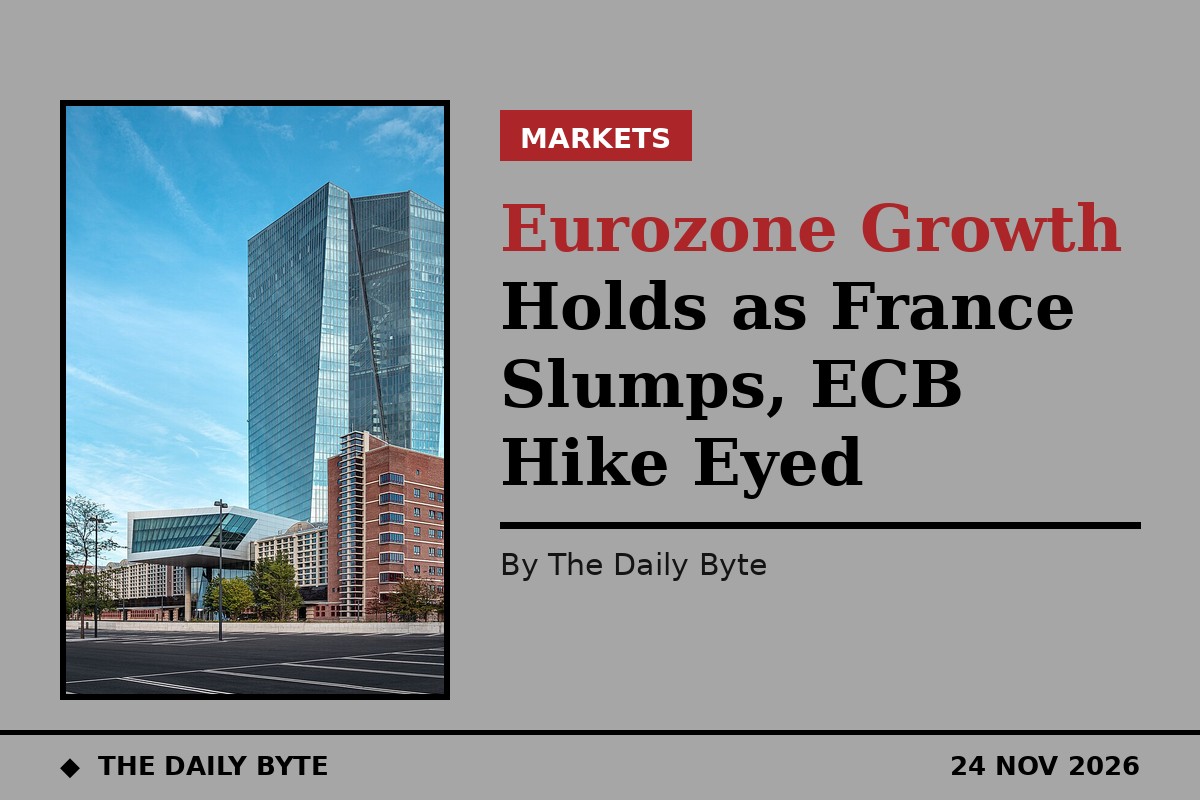
Growth in the eurozone held steady in November, but the headline hides a deepening split between its two largest economies, and the latest figures have strengthened the case for one more interest rate rise from the European Central Bank. The S&P Global flash eurozone composite PMI held at 51.7 in November, unchanged from October and slightly below the 51.9 forecast in a Reuters poll, marking a fifth straight month of expansion. Readings above 50 indicate growth in activity.
Germany did the heavy lifting. Its private sector PMI jumped to 55.0, the highest reading since March 2022, as growth accelerated sharply. France moved in the opposite direction: its composite PMI fell to 46.2, a six-month low and below the 47.8 economists had expected, with manufacturing output suffering its steepest decline since February 2025. Andrew Kenningham at Capital Economics said the unchanged eurozone reading was consistent with resilient growth, but with Germany expanding at a decent pace and France still contracting. S&P Global said the French figures raised the odds of the country entering a technical recession in the fourth quarter, after its economy contracted in the third.
The detail inside the survey was mixed. Manufacturing surprised on the upside, with the flash manufacturing PMI rising to a two-month high of 52.9 from 52.7, just ahead of the 52.8 poll estimate. Services, by contrast, softened: the flash services PMI fell to a five-month low of 51.2 from 51.4 in October, defying a Reuters poll forecast for a rise to 51.8. New orders rose for a fifth consecutive month and at a slightly quicker pace than in October, and new export orders also expanded, although growth was the slowest in three months. Business confidence in the year-ahead outlook fell for a fourth month to its lowest since May, while companies kept staffing levels broadly unchanged, with a near three-and-a-half-year high in manufacturing job creation offset by a second consecutive month of cuts in services employment.
Price pressures, the part of the survey the ECB watches most closely, remain elevated but are easing. Input costs rose sharply again in November, although the rate of inflation eased to a three-month low, and output price growth slowed to its weakest pace since August, with weaker increases across both manufacturing and services. Chris Williamson, chief business economist at S&P Global Market Intelligence, said lower oil prices had helped tame inflationary pressures somewhat in November, while higher interest rates were also starting to show up as an increasing drag on activity. He added that the elevated price signals alongside steady growth would support calls for a further rate hike from the ECB in December.
That is now the market's central expectation. Most economists polled by Reuters expect the ECB to deliver a final deposit rate hike in this cycle next month, and the swaps curve virtually fully prices in a 25-basis-point rise to 2.75 percent at the 17 December meeting, up from 2.50 percent today. Iain Simmons at Oxford Economics said the persistent prevalence of price pressures reinforced his expectation of further ECB tightening in December. With eurozone inflation still running well above the ECB's 2 percent target, the survey sends what Williamson called a clear hawkish signal for the coming months.
Britain, outside the currency union, told a similar story of slowing momentum. Its composite PMI eased to 52.3 in November from 52.9 in October, a two-month low, as weaker foreign demand for services and a soft property market were largely offset by the buildout of artificial intelligence capacity. The Bank of England raised Bank Rate to 4 percent at its meeting ending on 4 November, voting 8-1 for a quarter-point rise, and it too is watching whether price pressures fade. For the eurozone, the November survey leaves the ECB with a difficult balance: growth is holding, Germany is surging, France is sliding towards recession, and inflation is still too high to ignore.