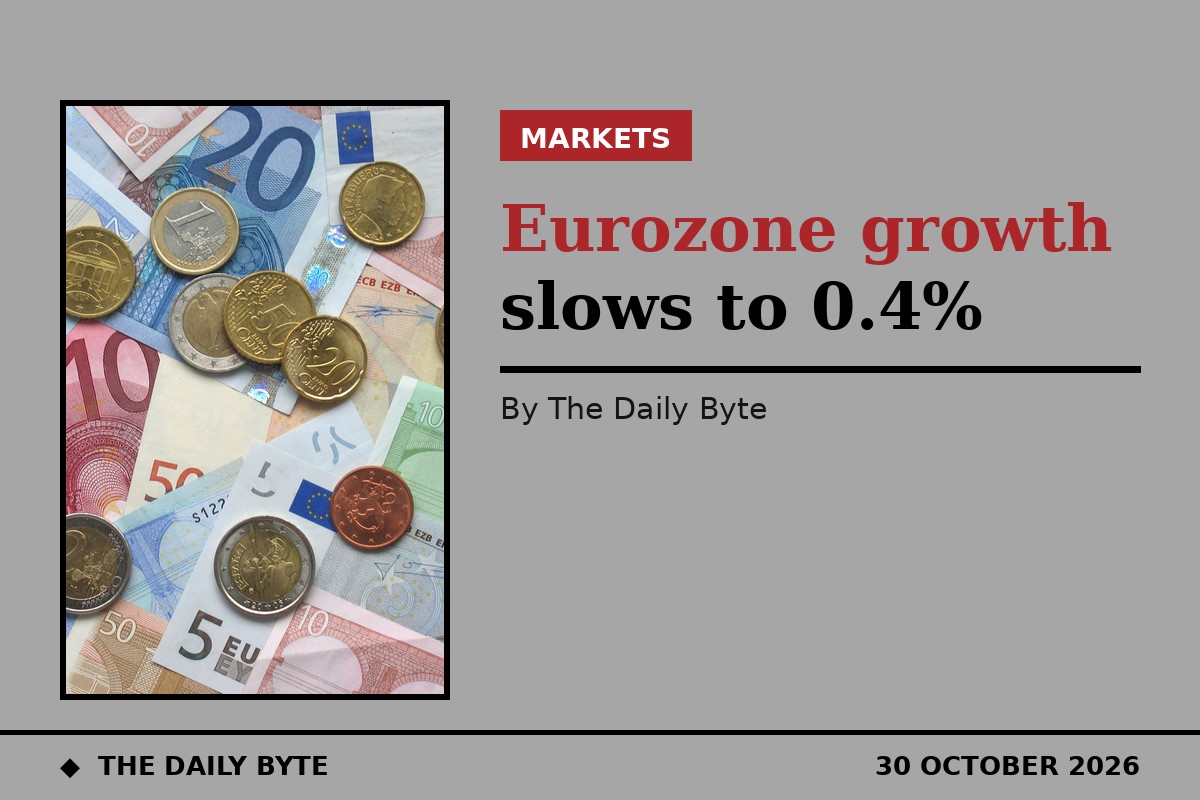
Eurozone growth slows to 0.4% as France contracts
Growth eases, but beats forecasts
Eurostat's preliminary flash estimate put euro-area GDP growth at 0.4% in the third quarter of 2026, down from 0.6% in the second quarter, the EU statistics office said on Friday 30 October. The figure beat the 0.2% growth forecast in a Reuters poll of economists, but confirmed a slowdown from the spring rebound after stagnation in the first quarter.
Across the wider 27-country European Union, growth slowed to 0.5% from 0.7%. Compared with a year earlier, euro-area GDP was 1.3% higher, up from 1.2% in the second quarter. Eurostat also put September euro-area unemployment at 6.5%, stable on the month and up from 6.3% a year earlier.
France contracts, Germany and Italy weak
France's economy contracted by 0.1% over July to September after no growth in the previous quarter, as falling exports, declining investment and industrial weakness weighed on the bloc's second-largest economy. Germany, the largest economy, grew by just 0.2%, while Italy was flat. Spain grew 0.6%, and Ireland recorded 5.5% growth — a headline figure Eurostat flags as highly volatile because of multinational activity, and subject to revision.
Lithuania recorded the largest quarterly decline among countries with data available, at 1.0%. The European Central Bank held interest rates steady on Thursday 29 October, saying the shock from higher energy prices had not yet fed into wider price pressures.
A preliminary figure, open to revision
The flash estimate is based on data from 19 EU member states covering 96% of euro-area GDP, and Eurostat stresses the underlying sources are incomplete. The figures will be revised with the GDP flash estimate scheduled for 13 November, followed by regular estimates on 7 December and 19 January.
Sources: Eurostat | Reuters via EuropeSays