Eurozone PMI holds at 51.7 as Germany surges
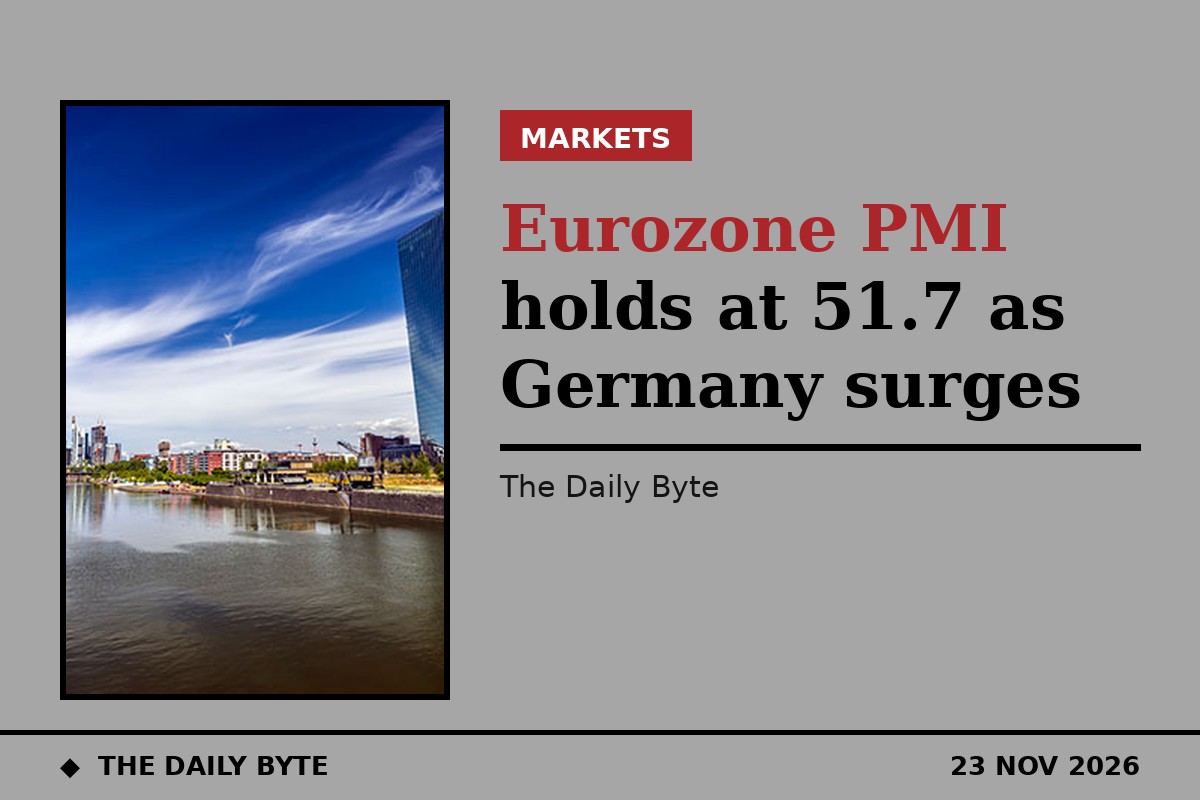
Growth in the eurozone held steady in November, but the headline figure hides a widening split between its two largest economies: Germany is growing at its fastest pace in more than four years, while France is suffering its sharpest contraction in six months. The S&P Global flash eurozone composite PMI held at 51.7 in November, marking a fifth consecutive month of expansion, Reuters reported.
The reading came in just below a Reuters poll estimate of 51.9. PMI readings above 50.0 indicate growth in activity, and S&P Global said the data pointed to the eurozone economy growing at close to 0.3% in the final quarter of the year.
Services weaken as manufacturing strengthens
The split inside the survey was clear. The flash eurozone services PMI fell to a five-month low of 51.2, down from 51.4 in October and below the 51.8 forecast in the Reuters poll. Manufacturing moved the other way: the flash manufacturing PMI rose to a two-month high of 52.9, up from 52.7 and just above the 52.8 estimate, InvestingLive reported.
New orders rose for a fifth consecutive month, and at a slightly quicker pace than in October. New export orders also expanded, although growth was the slowest in three months. Manufacturers saw stronger order growth than services firms, while the rest of the eurozone outside Germany and France grew at its slowest pace in six months.
Germany surges while France slumps
Germany's output rose at its fastest pace since March 2022, with its manufacturing sector enjoying a growth spurt of a kind not seen for more than five years. France, by contrast, posted its sharpest contraction in six months, the widest performance gap between the two economies in six years.
Chris Williamson, chief business economist at S&P Global Market Intelligence, said the headline resilience masked “worrying divergences in performance within the euro area”. He added that France was suffering a deepening downturn while growth in Germany had accelerated to the fastest for four and a half years.
S&P Global said France was struggling with weak domestic demand, in part because of hesitancy ahead of a highly uncertain presidential election in 2027. Sentiment in France deteriorated to near its worst level since the series began in 2012, outside of the COVID-19 pandemic.
Confidence falls to its lowest since May
Business confidence in the year-ahead outlook fell for a fourth month to its lowest since May. Eurozone companies kept staffing levels broadly unchanged in November: a near three-and-a-half-year high in manufacturing job creation was offset by a second consecutive month of cuts in services employment.
Price pressures eased. Input costs rose sharply again, although the rate of inflation slowed to a three-month low, and output price growth fell to its weakest pace since August, with weaker price increases across both manufacturing and services.
Frequently asked questions
What is the eurozone PMI? The purchasing managers' index is a monthly survey of businesses compiled by S&P Global. A reading above 50.0 signals that activity is expanding, while a reading below 50.0 signals contraction.
What does a composite PMI of 51.7 mean? It means private-sector activity in the eurozone grew for a fifth month in a row in November. S&P Global said the reading was consistent with the economy growing at close to 0.3% in the fourth quarter of 2026.
Why is France falling behind Germany? S&P Global pointed to weak domestic demand in France and hesitancy ahead of the presidential election in 2027, while German manufacturing is enjoying its strongest growth spurt in more than five years.
Sources: Reuters; InvestingLive.