Eurozone Investor Confidence Slips Again in November
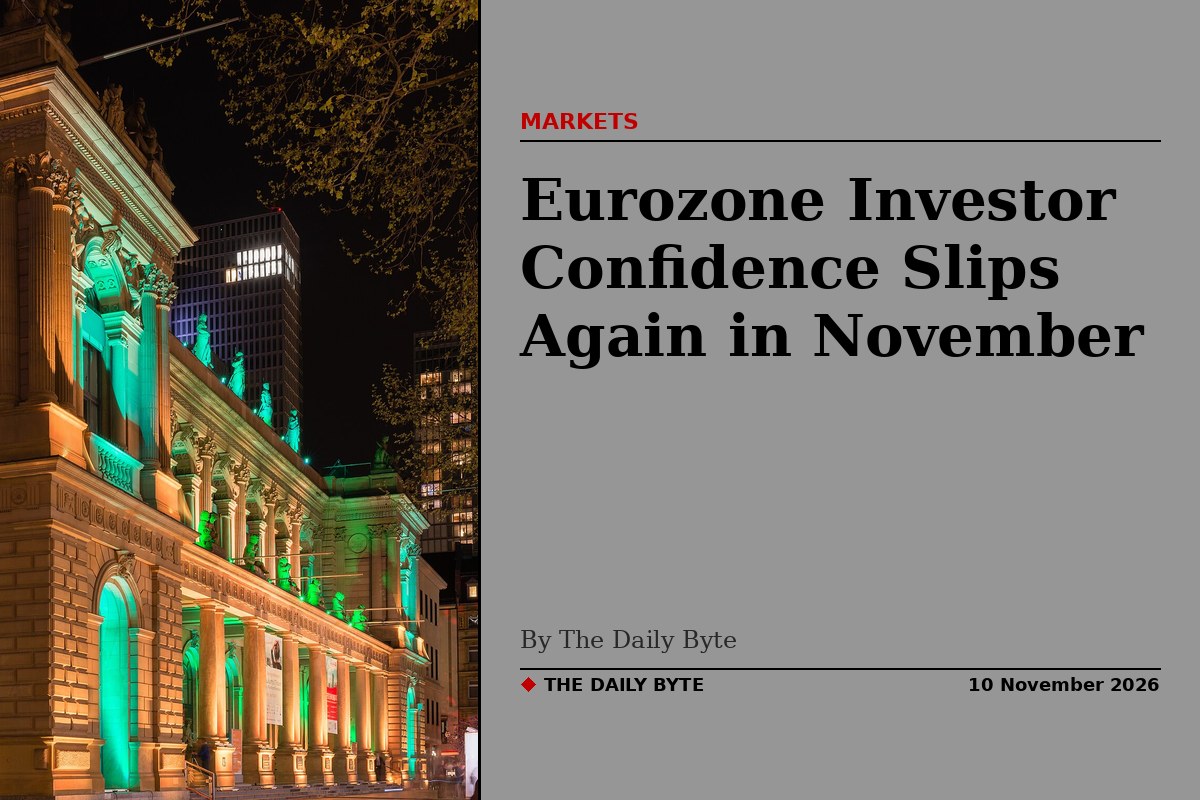
Investor confidence in the eurozone economy slipped for a second month running in November, despite the recovery in European stock markets, according to the latest Sentix survey released on Monday.
The Sentix investor confidence index for the single currency area fell 0.3 points to 2.4 in November, down from 2.7 in October. The survey, conducted between 5 and 7 November among 1,025 financial market participants, including 220 institutional investors, points to an economy that remains stuck rather than recovering.
The assessment of the current economic situation was unchanged at minus 3.3 points, while the expectations index fell 0.5 points to 8.3, its lowest level since June 2026. Sentix said hopes for a lasting economic recovery had suffered another setback, citing rising interest rates, elevated energy prices and political uncertainty as the main obstacles to activity.
Germany shows first signs of stabilising
Germany, the eurozone's largest economy, bucked the wider trend slightly. Its investor confidence index rose 0.3 points in November to minus 3.3, although it remains in negative territory.
The assessment of current conditions in Germany improved for a fifth month in a row, rising to minus 14.0 from minus 14.4, its highest level since May 2023. The expectations index for Germany was unchanged at 8.0 points.
The figures suggest the first signs of stabilisation in the German economy, but not a decisive recovery, with sentiment still negative overall.
Markets rally while confidence lags
The gloom among investors contrasts with the mood on stock markets. European shares have climbed towards record highs this week, with the pan-European STOXX 600 trading within 1% of its record, helped by falling oil prices and a rebound in technology shares after last week's sell-off.
The disconnect underlines the split between financial markets, buoyed by hopes that easing Middle East tensions will curb energy-driven inflation, and the real economy, where high borrowing costs and weak demand continue to weigh on confidence.
Sentix surveys around 1,600 financial analysts and institutional investors each month, and its index is watched as an early gauge of economic sentiment in the currency bloc. The next release will show whether November's dip was a pause or the start of a deeper slide in confidence.
Sentix also noted that the gloom is not uniform across the bloc. While the eurozone-wide expectations index fell, Germany's stabilisation and the resilience of equity markets suggest investors are distinguishing between countries and sectors rather than writing off the region as a whole. Even so, with the current-situation gauge still in negative territory, the survey points to an economy that is stabilising at a low level rather than accelerating.
Source: FXStreet