Europe Risks Falling Behind on Medicine Innovation
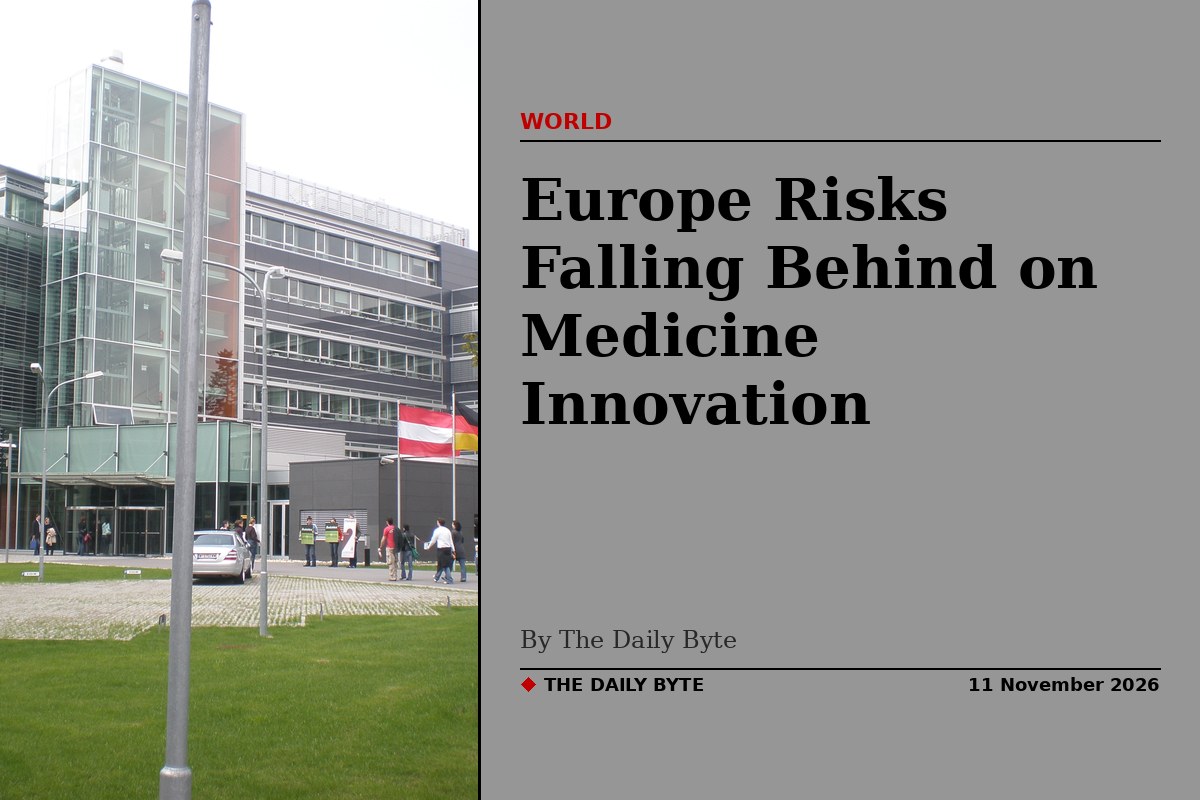
Europe risks falling further behind the United States and China on medical innovation unless governments change course on drug pricing, regulation and research funding, a major new report warned on Wednesday, 11 November 2026. The study, "Innovation at a Crossroads", was published by the consultancy EY and commissioned by the German pharmaceutical company Boehringer Ingelheim.
The report assesses France, Germany, Italy, Poland and Spain, as well as EU-level policy, and compares them with Canada, Japan and the UK. It warns that cutting investment in medical innovation today could push overall healthcare spending higher tomorrow, while stronger support for research could protect both patients and public finances.
Europe's research edge is not turning into growth
Since 2010, pharmaceutical research and development spending in the EU has grown by 4.4% a year, compared with 5.5% in the US and 20.7% in China. The European Economic Area's share of commercially sponsored clinical trial starts fell from 22% in 2013 to 12% in 2023, according to the report.
EY concludes that the EU is not losing its science edge as such. The problem, it says, is creating the commercial and regulatory conditions that allow science to turn into economic growth, new medicines and faster patient access. Attractive market conditions for new medicines are described as just as important for strategic healthcare autonomy as research and manufacturing capacity.
Two scenarios for 2035
The report sets out two contrasting scenarios. In a pro-innovation scenario, governments create predictable conditions through stable intellectual property frameworks, efficient regulation, competitive reimbursement and support for commercialisation. In a contra-innovation scenario, governments rely mainly on cost containment measures that ease budget pressures in the short run but create higher healthcare costs in the medium to long term.
The gap between the two paths is large. EY estimates that the difference in economic impact could mean €800 billion more GDP on average per assessed EU country by 2035 under the pro-innovation path. By contrast, policies leading to a contra-innovation scenario could be associated with an average of €29 billion in additional healthcare expenditure per selected EU country by 2035.
What the numbers mean for Germany, France and Italy
In France, corporate research and development spending in pharmaceuticals would rise by only 14% in the contra-innovation scenario, compared with 66% in the pro-innovation scenario. In Germany, a pro-innovation path would leave healthcare spending about 3.1 percentage points of GDP lower in 2035 than a contra-innovation path, saving around €124 billion.
The report also finds that a pro-innovation policy path could result in around 390 additional life sciences companies being founded per year by 2035 across France, Germany and Italy combined, strengthening Europe's domestic innovation ecosystem and its strategic autonomy.
Innovation should be treated as an investment
"Pharmaceutical innovations should not be seen simply as a cost for healthcare systems. Innovation allows us to prevent disease, reduce hospital stays, and keep economies productive. This report shows that affordability and innovation are not competing goals but need to be addressed together," said Shashank Deshpande, chairman of the board of managing directors at Boehringer Ingelheim.
The report calls for a coordinated approach that aligns healthcare, industrial, innovation and economic policy, based on predictable and transparent pricing frameworks, strong and reliable intellectual property protection, and efficient and timely regulatory pathways. The authors stress that the findings are a strategic assessment based on policy measures introduced or proposed between 2022 and June 2026, and on a set of assumptions and judgements, rather than a precise quantitative forecast. GlobeNewswire published the release, and EY hosts the full report.
Frequently asked questions
What is the Innovation at a Crossroads report? It is a study by EY, commissioned by Boehringer Ingelheim and released on 11 November 2026, assessing how policy choices could shape the economy, healthcare systems and strategic autonomy in the EU until 2035.
How far behind is Europe on drug research? EU pharmaceutical R&D spending has grown 4.4% a year since 2010, against 5.5% in the US and 20.7% in China, while the European Economic Area's share of commercially sponsored clinical trial starts fell from 22% in 2013 to 12% in 2023.
What could Europe gain from pro-innovation policies? EY estimates €800 billion more GDP on average per assessed EU country by 2035, plus around 390 extra life sciences companies founded each year in France, Germany and Italy.