FBR reverses 17-year tax integration over Rs3.4tr gap
The government is unwinding a 17-year-old tax reform after a Rs3.4 trillion sales tax gap exposed deep weaknesses in the way Pakistan collects its biggest domestic tax.
Sales tax and income tax will again be handled by separate specialised officers, reversing the integration introduced in 2009, and dedicated sales tax zones are being set up in the country's four major taxpayer centres: Karachi, Lahore, Islamabad and Multan.
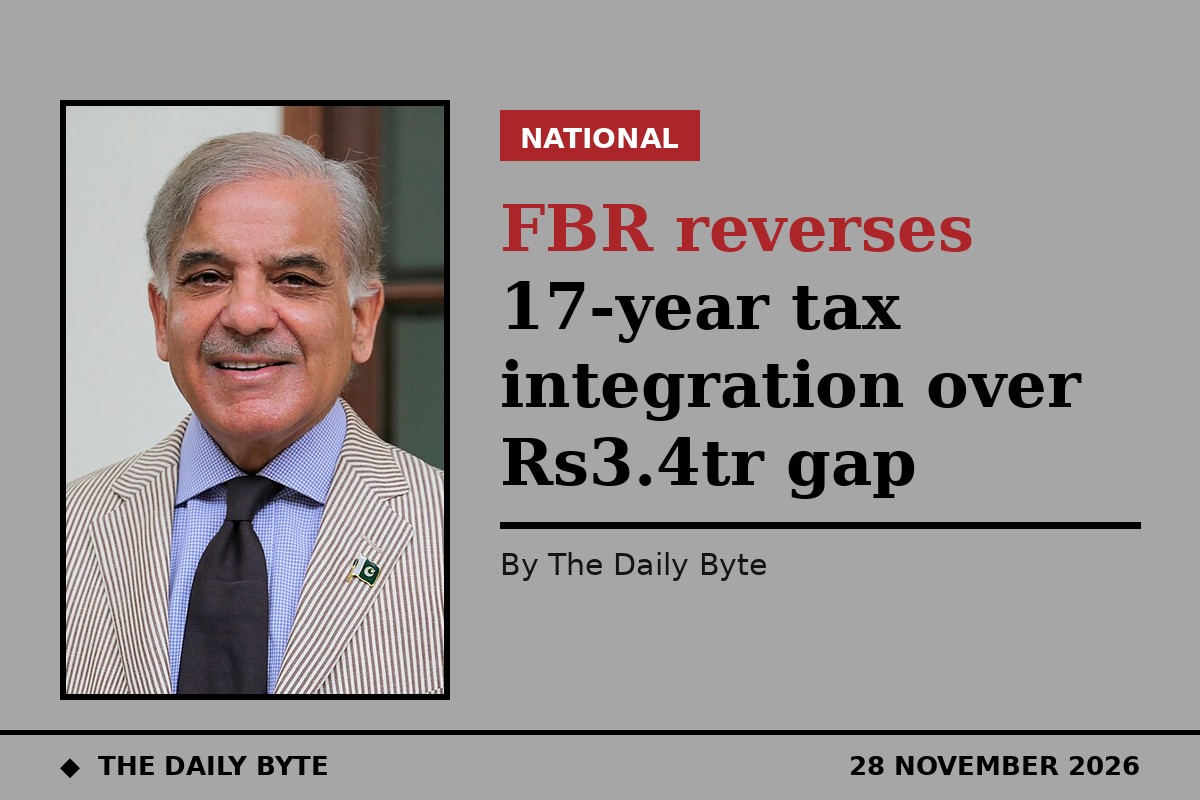
The changes were discussed at a weekly review meeting of the Federal Board of Revenue (FBR), chaired by Prime Minister Shehbaz Sharif in Islamabad, according to a statement issued by the Prime Minister's Office.
A Rs3.4 trillion gap
The estimated sales tax revenue gap has widened to Rs3.4 trillion, compared with about Rs2 trillion in income tax, according to the figures discussed at the meeting. The gap, coupled with persistent weaknesses in enforcement and collection, prompted the decision to reverse the functional integration of the two tax administrations.
The government now intends to introduce greater specialisation by assigning separate officers to the two tax streams, although both will continue to operate within the Inland Revenue Service rather than through entirely separate services.
The board has appointed Dr Muhammad Sarmad Qureshi as the first Member for Sales Tax and Federal Excise Duty, and 54 officers have been transferred to the new wing. Dedicated sales tax units are due to become operational in phases from December 2026, starting with Large Taxpayer Units and Corporate Tax Offices on 1 December, followed by Regional Tax Offices on 1 January 2027 and separate chief commissioners for sales tax on 1 March 2027.
The reform being reversed
The integration now being undone dates from 2009, when the government transferred the administration of sales tax and federal excise duty from Customs to the Inland Revenue Service as part of a World Bank-backed reform. The aim was to improve efficiency, reduce administrative duplication and strengthen revenue mobilisation by bringing the major domestic taxes under one roof.
After nearly 17 years, the widening sales tax gap has raised questions about whether that arrangement worked. The government now hopes that specialised tax administration, stronger enforcement, digital monitoring and stricter accountability will improve compliance, curb evasion and narrow the revenue shortfall.
The Policy Research Institute of Market Economy (PRIME), a think tank, has warned that the split could push more businesses to stay outside the tax net and expand the informal economy. That warning is a prediction, not a proven outcome, and no data yet shows the informal economy has grown because of the separation.
Rs24.4bn oil marketing irregularities
The same meeting was told that an audit of bonded warehouses operated by oil marketing companies had uncovered irregularities amounting to Rs24.4 billion, equivalent to about $87 million. Prime Minister Shehbaz Sharif ordered indiscriminate action against those responsible and directed that the outstanding amounts be recovered through legal procedures.
He directed the authorities to ensure that recoveries were made in accordance with the law and that no company or individual involved in financial irregularities was given preferential treatment.
Enforcement and tracking
Alongside the restructuring, the government is developing a modern cargo tracking system to address the widening sales tax gap and curb smuggling. The system will digitally monitor the movement of goods from loading to delivery through a single platform comprising an electronic consignment note, a risk management system, field enforcement arrangements and an analytics dashboard. A steering committee with provincial representation is being formed to oversee it.
The meeting was also told that the Indus Collectorate, an enforcement arm with 856 personnel, had started operations at bridges over the Indus River across the country and had seized illegal goods worth Rs1.849 billion in 302 operations so far.
The prime minister also directed the authorities to speed up customs clearance, immigration and other procedures at the country's airports and to make smart scanning systems operational at all international airports without delay. The technology will automatically direct passengers' baggage towards green or red channels.
Already being put into effect
The restructuring is already being put into effect. The FBR has issued SRO 1887(I)/2026, reported on 28 November, revising the jurisdiction of its Intelligence and Investigation (Inland Revenue) officers across Karachi, Lahore and Islamabad and reallocating federal excise cases among field formations after the restructuring of tax offices in the three cities.
The FBR is also establishing an office at Karachi's Korangi Industrial Estate to provide tax-related services to industrialists at their doorstep. Departmental proceedings are being initiated against FBR officers who previously issued unauthorised consumption certificates under the tax exemption regime for the former tribal areas.