FCC Lets Peshawar High Court Resume Most Cases
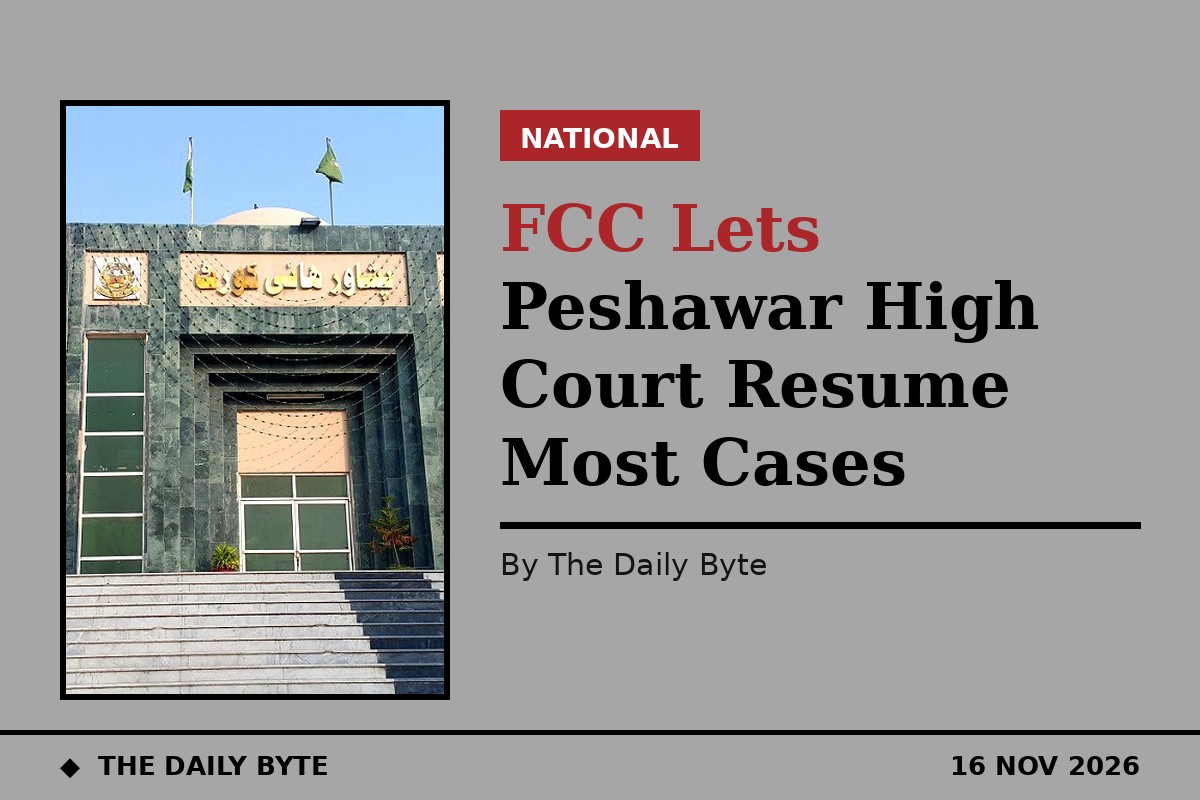
The Federal Constitutional Court (FCC) has narrowed its 5 November stay order and allowed the Peshawar High Court to resume hearing most constitutional petitions under Article 199 of the Constitution, while keeping the bar in place for two categories of cases. A two-member bench headed by Chief Justice Aminuddin Khan, with Justice Aamer Farooq, issued the clarification in Islamabad on Monday, 16 November 2026, while hearing a case about the high court's constitutional jurisdiction.
The court said its earlier order had covered only governor's-rule cases and arrests under Section 3 of the Maintenance of Public Order (MPO) Ordinance in Khyber Pakhtunkhwa. The Peshawar High Court can therefore proceed with other constitutional petitions, the bench said, and the court also allowed the Peshawar Bar Council to become a party to the proceedings. The constitutional case itself was adjourned for an indefinite period.
What stays barred
Two categories remain outside the Peshawar High Court's reach. Petitions challenging the proclamation of emergency and governor's rule in Khyber Pakhtunkhwa on 11 October cannot be heard by the high court, and neither can petitions concerning detentions under Section 3 of the MPO Ordinance.
That limit drew disappointment from the Pakistan Tehreek-e-Insaf (PTI), which had brought the petition. Party chairman Barrister Gohar Ali Khan told reporters afterwards that he was disappointed, saying the court had not allowed the high court to hear the detention cases and that, in his words, thousands of PTI workers remained detained under the MPO without an effective legal remedy. He had argued in court that the 5 November order had badly affected proceedings before the high court and brought lawyers' practices to a halt.
On the question of a remedy for detainees, the Khyber Pakhtunkhwa advocate general told the court that a statutory review board for preventive detention cases would be formed in the province after three months. Barrister Gohar had told the bench that no such board had yet been set up.
How the bar came about
The dispute goes back to the FCC's order of 5 November, which restrained the Peshawar High Court from hearing proceedings in Article 199 petitions filed on or after 12 October. The order cited clauses 3 and 4 of Article 245 of the Constitution, under which the armed forces were called in to aid the civil power in Khyber Pakhtunkhwa. Under Article 245(3), a high court cannot exercise jurisdiction under Article 199 in an area where the armed forces are acting in aid of civil power.
The bench observed on Monday that a literal reading of Article 245 would mean cases under Article 199 could not be heard at all, but said such an interpretation would bring the entire judicial system to a standstill. Pakistan Point reported the court's remarks in its account of the hearing.
The FCC is seized of more than 60 appeals against interim orders of the Peshawar High Court, moved by the additional chief secretary of the Khyber Pakhtunkhwa Home and Tribal Affairs Department. Before the bar, the high court had restrained 3-MPO arrests and ordered 28 PTI workers released. Around 105 petitions were removed from the high court's 10 November cause lists, and lawyers across Khyber Pakhtunkhwa observed a strike that day against the suspension of the high court's powers.
The emergency behind the case
The federal government imposed emergency and governor's rule in Khyber Pakhtunkhwa on 11 October, citing the provincial government's disengagement from the fight against terrorism. President Asif Ali Zardari approved the move on the federal government's recommendation, Governor Faisal Karim Kundi assumed executive authority, and the PTI-led provincial government became non-functional, with the army called in aid of civil power under Article 245.
Scores of PTI workers and leaders, including lawmakers, were detained after the 11 October move. Sohail Afridi, rendered non-functional as chief minister by the move, has not been seen since, and a federal minister confirmed he and some cabinet members were in preventive custody. Opposition leaders have already moved the FCC seeking their release.
What happens next
For most litigants in Khyber Pakhtunkhwa, Monday's clarification restores routine access to the high court for constitutional petitions that have no connection to preventive detention or to the emergency. The court noted that several miscellaneous applications had been filed at its Peshawar Registry and would be examined when placed before the bench.
The central constitutional questions — the legality of governor's rule and the emergency, and the detention of PTI workers under the MPO — remain undecided, with the hearing adjourned indefinitely. Until the FCC rules on them, the detainees' cases stay outside the Peshawar High Court's jurisdiction, and the review board the province has promised is still three months away. Feature Pakistan reported that the clarification was a partial win for the PTI, but not the relief it had sought.