FCC Restores PPSC Candidates After Paper Leak Row
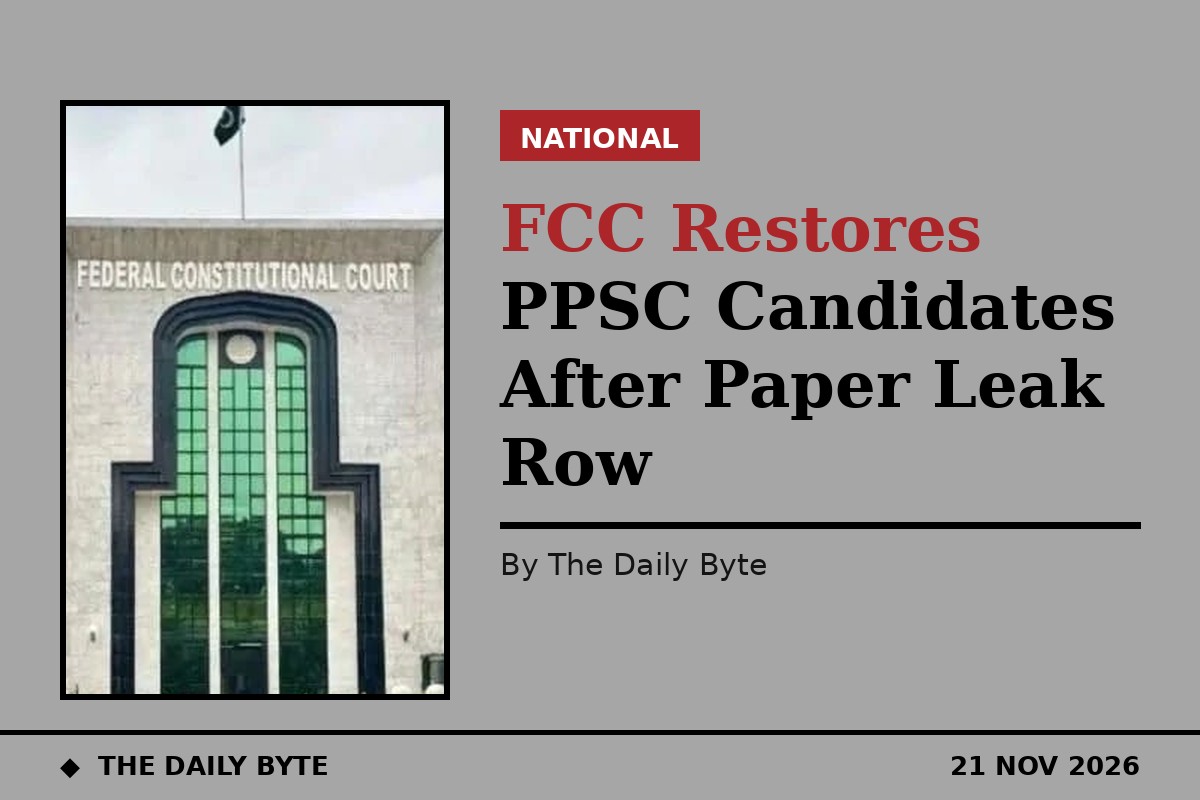
The Federal Constitutional Court has declared unlawful the withdrawal of the recommendations of successful Punjab Public Service Commission candidates solely on the basis of allegations of examination paper leaks.
The court accepted the candidates’ petitions, set aside the Lahore High Court Division Bench’s judgment dated 16 June 2025, and ruled in favour of the petitioners. Reports put the number of candidates restored at 123.
A two-member bench, headed by Chief Justice Amin-ud-Din Khan and comprising Justice Ali Baqar Najafi, had concluded hearings on 14 October 2026 on appeals filed by Farah Waheed, Muhammad Amir Shehzad, Muhammad Umair, Ziaullah Khan, Sidra Sadaf, Chand Iqbal and others against the high court’s decision.
In a 14-page judgment authored by Justice Najafi, the court held that withdrawing candidates’ recommendations on the basis of general apprehensions or allegations of examination paper leaks, without fulfilling the legal requirements, cannot be sustained under the law.
Innocent candidates cannot pay for staff corruption
The court observed that innocent candidates cannot be made to suffer for corruption committed by the commission’s own staff. “No institution can take advantage of its own mistakes to the detriment of citizens,” the judgment said.
According to a letter issued by the commission on 7 April 2021, a report had identified only four PPSC employees as being involved in the alleged wrongdoing. The commission later told the court that four officials had been dismissed over the leak.
The candidates were penalised without being issued show-cause notices or being given an opportunity to explain their position. The court further observed that even during the probationary period, an employee cannot be dismissed over a serious allegation such as examination paper leakage without fulfilling the legal requirements and providing the employee with an opportunity to defend themselves.
The posts and the withdrawal
The PPSC had completed the recruitment process for various posts, including deputy accountants in the Finance Department and inspectors in the Punjab Anti-Corruption Establishment, and had forwarded its recommendations for the successful candidates. Candidates appointed as deputy accountants had even started receiving their salaries, while recommendations for the inspector posts had been forwarded on 7 December 2020.
Following the initiation of an investigation into allegations of examination paper leaks, the full commission withdrew its recommendations, resulting in the dismissal of employees who had already been appointed. The leaked papers were recovered only after the candidates had cleared the examinations and the commission had issued its recommendations.
Government lawyers argued that serious irregularities had emerged during the Anti-Corruption Establishment’s investigation. They said the full commission, in the public interest and under Regulations 26 and 63, decided to withdraw its recommendations and conduct the examinations again.
Counsel for the petitioners argued that their clients were neither named in the first information report nor was any evidence against them placed on the record. The lawyer for a visually impaired candidate, who had only 10 percent vision, told the court that his client had taken the examination alone on a computer.
What the regulations actually allow
The court clarified that PPSC Regulation 63 applies only to correcting errors relating to eligibility, examination results or merit lists, whereas Regulation 26 applies only when a candidate fails to meet the prescribed eligibility criteria at the very outset of the recruitment process. In the present case, no objection had been raised regarding the candidates’ eligibility.
The court held that no matter how important the public interest may be, it cannot empower an institution to exercise authority that is not granted to it by law.
The court clarified, however, that if concrete evidence emerges establishing a candidate’s involvement in the use of unfair means, the competent authority remains empowered to initiate proceedings under Regulation 25 and other relevant laws, provided that a fair trial is conducted and the candidate is given a proper opportunity of hearing.