Federal Constitutional Court Rules Its Legal Observations Bind All Courts, Including the Supreme Court
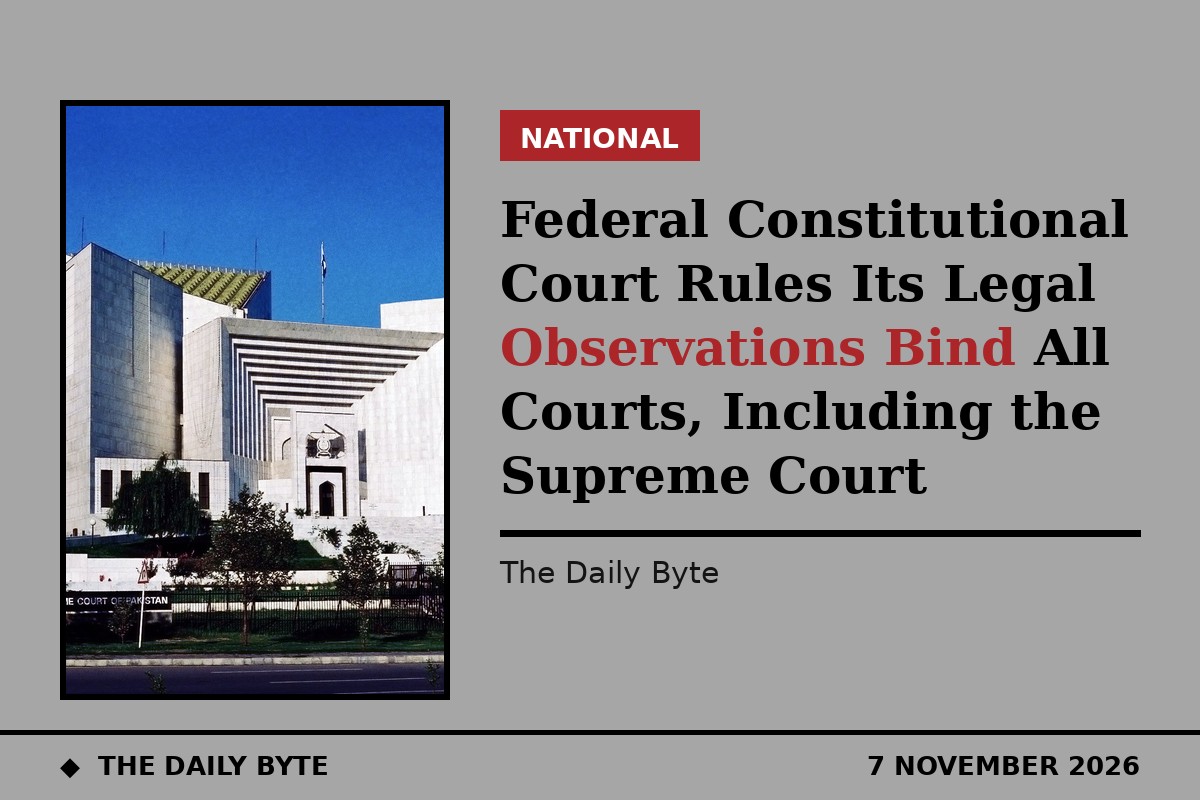
The Federal Constitutional Court (FCC) has ruled that its legal observations bind all courts in Pakistan, including the Supreme Court. The finding, in a 16-page judgment authored by Justice Aamer Farooq and reported on 5 November, rests on Article 189 of the Constitution as amended through the 27th Constitutional Amendment.
"When any observation made by this Court in any judgment or order has the effect of deciding a question of law or is based upon or enunciates a principle of law, it shall be binding on all courts, including the Supreme Court," the judgment says.
Ratio and obiter both covered
The ruling expressly covers both ratio decidendi — the reasoning essential to a decision — and obiter dicta, the remarks a judge makes along the way that were not necessary to the outcome. Treating obiter as binding is unusual in common-law systems, because it gives the force of law to observations made without full argument from both sides.
How the question arose
A three-member bench headed by Chief Justice Amin-ud-Din Khan delivered the judgment while deciding a case involving two permanent appointments in the Islamabad Capital Territory Private Educational Institutions Regulatory Authority. The court observed that Article 189(1) clearly establishes the binding authority of FCC judgments on all other courts whenever they determine a question of law or explain a legal principle.
A one-way hierarchy
The judgment follows one reported on 2 November in which the same court held that Supreme Court judgments are not binding on it and carry persuasive value only. Read together, the two rulings establish a one-way hierarchy: the Supreme Court's decisions guide the FCC, while the FCC's observations bind the Supreme Court.
Two courts, one relationship still unsettled
The FCC was created by the 27th Constitutional Amendment, and tension between the two benches has been evident since. The same court has also barred the Peshawar High Court from hearing detention cases under the Maintenance of Public Order Ordinance, including that of Khyber Pakhtunkhwa's non-functional chief minister. No response from the Supreme Court has been published, and it is not clear whether the binding effect attaches to legal observations made before the 27th Amendment took effect.