FCC Voids Sindh, KP Infrastructure Cess Laws
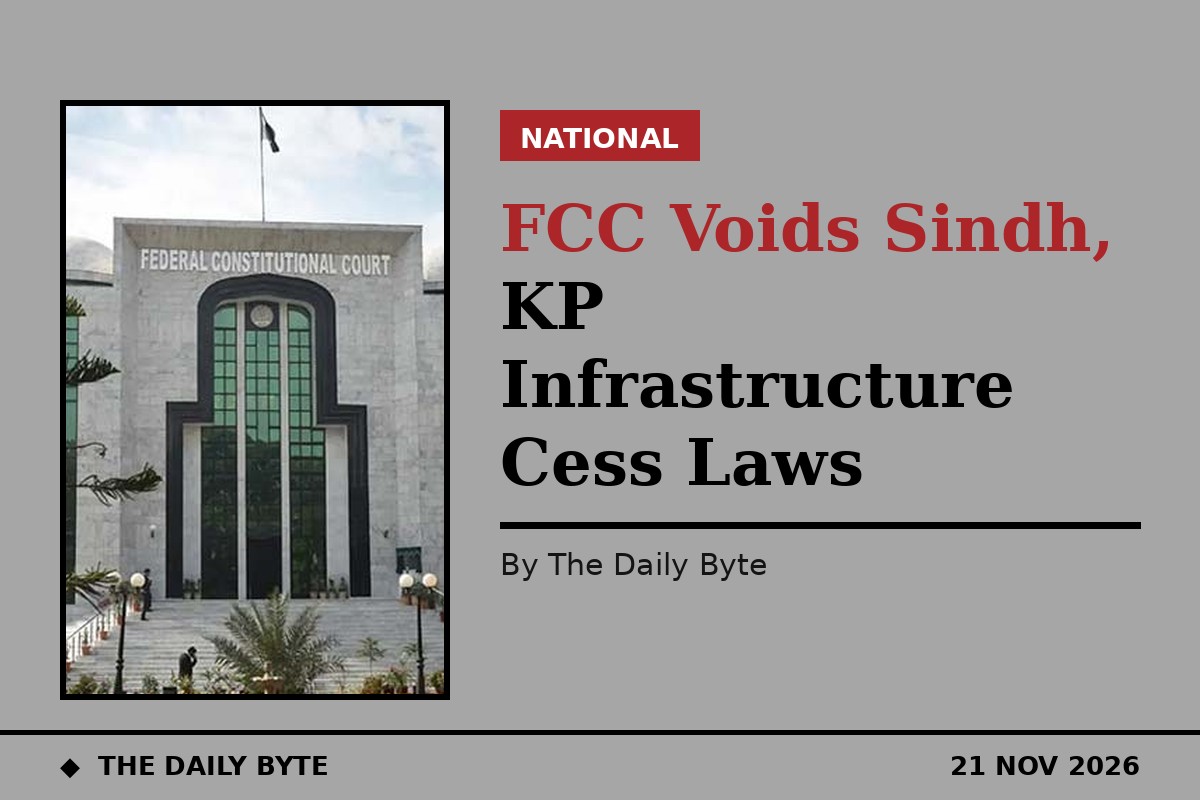
The Federal Constitutional Court has declared the infrastructure cess imposed by the governments of Sindh and Khyber Pakhtunkhwa unconstitutional, ruling that the provinces had no legislative power to impose it.
A two-member bench headed by Chief Justice Amin-ud-Din Khan and comprising Justice Aamer Farooq announced the reserved judgment on Thursday, 19 November. The court also set aside the judgments of the Sindh High Court and the Peshawar High Court, which had both upheld the levies.
The bench was hearing 568 appeals challenging the two high court decisions. The appeals concerned the Sindh Infrastructure Development and Maintenance Cess Act, 2017, and the Khyber Pakhtunkhwa Infrastructure Development Cess Act, 2022, including amendments introduced through the Finance Act, 2024.
The court held that imposing this type of cess falls outside the constitutional powers of the provincial governments. The petitioners, 568 importers, exporters and industrialists, had argued that the levy was in effect an export duty, which falls exclusively within the jurisdiction of the federal government.
A dispute that dates back to 1994
The dispute over the infrastructure cess in Sindh dates back to 1994 and was later given legal cover through the 2017 Act. Under that law, a cess was imposed on goods entering or leaving Sindh from abroad through air or sea routes. When the law was challenged, the Sindh High Court upheld the levy in a judgment dated 4 June 2021.
The Khyber Pakhtunkhwa government imposed its own cess on the transportation of goods within the province through the 2022 Act. The rate was later increased from one percent to two percent under Section 14 of the Finance Act, 2024, and the scope of the levy was also expanded. The Peshawar High Court, on 14 November 2025, dismissed 157 petitions challenging the legislation and upheld the validity of the provincial tax.
The appeals now decided were filed before the Federal Constitutional Court against those two judgments. The court’s reasoning, as reported, is rooted in Article 142(a) of the Constitution, read with the Fourth Schedule, which reserves customs duties and taxes on the international movement of goods for the federal legislature.
What the ruling means for business
The ruling strikes at a revenue stream that has been central to Sindh’s finances. Sindh levied a 1.85 percent cess on imports, which has generated more than Rs1.5 trillion over the past five years, according to a Federation of Pakistan Chambers of Commerce and Industry executive committee member.
For businesses, the decision could reverse outstanding liabilities. According to an Arif Habib Limited report, eleven Pakistan Stock Exchange-listed companies, including Fauji Fertilizer Company, Indus Motor Company and Honda Atlas Cars, could benefit from about Rs42.9 billion in tax relief as cess liabilities are reversed and financing costs fall.
The court announced a short verdict, and the detailed judgment is yet to be issued. Companies are expected to wait for the detailed reasons before reversing liabilities already recognised in their accounts, and the ruling could still face review petitions.
Why the court struck the laws down
The central question was whether a province can tax goods crossing the customs frontier. The court held that the infrastructure cess effectively functioned as a customs duty because it was imposed on the international movement of goods and collected during customs clearance, and that a province could not build a fiscal barrier within the national trading system by presenting it as infrastructure compensation.
The judgment also held that retrospective provisions cannot cure a legislature’s lack of competence, declaring the corresponding charging provisions, along with dependent rules, notifications, assessments and recovery measures, unconstitutional and without lawful authority.
The case was first filed in the Supreme Court and later transferred to the Federal Constitutional Court, which was created in November 2025 and holds exclusive jurisdiction over constitutional interpretation and disputes between the federal and provincial governments.