Fed December Hike Bets Shift as 50bp Move Priced Out
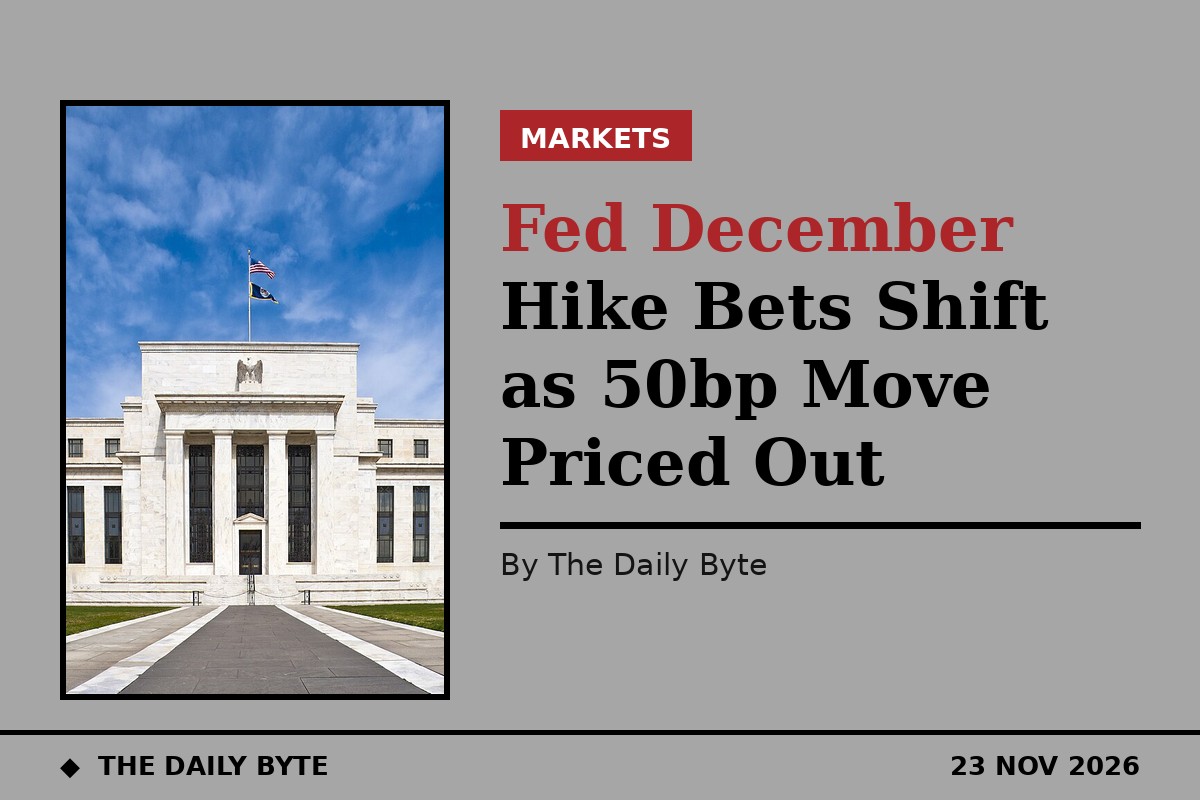
Traders have abandoned bets on a half-point interest-rate rise from the United States Federal Reserve in December, after one of the worst weeks for American shares since the pandemic swept through financial markets. Fed funds futures now assign essentially no chance to a 50-basis-point increase at the central bank's December meeting, a sharp reversal from only ten days ago, when the same outcome carried roughly a 10 per cent probability, according to CME FedWatch data cited by CoinDesk.
The repricing leaves a smaller quarter-point rise as the expected outcome. Such a move would lift the Fed's benchmark rate to a range of 4.00 per cent to 4.25 per cent. Market pricing reported by Cointelegraph on 23 November put the probability of a quarter-point December increase at 91.2 per cent. The Federal Open Market Committee meets on 8 and 9 December, with its decision due on 9 December.
What the futures market now expects
The speed of the shift has startled even seasoned market watchers. Eleven days ago, investors were pricing about a 15 per cent chance of a half-point increase and no chance at all of the Fed holding rates steady, according to the pseudonymous macro commentator The Macro Paper. Now the half-point move is, in that account's words, completely off the table, while the probability of no increase at all has jumped to about 12 per cent.
Nor do traders expect the tightening to stop in December. Futures imply a nearly 60 per cent chance of another quarter-point increase in January, which would take the target range to 4.25 per cent to 4.50 per cent. JPMorgan, by contrast, expects one further rise in March, pointing to a slower but still continuing path of tightening rather than a turn towards lower rates.
The backdrop is a market that has turned sharply against risk. The Nasdaq fell 10.4 per cent last week, its steepest weekly decline since the March 2020 Covid crash, while the VIX, Wall Street's gauge of expected volatility, jumped 86 per cent, one of its four largest weekly advances since 2004. Losses spread well beyond American equities: global shares retreated, and gold, copper and commodity-linked currencies all sold off hard. Bitcoin was not spared, dropping below 55,500 dollars at one point before recovering above 60,000 dollars.
A brutal week changed the maths
The sell-off has reframed the debate inside and around the Fed. In October, the central bank held its target range at 3.75 per cent to 4.00 per cent in a 10-2 vote, with Governors Lisa Cook and Beth Hammack dissenting in favour of a quarter-point increase. The minutes of that meeting showed almost all participants judged that further increases would probably be appropriate under their baseline outlook. Fed Governor Christopher Waller had even argued for a larger half-point move, the very step the market has now priced out.
But the scale of last week's losses has given the hawks pause in the eyes of investors. Swaps markets priced out expectations of further Fed hikes as concerns about economic growth intensified, effectively removing any bet that the central bank could raise rates by half a point in December, Bloomberg reported. The episode underlines how tightly the Fed's next move is now bound to financial conditions: when markets fall hard enough, the expected path of rates moves with them.
Ackman and Bessent warn of a policy mistake
The debate spilled into public view over the weekend. Billionaire investor Bill Ackman, chief executive of Pershing Square, warned on 22 November that the Fed was about to make another mistake on 9 December, arguing that financial conditions had tightened sharply. Treasury Secretary Scott Bessent also weighed in, telling broadcaster CBS that hawkish remarks from Fed officials had been one factor behind the stock sell-off.
The warnings carry weight because they come from very different corners of the market: Ackman as a prominent investor, Bessent as the administration's most senior economic official. Both are, in effect, arguing that the central bank risks doing too much, too fast, at a moment when markets are already signalling distress. Their interventions add political pressure to a decision the Fed insists will be driven by data.
Citi sees one last hike, then cuts
Not every forecaster expects the tightening to run on. Citigroup's United States economists, Andrew Hollenhorst and Veronica Clark, said in a research note released on 20 November that the Fed would raise rates by 25 basis points to 4.00 per cent to 4.25 per cent on 9 December and then stop raising rates altogether. The bank expects the Fed to cut rates by 25 basis points in three separate moves in June, September and December 2027, bringing the policy rate down to a range of 3.25 per cent to 3.50 per cent by the end of 2027.
That view rests on a judgement that the decline in the two-year Treasury yield, alongside the slide in American shares, reflects the market pricing in a risk that a slowdown in artificial-intelligence-related investment will drag down United States economic growth. If that slowdown materialises, further rate rises would risk deepening it, and the case for cuts next year would strengthen.
What to watch next
The next catalyst is this week's release of core personal consumption expenditures data, the inflation measure the Fed watches most closely, due on Wednesday. If the figures show lingering price pressure, traders could bring back bets on a larger half-point rise; a softer reading could cool expectations of an outsized hike and give investors a reason to step back in. The Royal Bank of Canada expects inflation to accelerate, while analysts at eToro have said softer data could steady nerves.
For now, the market's message is clear: the half-point December hike is gone, the quarter-point rise is the base case, and the argument over whether the Fed should be raising rates at all is only getting louder. The decision on 9 December will show whether the central bank agrees. Bloomberg first reported the collapse in half-point hike bets, and CoinStats reported the warnings from Ackman and the market pricing behind them.