Fed's Daly: More Rate Hikes Likely, But No Rush
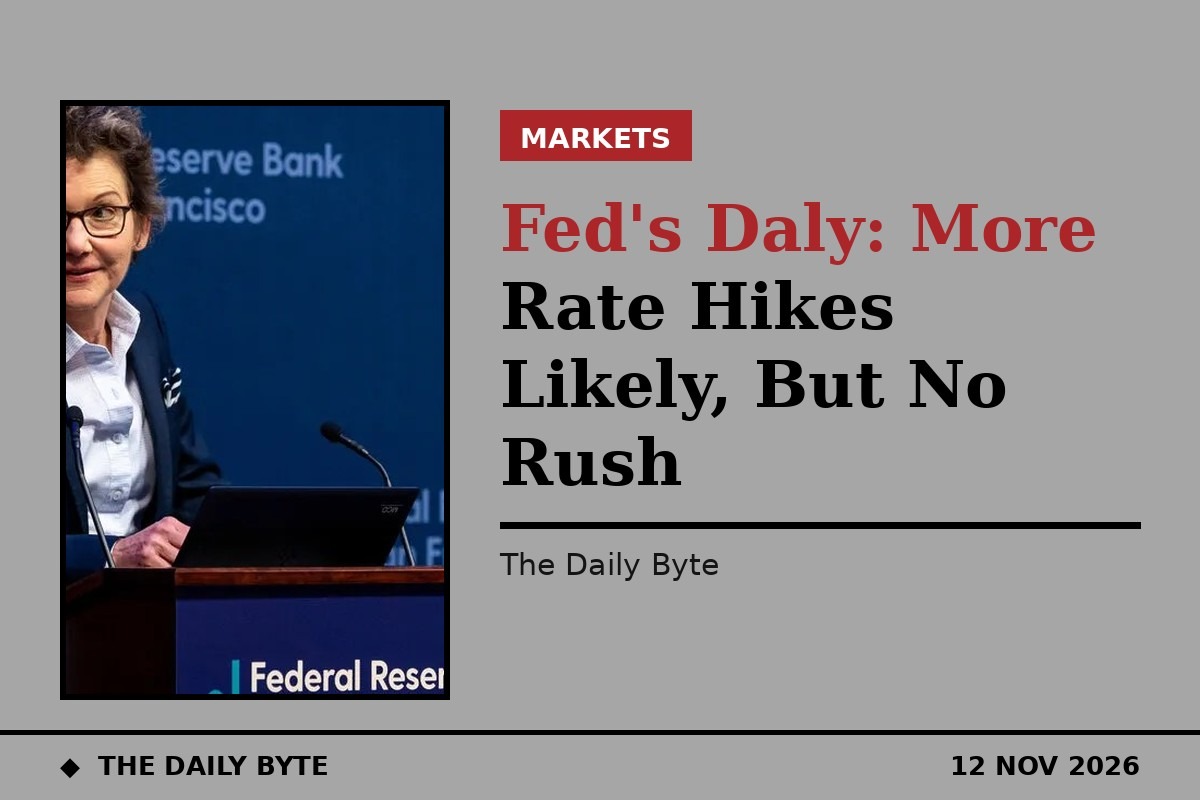
San Francisco Federal Reserve President Mary Daly said on Thursday that the US central bank will probably need to raise interest rates further to deal with elevated inflation, but she made clear she is in no hurry to act.
Speaking at the Stanford Institute for Economic Policy Research, Daly said her bias was that further tightening would be needed, while stressing that policymakers had time to make careful, calibrated decisions.
Her comments came days after hotter-than-expected US inflation data pushed traders to price in a further rate rise at the Federal Reserve's December meeting, and as the yield on the 10-year US Treasury note climbed above 5.1 per cent.
Services inflation is the worry
Daly said price pressures were spreading beyond energy and goods and into services, where inflation can be very sticky once it takes hold.
"We have a labor market that's stable, growth that's good, but we definitely have an inflation problem right now," she said.
A Bureau of Labor Statistics report earlier this week showed core consumer prices, which exclude food and energy, rose by 0.3 per cent in October for the third month in a row. The Federal Reserve targets 2 per cent inflation as measured by the 12-month change in the personal consumption expenditures price index.
Daly added that the Fed could not change its mandate simply because it disliked the outcome, and said she wanted more confidence that the disinflation process was firmly under way.
No rush — and bond yields are helping
Unlike some of her colleagues, Daly did not join calls for bigger or faster rate rises at the Fed's December 8-9 policy meeting. Instead, she welcomed the recent rise in longer-term bond yields, which tightens financial conditions on its own.
"Rising bond yields are most welcome," she said, adding that tighter financial conditions "gives us a little more time to make really calibrated decisions."
"I think the markets are assisting in making sure that we're bringing inflation down — but our job is not done," Daly said. "That's why I have said that my bias is to have additional tightening, but exactly how much and exactly when … we have many more pieces of data and information over many, many quarters."
A stable jobs market gives the Fed room
Daly pointed to a labour market that remains solid. Separate data from the US Labor Department on Thursday showed weekly initial jobless claims rose by 9,000 to 200,000 in the week ended November 7 — slightly above forecasts, but still low by historical standards — while continuing claims fell by 20,000 to 1.697 million.
That combination — steady hiring, firm growth and stubborn inflation — is why the Fed can afford to wait for more evidence before moving, Daly suggested, even as its bias remains towards tighter policy.
What it means for December
Attention now turns to Friday's producer price data for October, the next test of whether inflation pressures are easing. The Fed's December 8-9 meeting will be the first chance for policymakers to act on the latest run of hot price figures.
Daly's message was that the direction of travel is clear — rates are more likely to go up than down — but the pace will be deliberate. Markets, she argued, are already doing some of the Fed's work for it through higher yields.