Fed's Waller backs December hike, 50bp if CPI hot
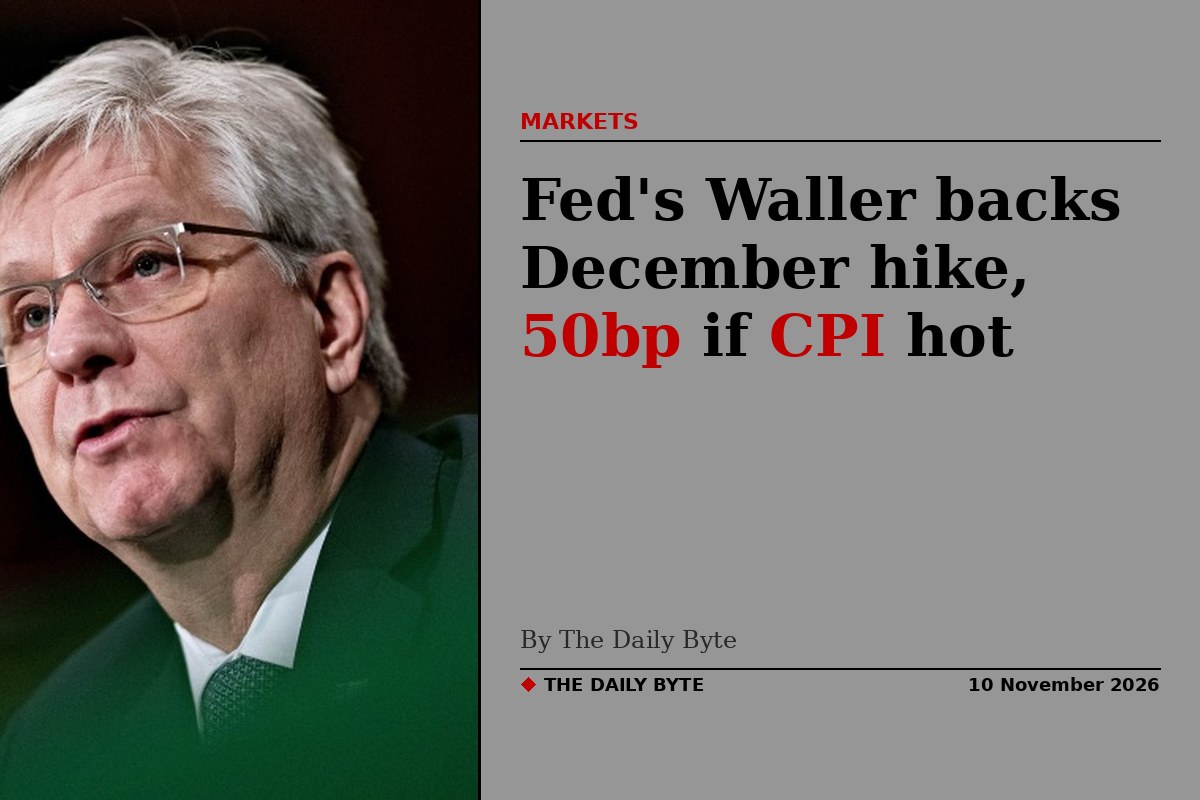
Federal Reserve Governor Christopher Waller said on Tuesday that he would support an interest rate rise at the central bank's December meeting even if October inflation comes in cooler than September, and that a larger half-point move should be considered if price pressures stay hot. The remarks, delivered in a speech in London hours before the release of October consumer prices, hardened market expectations of a December increase.
Waller told the Bank of England Watchers' Conference that his base case was a quarter-point rise at the Federal Open Market Committee meeting on 8 and 9 December. Reuters reported his words: "While I am hoping for an improvement over September, even if this occurs, I would still support a 25 basis point increase in the FOMC's policy rate at our December meeting."
Waller sets a clear test for a half-point move
Waller drew a precise line for when a bigger step would be justified. If core consumer prices, which strip out food and energy, rise by 0.3% or more from September, he said a 50 basis point increase should be considered at the December meeting. Core prices rose 0.3% in each of the previous two months.
"In that case, I believe a 50 basis point hike in the policy rate should be considered at the December meeting," Waller said, adding that anything less would risk hurting the Fed's inflation-fighting credibility at a time when inflation is too high and appears to be broadening out.
Economists polled by Reuters expected a more modest outcome: headline consumer prices up 0.3% on the month and core prices up 0.2%. That leaves the consensus just below Waller's trigger, so a single tenth of a percentage point in the core reading could separate a quarter-point rise from a half-point one. There will be no official annual inflation rate, because October 2025 price collection was disrupted by last year's government shutdown.
Markets already expect a December rise
Investors had already moved a long way towards pricing in a December increase before Waller spoke. Futures contracts that settle to the Fed's policy rate pointed to about an 85% chance of a rise at the December meeting as of Monday's close, taking the target range to 4.00% to 4.25% from 3.75% to 4.00%, with a better-than-even chance of a further rise as soon as March.
CoinDesk reported that traders were pricing 25 basis points of tightening for 9 December, and that Waller had fuelled that outlook by saying he favoured a higher rate even if inflation cooled last month.
Waller backed the Fed's decision in October to leave rates unchanged, in part because policymakers had already signalled further tightening. He warned that failing to deliver the increases markets expect would itself loosen financial conditions. "If, however, the hikes are not carried out, markets will reduce expectations of rate hikes and rates will immediately fall, which would loosen monetary policy in an undesirable way," he said.
Inflation is still too high, Waller says
The governor's concern is the breadth of price increases rather than a single month's figure. The Fed targets 2% annual inflation as measured by personal consumption expenditures, but September's reading was 3.7%, and core PCE inflation rose 3.1% from a year earlier. More than 70% of the components of core PCE services inflation rose by 3% or more in September, Waller said.
"Later today, I will be looking to see whether this breadth of elevated inflation continues, including whether high-tech goods prices related to the AI buildout continue to rise at the very high rate of recent months," he said. He will also watch whether higher energy prices are passing through to goods and services, and warned that recent Fed staff analysis suggests energy shocks may now push prices up for longer than they did before the pandemic.
On the wider economy, Waller was more upbeat. He described the labour market as solid, with worker demand and supply in rough balance and unemployment at 4.1%, and said output would continue to grow at a solid pace even as consumer spending cools. US gross domestic product grew at a 3.4% annualised rate last quarter.
One governor does not decide alone
Waller's view is not the committee's decision. The December move needs broader support on the Federal Open Market Committee, which voted 10 to 2 to hold rates steady in October after raising them by a quarter point to 3.75% to 4.00% on 16 September. Other policymakers have not yet signalled support for a half-point step.
For now, the October inflation data will set the terms of the debate. A core reading of 0.2% keeps the quarter-point rise as the base case. A reading of 0.3% or more puts Waller's half-point option firmly on the table for 9 December.