Infrastructure Cess Struck Down in Sindh and KP
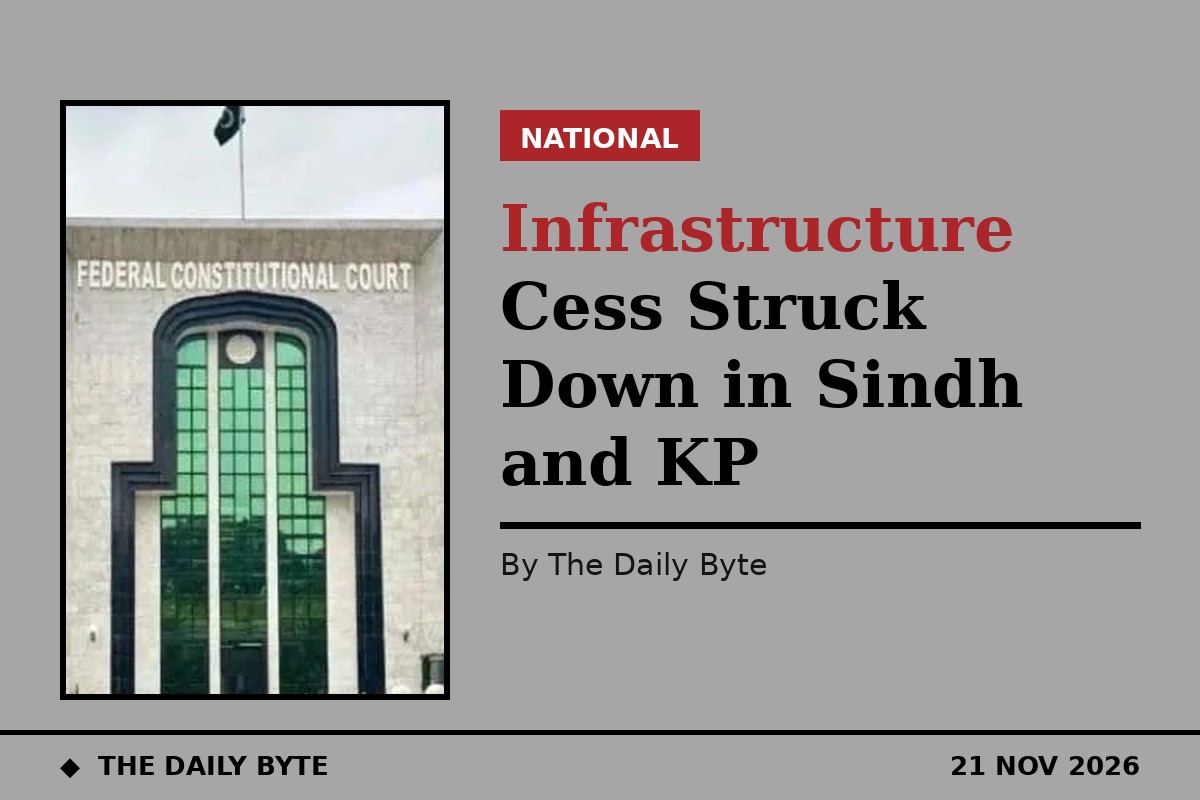
Pakistan's Federal Constitutional Court has declared the infrastructure cess imposed by the governments of Sindh and Khyber Pakhtunkhwa unconstitutional, ending a tax dispute that has run for more than a decade and could hand listed companies billions of rupees in relief.
A two-member bench headed by Chief Justice Amin-ud-Din Khan, with Justice Aamer Farooq, announced the reserved judgment on Thursday, 19 November. The court set aside earlier rulings by the Sindh High Court and the Peshawar High Court that had upheld the levies, and held that imposing this kind of cess falls outside the constitutional powers of the provincial governments.
The judgment was delivered in 568 appeals brought by importers, exporters and industrialists who had challenged the Sindh Infrastructure Development and Maintenance Cess Act, 2017, and the Khyber Pakhtunkhwa Infrastructure Development Cess Act, 2022, including amendments made through the Finance Act, 2024. The petitioners argued that the levy was, in effect, an export duty, which falls exclusively within the federal government's jurisdiction.
Why the court struck the levy down
The court reasoned that the infrastructure cess functioned as a customs duty because it was charged on the international movement of goods and collected through customs clearance. Since customs falls under federal authority, the provinces did not have the legislative power to impose it.
The court further held that directing the proceeds toward provincial infrastructure did not by itself create a valid provincial taxing power, especially where there was no direct link between the charge and specific provincial services. The provinces had defended the laws as provincial levies meant to pay for roads and infrastructure, but the court did not accept that argument.
A dispute running since 1994
The dispute over the infrastructure cess in Sindh dates back to 1994 and was later given legal cover through the 2017 Act, under which a cess was imposed on goods entering or leaving Sindh from abroad through air or sea routes. When the law was challenged, the Sindh High Court upheld it in a judgment dated 4 June 2021.
Khyber Pakhtunkhwa imposed its own cess on the transportation of goods within the province through the 2022 Act. The rate was later raised from one percent to two percent under Section 14 of the Finance Act, 2024, and the scope of the levy was expanded. The Peshawar High Court dismissed 157 petitions challenging the legislation on 14 November 2025 and upheld the tax. The appeals decided on Thursday were filed against those two judgments.
What it could mean for listed companies
Eleven companies listed on the Pakistan Stock Exchange could collectively see tax relief of roughly Rs43 billion after the ruling, according to an analysis by Arif Habib Limited. The brokerage estimates the total outstanding Sindh infrastructure cess liability of the 11 companies at Rs42.9 billion, and says reversing those liabilities could save about Rs5.15 billion a year in finance costs, based on a 12 percent interest rate.
Fauji Fertilizer Company carries the largest individual exposure, accounting for approximately 27 percent of the total liability, with an estimated per-share benefit of Rs6.05. Indus Motor Company has the highest per-share upside at an estimated Rs47.37, followed by Honda Atlas Cars at Rs25.47. The other companies in the analysis are Nishat Mills, D.G. Khan Cement, Lucky Cement, Lotte Chemical, Engro Fertilizers, LCI, EPCL and International Industries.
Companies that signed settlement agreements in February 2026 have already recorded Rs16.7 billion of the amount as present value gains. The ruling may yet face a review petition from the authorities, and companies are expected to wait for the court's detailed judgment, which is still to be issued, before deciding whether to reverse liabilities they have already recognised.