Fiji Develops AI Frameworks for Civil Service
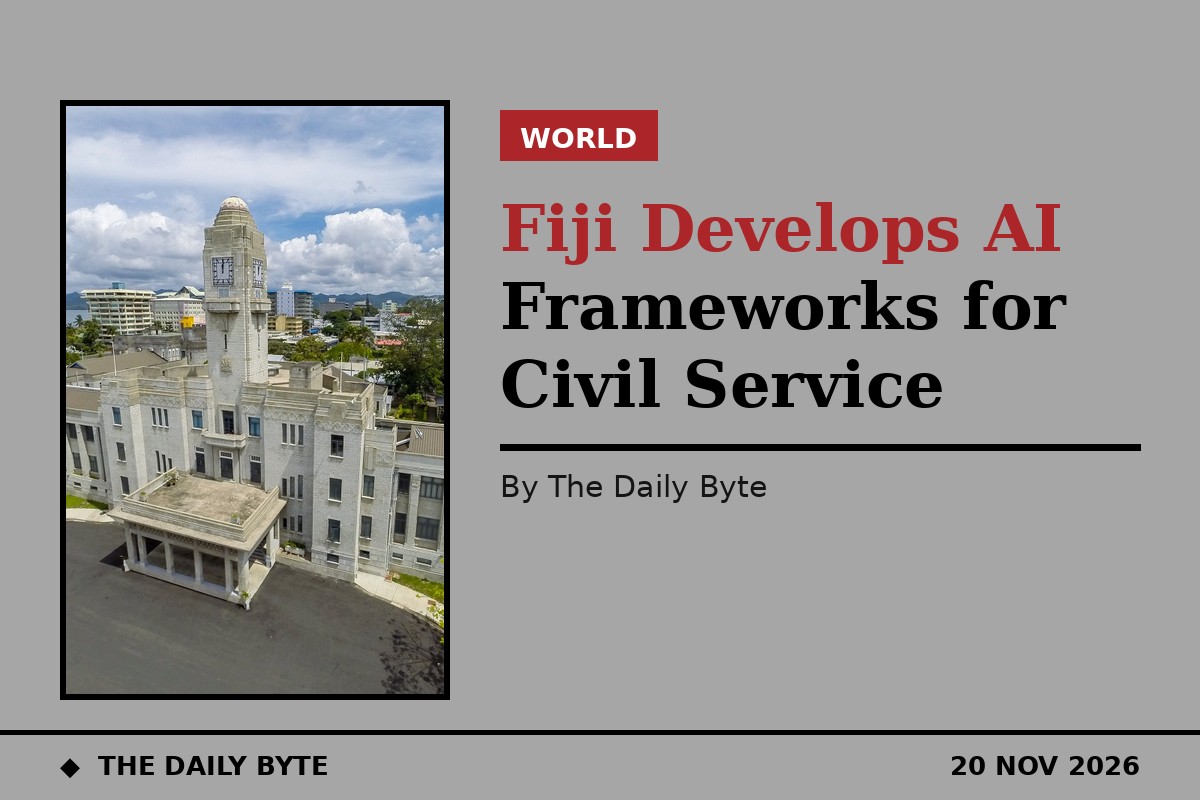
Fiji is developing three frameworks to govern how artificial intelligence is used across its civil service, as the Pacific island nation accelerates a plan to take hundreds of public services online. The frameworks were announced on Friday by the Minister for Communications, Ioane Naivalurua, who said they would set clear rules for the adoption of AI inside government institutions.
The three instruments are the Fiji Civil Service AI Policy, the AI Competency Framework and the AI Governance Framework. Together they are intended to make sure AI is used ethically, transparently and accountably, and that new tools serve government priorities and public expectations rather than running ahead of them.
Three instruments, one rulebook
Naivalurua said the frameworks would give public servants practical guidance on when and how to use AI in their daily work. “These frameworks will guide public servants in the ethical, transparent, and accountable use of AI, while ensuring that innovation remains aligned with government priorities and public expectations,” he said, according to Fiji Broadcasting Corporation News.
About 40 participants are involved in shaping how AI is used across government agencies, FBC News reported, with the aim of making sure the technology delivers better results for the public. Varunesh Rao, a programme specialist with UNESCO, said strong policies and safeguards had to keep pace with the growing use of AI in the public sector.
The work sits inside Fiji’s National Digital Strategy 2025-2030, which lists digital infrastructure, digital inclusion, innovation-led economic growth, smart governance and digital public services as its priorities. The strategy also covers a unified online services portal, better data-sharing between agencies and stronger cybersecurity.
Digitising 385 services by 2030
A government-wide assessment has identified 788 services across ministries and agencies, of which 385 are targeted for digitisation by 2030. Officials say the shift should cut administrative costs and paperwork, shorten waiting times and improve access to services, particularly for people in remote and maritime communities spread across Fiji’s islands.
Fiji told a United Nations dialogue on AI governance in July that 96 percent of its population is now connected, with more than 85 percent using digital technologies, and that a national AI framework was already in development. The same statement acknowledged the gaps that remain: about four percent of people in deep mountain interiors and across 110 remote islands are still unconnected, alongside a 15 percent usage gap.
Safety, skills and data protection
The AI frameworks are part of a wider package of digital safeguards. In August, Naivalurua told parliament that work was moving ahead under both the National Digital Strategy and the National Cybersecurity and Resilience Strategy 2026-2031, and that a national identification initiative was also progressing.
Fiji has set up a National Computer Emergency Response Team and a round-the-clock Government Network and Security Operations Centre. Work is also continuing on a review of the Online Safety Law, focused on protecting children online, while a data protection law is advancing through the system.
No start date or completion date for the three AI frameworks was given in the reports. The emphasis, for now, is on getting the rules and the skills in place before AI use spreads further through the civil service, so that the technology is adopted on the government’s terms rather than by default.