Fine Gael united Ireland plan costs up to €25bn in year one
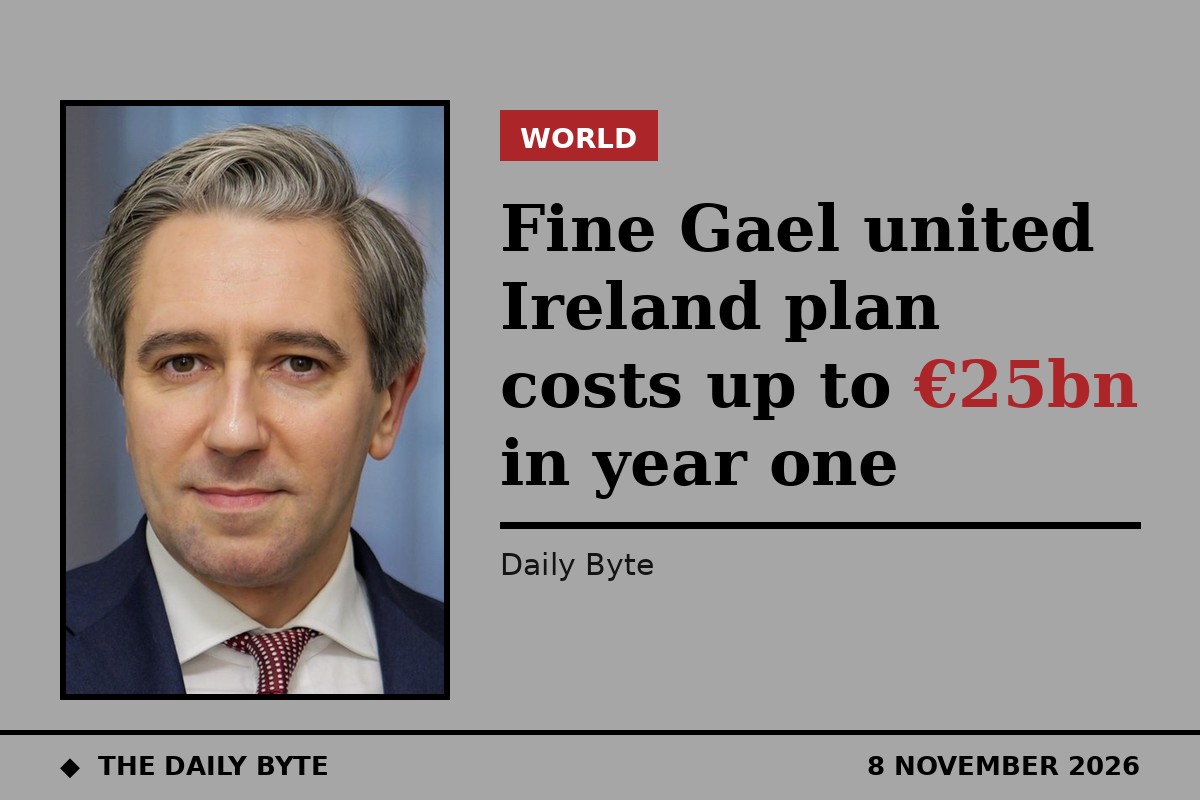
Fine Gael has published its blueprint for a united Ireland, putting a price on unification for the first time and calling for preparations to begin now, well before any border poll is called. The plan was unveiled by party leader and Tánaiste Simon Harris at the party's Ard Fheis in Cork on Saturday, 7 November.
The blueprint warns that a united Ireland could cost the Irish exchequer up to €25 billion in its first year. Economic modelling compiled by Stephen Kinsella, professor of economics at the University of Limerick, puts the year-one cost at between around €3.2 billion and €25 billion, depending on the design of unification, the deal struck with the United Kingdom, and how pay, pensions and public services are harmonised. The document argues that economic policy must sit at the centre of any debate about the island's future, because significant financial resources would be needed whatever model is pursued.
Fine Gael's plan proposes a new minister of state for north-south relations and a standing constitutional forum to examine how unification would work in practice for healthcare, education and other public services. It also recommends moving lead responsibility for long-term constitutional planning from the Department of Foreign Affairs and Trade to the Department of the Taoiseach, where a dedicated constitutional planning unit would be set up. Work on the blueprint was overseen by Emer Currie, the Fine Gael TD who chairs the party's Northern Ireland engagement group.
Harris told delegates that Fine Gael is the united Ireland party, and that preparations must start now rather than waiting for a referendum to be called. Under the coalition agreement with Fianna Fáil, Harris is due to return as Taoiseach in late 2027, and a party source said the plans would be brought to the parliamentary party next year so he can pursue them from that office. Around 1,200 members gathered in Cork for the Ard Fheis, the party's first since 2024, debating more than 450 motions across the weekend.
The launch comes days after Taoiseach Micheál Martin set out a separate Fianna Fáil initiative to examine the constitutional future of the island. Martin's Futures Study Initiative will explore three scenarios: a single unitary republic based in Dublin, in place within a maximum of five years of a unification referendum; an all-island state with devolved government in Northern Ireland, similar to the arrangements under Strand One of the Good Friday Agreement; and a continuation of the status quo, with long-term cooperation under the agreement and no constitutional change. A chairperson is to be appointed to oversee the work, and the initiative will not recommend a single proposal.
Under the Good Friday Agreement, the Secretary of State for Northern Ireland may call a referendum on reunification when it appears likely that a majority would vote in favour. Recent polling has suggested that prospect may be closer than before, although no border poll has been called. Harris also used his keynote speech in Cork to set out plans on law and order, a new benefit to protect parents' incomes during time with newborn children, and a tougher response to illegal immigration.
Fine Gael's intervention puts the party in direct competition with Sinn Féin, long the loudest voice for Irish unity, but Harris framed his party's approach around the principle of consent and its historical role in seeking unity through agreement. The blueprint is the most detailed statement yet from a governing Irish party on what unification would actually cost and how it would be organised.