Rare Essex moth hits record 111 sightings in 2026
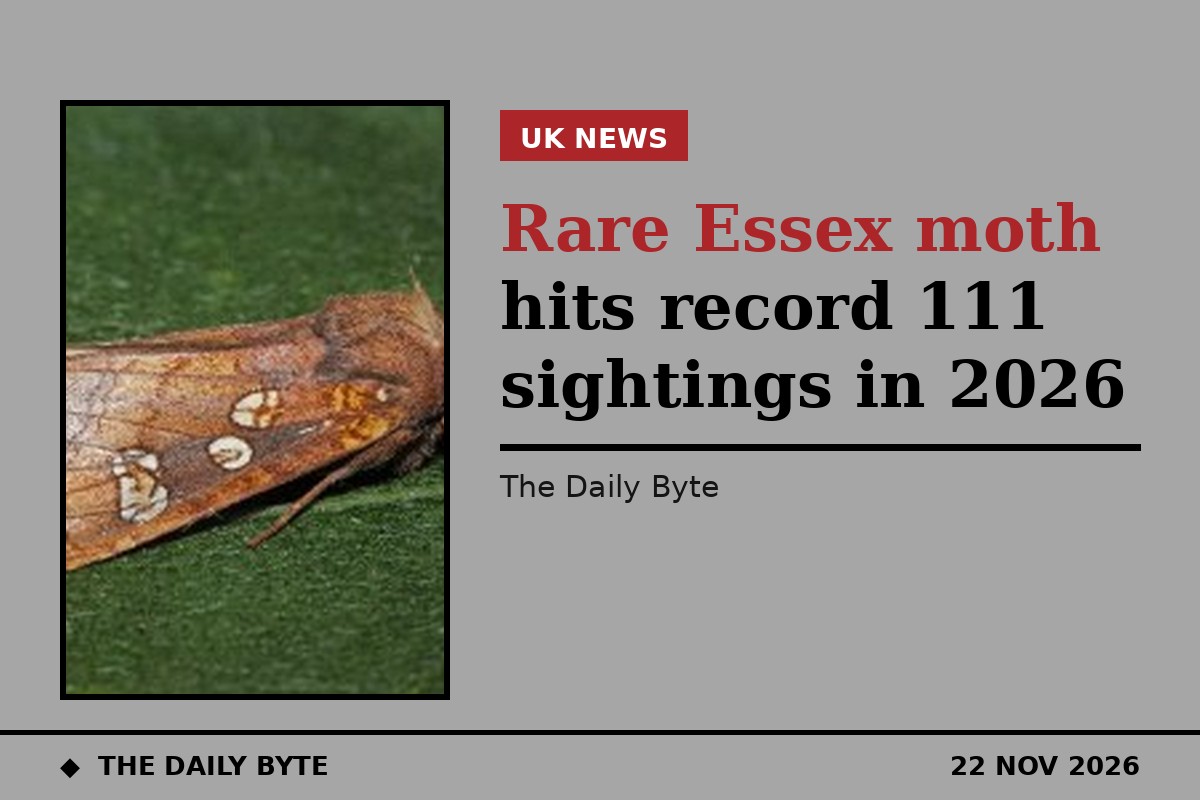
A record 111 Fisher's estuarine moths have been recorded at Abbotts Hall nature reserve in Essex in 2026, the highest count in the 21-year history of a project to save one of Britain's most threatened insects. Essex Wildlife Trust says it is now confident the population at the site is self-sustaining.
The moth, with pale gold-brown wings marked with light and dark spots, was counted during night surveys in September 2026. More than 100 were recorded at Abbotts Hall for the first time in 2025, and this year's total of 111 has beaten that record.
A 21-year rescue effort
The project began in 2005, when Essex Wildlife Trust, Natural England, the Environment Agency, Tendring District Council, Butterfly Conservation and Colchester Zoo joined forces to find and create new habitat for the moth in places less exposed to rising sea levels.
Hog's fennel was planted at Abbotts Hall in Great Wigborough, near Colchester, in 2005. After five years of planning and monitoring the plants, the moth's eggs were introduced at the site in 2010, supplied from a captive breeding programme at Colchester Zoo.
Progress was slow at first. Only three moths were recorded in the first year, and numbers stayed in single figures until 2014, when 20 were counted. Numbers have risen steadily since, passing 100 for the first time in 2025.
Dr Zoe Ringwood, senior conservation evidence manager at Essex Wildlife Trust, called the result an important success story and a reflection of how evidence-based conservation action can achieve positive results for a threatened Essex species.
Why the moth depends on hog's fennel
The Fisher's estuarine moth is completely reliant on hog's fennel, a rare plant that is its sole caterpillar foodplant. The plant grows up to five feet tall, with feathery leaves and yellow flowers that bloom in the summer, but it is not salt-water tolerant and needs to grow further inland as sea levels rise.
The moth was previously found only on isolated sites on the north Essex and north Kent coasts, low-lying land vulnerable to coastal flooding and increasing storm surges. One of its main strongholds, Skipper's Island nature reserve in the Walton Backwaters, is inaccessible to the public and has suffered considerable coastal erosion.
Each year the population is monitored by searching hog's fennel plants for frass volcanoes in July and August. These are piles of caterpillar droppings formed at the base of plants when the caterpillar bores into the rootstock. The adult moths are then monitored through nocturnal surveys when they emerge each September.
What happens next
New locations are regularly sourced for planting further hog's fennel plots, including at Fingringhoe Wick Nature Discovery Park and Wrabness nature reserve. In October 2026, Essex Wildlife Trust worked with local farmers and a group of Brownies in Tollesbury at Hunts Farm to create a new hog's fennel plot, with the children spreading seeds across the site.
The Trust says it will keep surveying new and existing plots to monitor the population and ensure the moth has a future on the Essex coast. The record count was reported by Essex Wildlife Trust, and the record-breaking 2026 survey season was also covered on 22 November 2026.
Frequently asked questions
Where was the record set? At Abbotts Hall nature reserve in Great Wigborough, near Colchester in Essex, where 111 Fisher's estuarine moths were recorded in 2026.
Why is the moth so rare? It lives only on low-lying coastal grassland in north Essex and north Kent, and its caterpillars feed solely on hog's fennel, a rare plant threatened by rising sea levels and coastal erosion.
What is hog's fennel? Hog's fennel is a rare plant that grows up to five feet tall with feathery leaves and yellow summer flowers. It is the Fisher's estuarine moth's only caterpillar foodplant.