FPI Inflows of Rs45,970 Crore Lift India's Nifty 8.6%
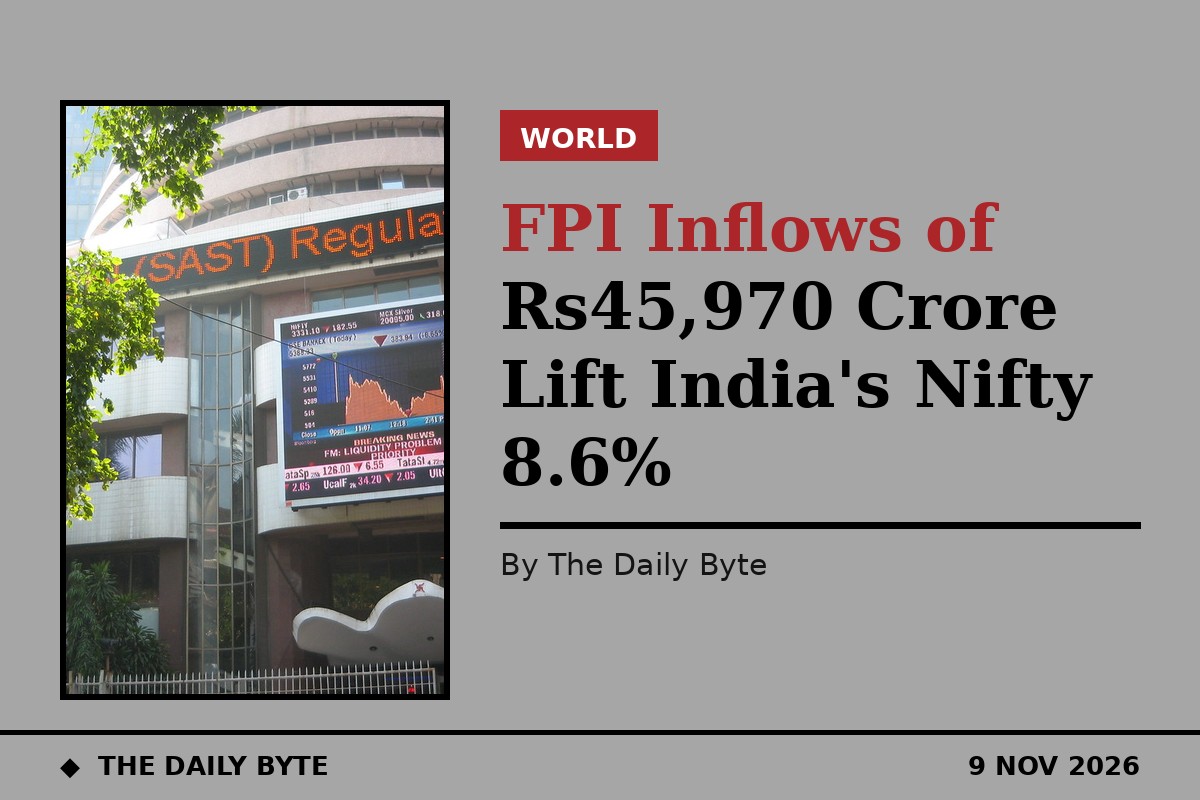
Foreign portfolio investors have poured a net Rs45,970 crore into Indian equities in November 2026 so far, as a sharp global sell-off in artificial intelligence stocks redirected capital towards India, widely seen as a market with limited direct exposure to the AI infrastructure boom. The buying spree propelled the Nifty 50 up 8.6 per cent across five consecutive sessions, closing the week at 25,030.35.
Data from Bloomberg shows India was the top recipient of foreign equity inflows among emerging markets in the first week of November, with net investments of $4.11 billion. The next highest inflow went to Dubai, at $165 million, while Malaysia, Qatar and the Philippines recorded marginal net inflows. By contrast, Taiwan recorded the largest outflow at $15.7 billion, followed by South Korea at $7.93 billion, and Thailand, Indonesia, Vietnam and Brazil also saw net outflows.
AI sell-off drives the rotation
The global rout in AI-linked stocks began in the United States, where fears over runaway data-centre spending unsettled investors. Market participants expect the Democrats, who won both chambers of Congress, to push for regulatory guardrails on artificial intelligence and to curb indiscriminate data-centre expansion. The sell-off then spread through other AI-intensive markets, including South Korea, Taiwan and Japan, prompting a rotation of capital into markets less exposed to the theme.
India's equity market, which carries relatively modest direct exposure to global AI infrastructure spending, emerged as a primary beneficiary. Dr V K Vijayakumar, chief investment strategist at Geojit Investments, attributed the surge to a combination of factors, saying that impressive earnings growth in India and attractive large-cap valuations made the country a favoured destination for foreign money.
Foreign investors concentrated their buying in index heavyweights across financials, information technology, automobiles and telecom. The aggressive inflows also triggered a significant short squeeze, as bearish positions were unwound, amplifying the market's upward move. Among Nifty 50 stocks, non-banking financial companies gained the most in the first week of November. Shriram Finance led the index constituents, rising 15.26 per cent, followed by Mahindra and Mahindra at 14.65 per cent and Bajaj Finance at 13.75 per cent. Reliance Industries and Jio Financial Services advanced around 12.6 and 12.5 per cent respectively.
Broad gains, but domestic investors sold
The Bank Nifty rose 8 per cent over the week, while broader markets underperformed the large-cap rally: the Nifty Midcap 100 closed 5.8 per cent higher and the Nifty Smallcap 100 added 2.8 per cent, suggesting the rally was primarily driven by large-cap stocks.
The week also saw a complete reversal of institutional roles. Domestic institutional investors turned net sellers on all five sessions, while foreign portfolio investors turned aggressive buyers, a sharp departure from the trend that had dominated much of the year. The rupee's appreciation of 1.94 per cent against the dollar since 12 October, helped by falling crude oil prices, may also have supported the inflows, along with speculation about a possible cut in long-term capital gains tax levied on foreign investors.
Analysts caution that the sustainability of the inflows remains the critical question. Madan Sabnavis, chief economist at Bank of Baroda, said one week is too short a period to ascertain patterns, adding that firm conclusions can only be drawn if inflows sustain for the next few months. With heavy domestic profit-booking leaving the rally heavily reliant on continued foreign support, market participants are watching Brent crude prices and developments surrounding US-Iran tensions as the main near-term risk factors. Karan Marwah, partner at Grant Thornton Bharat, said the appetite for non-AI stocks is fuelling the return of foreign investors to Indian markets as a de-risking and diversification strategy.


