France 2027 candidates face public services test
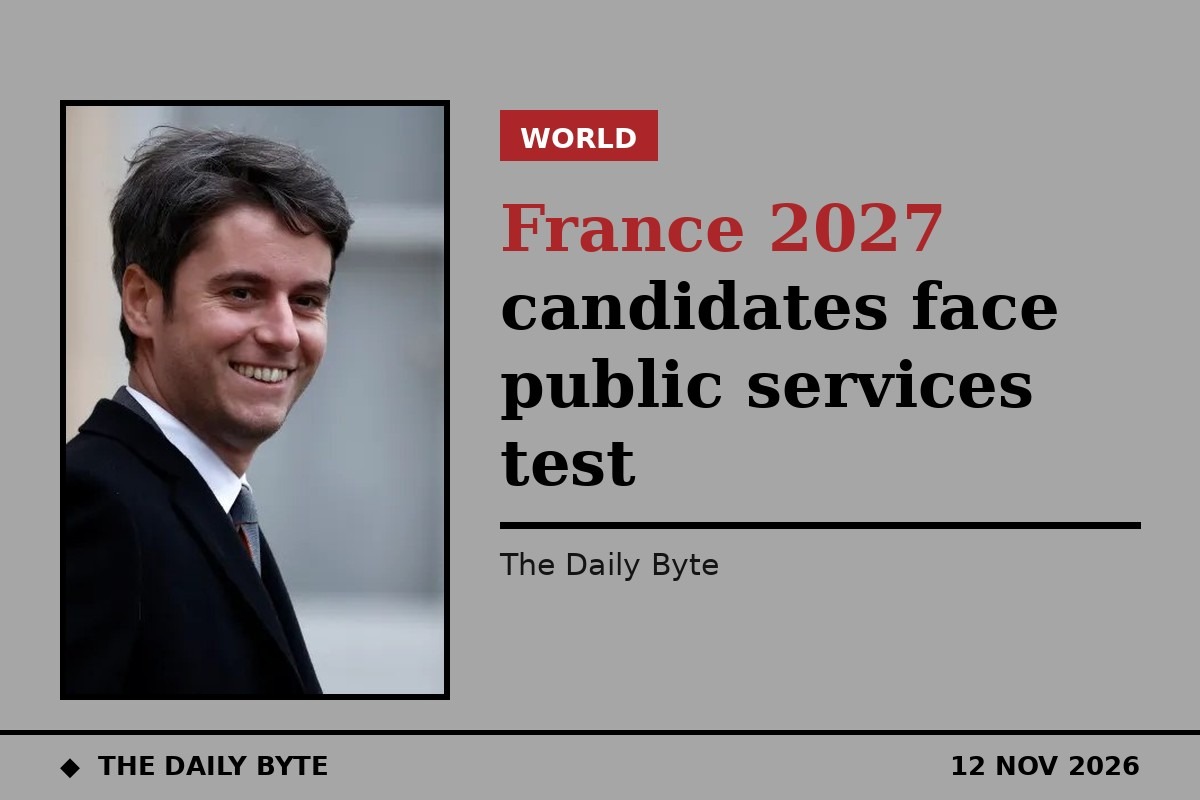
Eight candidates for the French presidency spent Thursday being questioned in turn on the state of the country's public services, in a day-long live event staged by public broadcaster franceinfo five months before voters go to the polls.
The event, called "Nos services publics", ran from 10am to 7pm on 12 November 2026 at Studio 104 of the Maison de la Radio et de la Musique in Paris. Each candidate was interviewed for 40 minutes on schools, hospitals, transport and policing, and on access to public services across France.
It was the first time so many of the main contenders had appeared in a single day of interviews in this campaign, and the pledges they made offered voters one of the clearest comparisons yet of their plans for the French state.
Who took part, and who stayed away
Gabriel Attal of Renaissance opened the day at 10.10am, followed by Fabien Roussel of the Communist Party, Raphaël Glucksmann of Place Publique, Éric Zemmour of Reconquête, Bruno Retailleau of Les Républicains, Marine Tondelier of the Greens, Édouard Philippe of Horizons, and finally Jean-Luc Mélenchon of La France Insoumise at 6.10pm.
Two prominent figures declined the invitation: Marine Le Pen of the Rassemblement National and David Lisnard of Nouvelle Énergie. Le Pen leads the race in the polls, while Lisnard has emerged as a rising figure on the right.
Each interview was broadcast live on franceinfo radio and television for its first 20 minutes, with the second half shown only on the broadcaster's digital platforms, followed by a 20-minute debrief with journalists.
The pledges that stood out
Attal promised to raise teachers' pay from 2028 and to keep teaching posts despite falling pupil numbers, with a maximum of 20 pupils per primary school class. He also defended 100,000 voluntary departures from the civil service, arguing the state should do more with fewer staff.
Roussel proposed scrapping the Parcoursup university admissions system, hiring 500,000 people to staff public services and creating a 60,000-strong community police force. Glucksmann promised pay rises for teachers of up to 25 percent.
Tondelier said she would not create additional prison places, while Philippe argued that hiring more staff was not the answer and that technology and reorganisation should come first. He also warned that if a financial crisis struck, public services would suffer most.
Mélenchon, the last candidate to appear, promised €22 billion of investment in public services in the months after his election if he wins, accusing his opponents of a deliberate attempt to dismantle the public sector so the private sector could take its place.
The primary question hanging over the right
The interviews also kept alive the argument over whether the centre and centre-right should hold a primary to choose a single candidate. Attal repeated his support for a common primary during his appearance.
Retailleau has formally proposed a two-round primary on 31 January and 7 February 2027, writing to Philippe, Attal and Lisnard to ask their campaign teams to meet within 15 days to agree the rules. Philippe has refused to take part, saying a primary would create confusion and division, a position he restated during his own interview.
The dispute matters because the latest Toluna Harris Interactive poll for M6 and RTL, carried out online among 2,101 registered voters between 3 and 5 November, puts Le Pen on 34 to 36 percent in the first round and Mélenchon on 18 to 19 percent, ahead of Philippe on 11 to 14 percent. A poll is a snapshot of opinion, not a prediction, but the figures explain why the centre-right is under pressure to unite behind one candidate.
Why it matters
Public services have become one of the defining issues of the 2027 campaign, with voters concerned about school closures, hospital waiting times, train reliability and safety. Thursday's event gave each candidate an extended chance to set out a detailed programme rather than a slogan, and the contrasts were sharp: more staff and more spending from the left, reorganisation and technology from the centre, and a smaller state from parts of the right.
With the first round about five months away, the candidates will now be judged on whether the promises made in the franceinfo studio survive contact with the campaign trail.
Sources: L'Internaute and Radio France.