France-Algeria trade collapses as French exports fall 34%
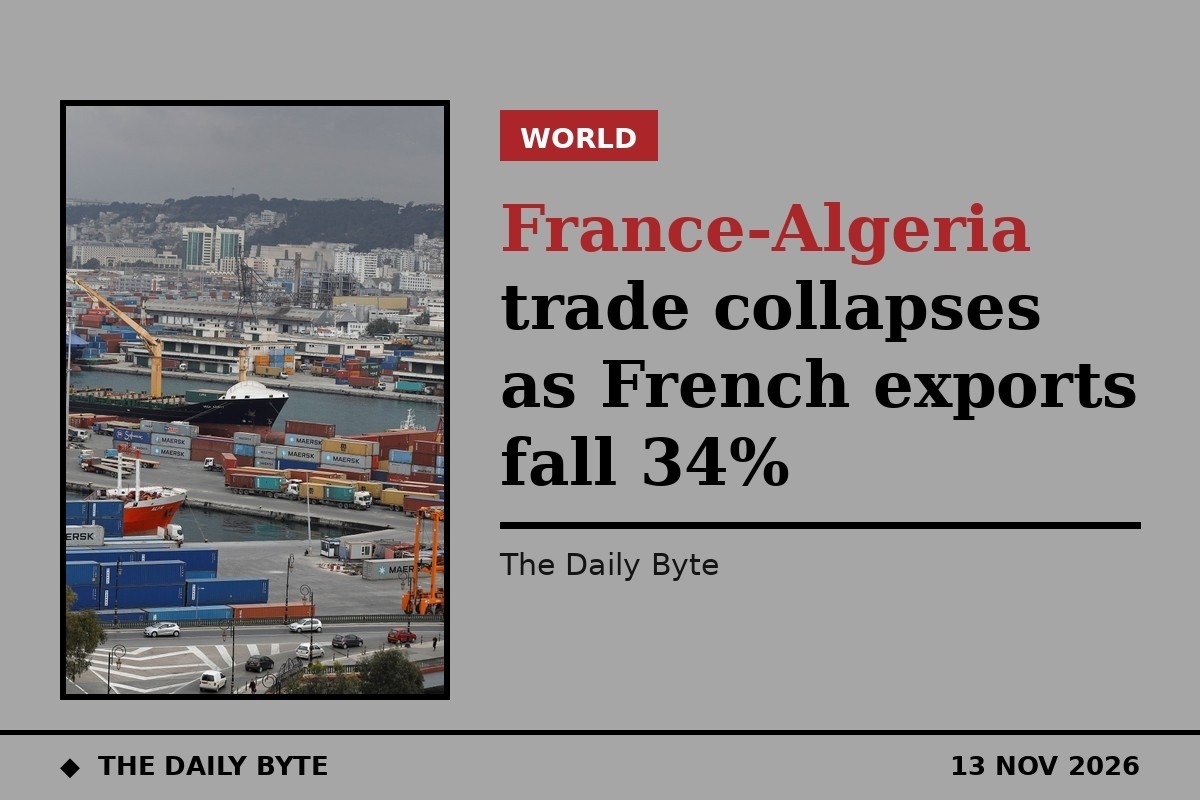
Trade between France and Algeria has collapsed, with French exports to the North African country falling by more than a third in two months as a deepening diplomatic rift turns into an economic blockade.
French customs figures show exports to Algeria were worth 466 million euros in August and September, down 34% from 707 million euros in the same period of 2025. Compared with the same two months in 2024, when exports stood at 819 million euros, the fall was 43%.
The scale of the downturn was laid bare at a meeting at the French Finance Ministry on 6 November, when around 30 businesses and trade associations pressed officials for help.
Those present described exporters blocked from the Algerian market, import authorisations refused and order books shrinking. One participant said officials offered little beyond a promise to continue dialogue with Algiers.
From diplomatic freeze to trade blockade
The trade collapse is a direct consequence of the diplomatic freeze that followed President Emmanuel Macron's recognition of Moroccan sovereignty over Western Sahara in July 2024. There were tentative signs of a thaw in the spring, but the crisis flared again on 8 July, when a Paris appeal court refused to release an Algerian consular official held in connection with the kidnapping of Amir Boukhors, a YouTuber critical of the Algerian government who is known as "Amir DZ".
Algiers responded swiftly, and the decline in French sales accelerated sharply from August. Trade between the two countries had already been shrinking: Reuters reported in October that total French exports to Algeria fell about 12% to 4.2 billion euros in 2025, and were down about 12% year on year in the first eight months of 2026.
Algeria has also moved against French supplies. In October, Reuters reported that Algiers had told urea producers to stop exporting the fertiliser to France, a step that could put at risk around 30% of French urea imports. France has raised the curbs at European Union level.
Wheat exports fall to almost zero
Cereal exports have been the main casualty. Algeria was long a major outlet for French wheat, taking up to half of France's overseas sales. That trade has now all but disappeared.
"Whereas France exported between six and eight million metric tons of soft wheat each year from 2018 to 2023, now it is almost zero," Thierry Pouch, an economist at the Permanent Assembly of Chambers of Agriculture, told Le Monde.
Other sectors have been hit hard too. French customs data show that between October 2025 and September 2026, exports of steel products to Algeria fell by 52.3% compared with a year earlier, food products by 50.9%, clothing by 31.3%, refined petroleum products by 28.3%, automotive products by 25%, chemicals by 22.7% and machinery and equipment by 22.3%.
French firms count the cost
About 5,000 French companies sell part of their output in Algeria. Around 600 of them, or 12%, are now bankrupt, according to a report published in September by the Institut Montaigne think tank, written by Michel Duclos and Augustin Motte.
Many of the firms that have survived are considering moving production to another European country to escape the stigma of the "France" label, a step that would mean job losses at their French sites. France, the second largest exporter to Algeria in 2023, is set to be overtaken by Italy.
The retreat is visible on the ground in Algiers, where the support office for French companies run by the government agency Business France has shrunk from 13 staff to three.
Import controls used to pick partners
Algiers has used an administrative tool to steer trade away from France. The Mandatory Import Forecast Program, introduced in summer 2025 to combat import fraud and protect foreign currency reserves, requires Algerian importers to submit planned foreign purchases for administrative approval, allowing targeted exclusions.
"Any request to import products made in France or passing through a French port is being refused," one industry professional told Le Monde.
The boycott is usually communicated verbally or by telephone, since written orders could create legal problems for Algeria under the EU-Algeria Association Agreement signed in 2002. But an internal letter signed on 30 September by the head of the Algerian Desalination Company, a subsidiary of the state hydrocarbons firm Sonatrach, instructed staff to ban the direct or indirect import of goods and services from countries whose diplomatic relations with Algeria are severed or considered hostile. The letter did not name France, but it was clearly aimed at France, along with Morocco and the United Arab Emirates.
With the final quarter of the year expected to be worse still, French exporters fear the annual decline could approach collapse-level figures, and there is little sign in Paris of a way back.
Source: Le Monde; Reuters, via Euronext, 23 October 2026.


