France-Germany defence cooperation hits a dead end
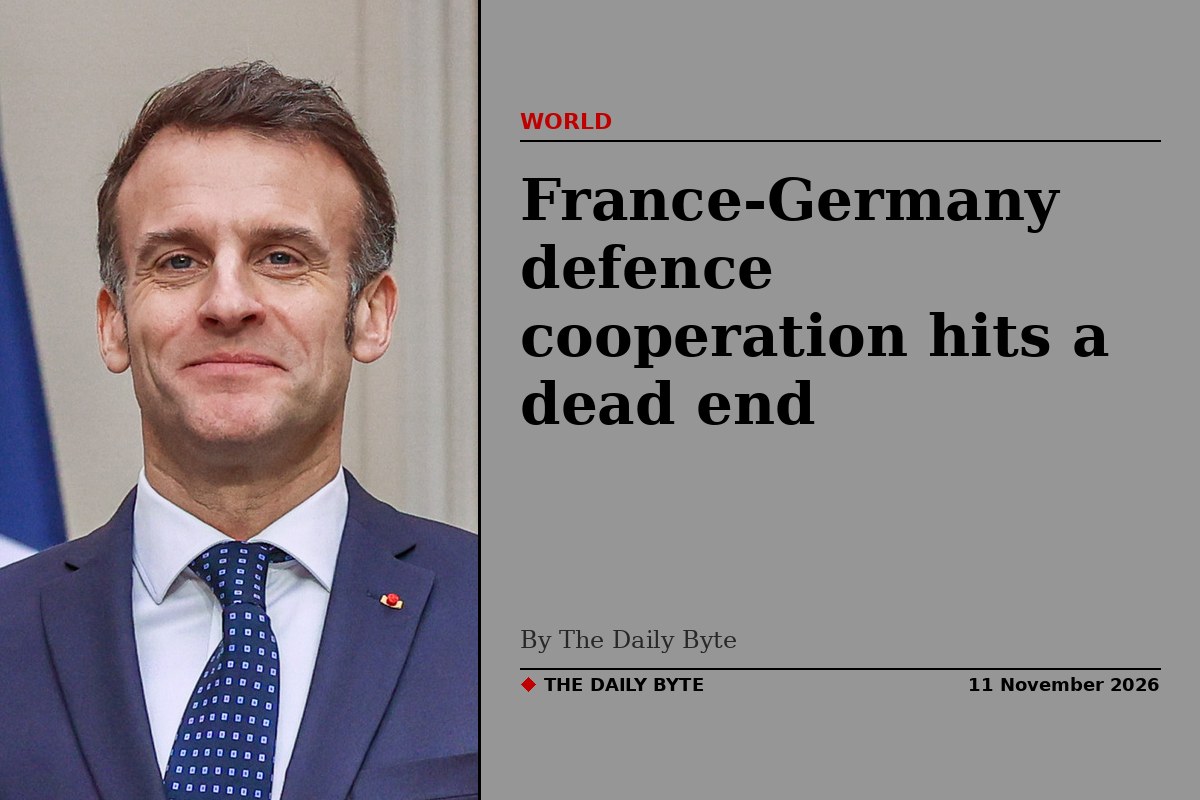
Defence cooperation between France and Germany, long presented as the engine of European security, has come to a standstill, according to a detailed account published by Le Monde on 11 November 2026. The two flagship joint projects that were meant to seal the partnership have both run aground, and the two capitals now disagree openly about how Europe should defend itself.
The clearest sign of the breakdown concerns the Future Combat Air System, known as FCAS, the next-generation fighter jet programme launched by Paris and Berlin in 2017. The project for a joint aircraft was officially abandoned in June 2026 after years of dispute between the French manufacturer Dassault Aviation and Airbus over leadership, work-sharing and intellectual property. France is now expected to pursue its own aircraft, while Germany must choose a new path.
The second project, the Main Ground Combat System, or MGCS, a joint battle tank, has not been formally scrapped. But according to Le Monde, it might as well have been: the French armed forces now refer to it in the past tense. Together, the two programmes would have cost nearly 200 billion euros.
Ministers questioned in Berlin
The state of the relationship was on display on Monday 9 November, when the French and German defence ministers, Catherine Vautrin and Boris Pistorius, were questioned in a Bundestag room in Berlin during a session of the French-German parliamentary assembly, which meets twice a year.
Vautrin argued that European defence money should go first to European industry. Otherwise, she said, Europe would keep the dependencies it wants to free itself from, adding that strategic autonomy is at stake in French and German factories. She invited her counterpart to join the Samp/T NG anti-missile system, which France is developing with Italy. Pistorius did not respond. Germany is promoting the Skyshield project, built in particular around United States-made Patriot missiles.
Pistorius, for his part, said the MGCS and FCAS projects had been weighed down by too much ideology, and that the two sides had made the mistake of idealising them. The time for French-German cooperation simply for its own sake has passed, he suggested. He also laid out Germany's approach: after 30 years in which the European arms industry was not at the forefront, Berlin sees a transition phase in which it must make do with what is available on the market, in particular in the United States.
A widening gap in spending and outlook
The disagreement is sharpened by a growing imbalance in resources. Germany lifted its debt brake for military spending after the war in Ukraine forced a strategic awakening, and its defence budget is expected to reach nearly 140 billion euros in 2027, a record, compared with 63.7 billion euros for France.
The two countries also remember the past differently. A German official quoted by Le Monde put it bluntly: the task now is no longer chasing terrorists in the Sahel, but defending the Baltic states and deterring Russia. That, the official said, is a completely different kind of war.
What still works, and what comes next
Not everything has stopped. A French-German armaments council bringing together the two countries' directors general for armaments met in October, with another meeting scheduled for January 2027 to take stock of possible cooperation in space, aerial systems and artificial intelligence. In July, Paris and Berlin announced a joint exercise as part of the advanced nuclear deterrence proposed by President Emmanuel Macron, aimed at extending France's nuclear umbrella to the rest of Europe, a proposal to which Germany has finally responded positively.
But ambition and motivation appear to be lacking, and the political climate in France adds to the gloom. With less than six months to go before the presidential election, Marine Le Pen of the far-right Rassemblement National and Jean-Luc Melenchon of the radical-left La France Insoumise are leading the polls. Le Pen has warned that, if she wins, the advanced nuclear deterrence advocated by Macron would be a thing of the past.
The collapse of FCAS has wider consequences for Europe. Breaking Defense reported on 6 November that the fall of the Franco-German-Spanish programme leaves the UK-led Global Combat Air Programme, involving Italy and Japan, as the continent's only remaining multinational next-generation fighter effort. Both countries are also weighing collaborative combat aircraft, unmanned planes designed to fly alongside crewed fighters.
Nearly a decade after Macron and then-chancellor Angela Merkel announced the joint fighter jet at the Elysee in 2017, the project meant to seal the French-German rapprochement on defence has ended. The Treaty of Aachen, signed in 2019, promised closer cooperation, but progress stayed slow, and the war in Ukraine has exposed how differently Paris and Berlin see Europe's security future.


