France protests shrink as 146,000 march on 7 November
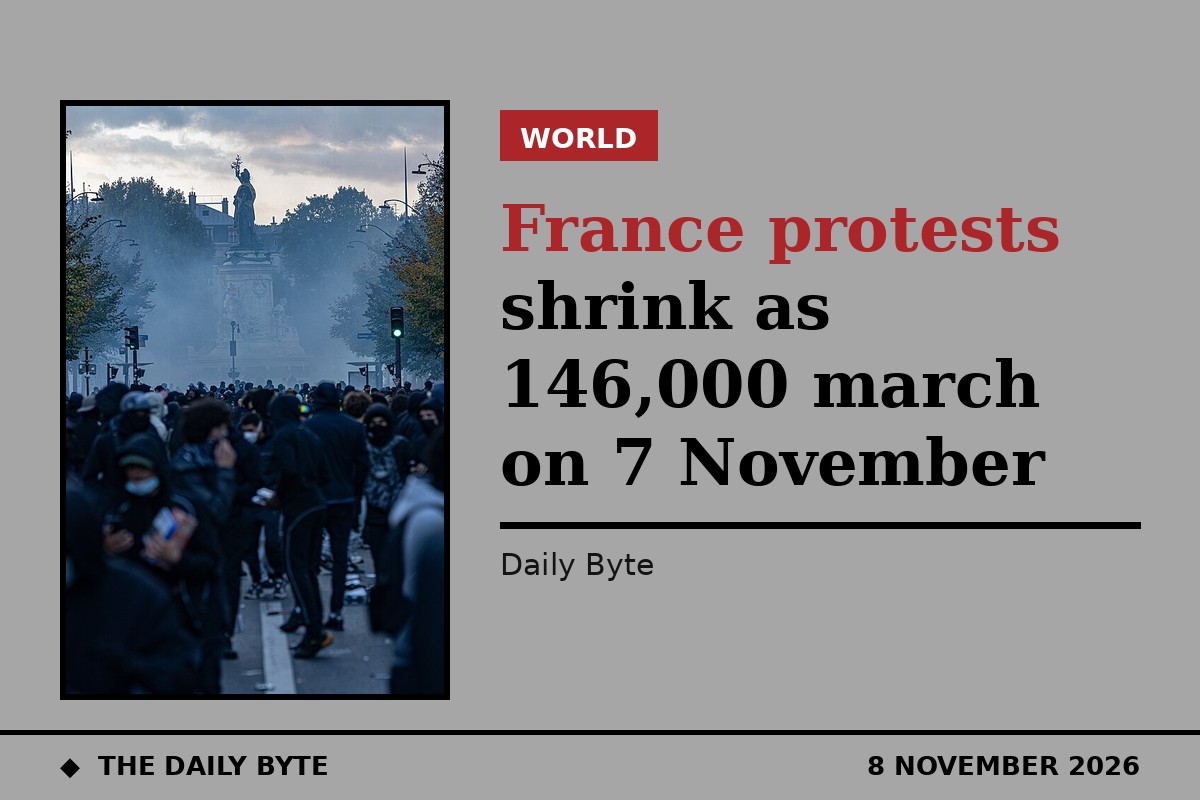
About 146,000 people demonstrated across France on Saturday in a fourth consecutive weekend of protests against the rising cost of living, the smallest turnout since the movement began, according to the Interior Ministry.
The ministry said 46,000 people marched in Paris. Organisers put the figures far higher, at 250,000 nationwide and 75,000 in the capital, a familiar gap between official and organiser counts that has run through every weekend of the protests. Europe Says reports that by 7pm, 360 people had been arrested across the country.
Clashes despite the smaller crowds
Although the marches were smaller, they were not peaceful everywhere. The Interior Ministry said gatherings in Toulouse, Marseille, Lyon, Bordeaux and Strasbourg were marred by riots and incidents, and clashes broke out between police and some protesters in Paris despite the lower turnout. Interior Minister Laurent Nunez had deployed about 70,000 police officers and gendarmes across the country, with armoured vehicles and water cannon on standby, warning in advance that the authorities would be "ready and waiting" for anyone engaging in rioting or looting.
In Paris, the main inter-union march set off in the early afternoon from Place de la Republique towards Place de la Nation, following a route authorised by the police prefecture. A separate Yellow Vest rally at Place de la Concorde had been banned, and police carried out thousands of preventive checks across the country during the day.
A movement losing momentum
The figures show a movement shrinking week by week. The Interior Ministry counted 550,000 demonstrators on 17 October, 410,000 on 24 October and 320,000 on 31 October, before Saturday's 146,000. The decline is even sharper against the nationwide strike on Thursday 5 November, when the ministry counted 575,000 people taking part in a day of action over wages and purchasing power, and the CGT union put the figure at 1.6 million.
The protests began in mid-September, when high-school students blockaded their schools over what they described as deteriorating conditions, including dilapidated buildings and teacher shortages, and an unfair system for access to higher education. The movement has since widened into a broader protest over the cost of living, wages, inequality and the state of public services, drawing in trade unions, students and the Yellow Vest movement.
What happens next
The government is now trying to move the dispute into negotiation. Prime Minister Sebastien Lecornu is due to meet union and employer representatives on Monday 9 November to discuss wages and purchasing power. Education unions have already called a further day of strikes and demonstrations for Tuesday 10 November, before the National Assembly begins its review of the education budget on 12 November.
The unrest comes as France approaches a presidential election in April 2027. President Emmanuel Macron is constitutionally barred from seeking a third consecutive term and will leave office in 2027, and the protests have become part of the contest to succeed him, with the far right seeing its best chance yet of winning power. The movement's organisers have announced further protests next Saturday, and the Yellow Vest coordination is already preparing a fifth round of action for 14 November.
For now, though, the direction of travel is clear: four weekends in, the crowds are getting smaller, the policing heavier, and the argument increasingly about whether street protest or negotiation will decide what happens to pay, prices and schools in the months before the election.