Friday rating reviews test Germany, Italy, Bulgaria
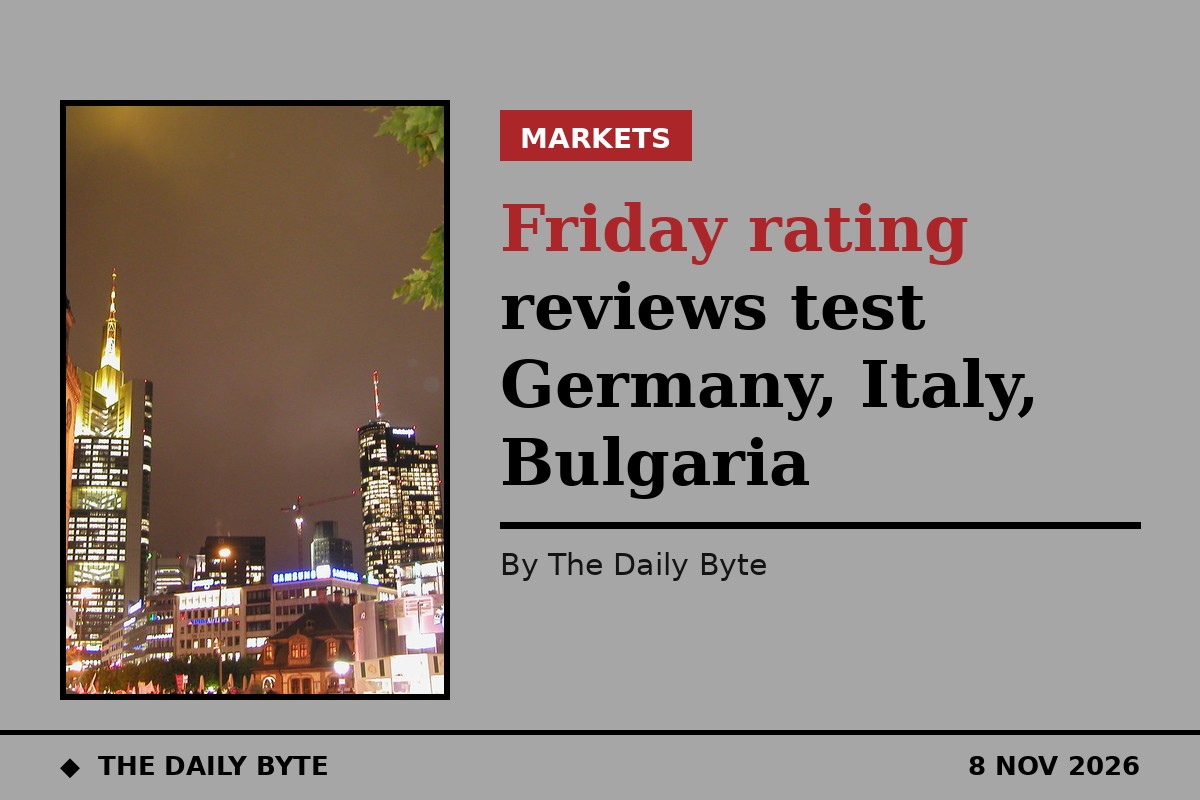
Friday brings a crowded day for Europe's sovereign borrowers, with Fitch due to review Germany and S&P due to review Italy, alongside a wider set of rating decisions that will test how agencies read the continent's public finances after a volatile autumn.
Newsquawk's week-ahead diary lists the Fitch review of Germany and the S&P review of Italy among Friday's scheduled events, on a day that also brings a second estimate of eurozone third-quarter GDP, US producer price inflation and an informal meeting of EU leaders in Dublin. Fitch's own published sovereign review calendar also shows Germany down for review on Friday 13 November.
Germany carries the top AAA rating with a stable outlook from Fitch, so the market expectation is confirmation rather than change. Even so, the review lands at a sensitive moment: German borrowing costs and the country's fiscal stance have been under close scrutiny all year, and any shift in tone from the agency would be read well beyond Berlin.
Italy is the more closely watched of the two. S&P currently rates Italy BBB+ with a positive outlook, a position it affirmed in January 2026 when it lifted the outlook from stable. Reporting on the review suggests S&P is expected to hold the rating, with Italy's budget deficit projected to fall to 3% of GDP this year, although US tariffs are estimated to have trimmed about 0.5% from growth in 2026. A move to an upgrade would be significant; a decision to drop the positive outlook would signal the opposite.
Bulgaria may matter most of all on the day. Aephel's forward look for the week notes that S&P reviews Bulgaria, rated BBB+ with a positive outlook, and calls it the most consequential decision on Friday's calendar because any upgrade would feed directly into the country's path towards adopting the euro. Upgrades at that level are rare, the note argues, and tend to be underpriced in peripheral euro-area bond spreads.
The same calendar carries reviews of Ivory Coast, Namibia, Nigeria, Rwanda, the United Arab Emirates and Ukraine. Nigeria and Ukraine are the tail risks: neither is expected to move, but any change in either would produce an outsized reaction in their bond spreads given how investors are positioned.
The reviews come in an already active week for sovereign ratings. S&P cut Poland's rating outlook to negative, a decision reported on 8 November, and France remains under pressure after its parliament rejected the 2027 budget on 7 November, the day after Moody's had conditioned its Aa3 rating on a deficit-reducing budget being adopted. A Sunday market note put the French-German 10-year spread at about 139 basis points and the Italian-German spread at about 105 basis points.
For investors, the key point is that a scheduled review is not the same as a rating change. Agencies publish these dates in advance and often confirm the existing rating. What moves markets is the wording: whether the outlook stays, whether the agency flags a specific risk, and whether it sets a condition the government must meet. On Friday, Germany, Italy and Bulgaria will each get that treatment in turn.