G7 Demands Iran End Shipping Attacks in Strait of Hormuz
Foreign ministers of the Group of Seven have demanded that Iran stop attacking civilian shipping in the Strait of Hormuz and that Hezbollah surrender its weapons in Lebanon, in a joint declaration issued after two days of talks in Paris.
The ministers of Canada, France, Germany, Italy, Japan, the United Kingdom and the United States, along with the High Representative of the European Union, met under the French G7 presidency in Paris on 9 and 10 November. The declaration was issued on 11 November.
On Iran, the ministers praised regional mediators and restated support for diplomacy aimed at a lasting settlement addressing concerns over Iran's nuclear programme. They repeated that Iran must never be allowed to develop or acquire a nuclear weapon, and urged Tehran to stop supporting non-state armed groups. Without a diplomatic solution, they committed to keep working together to constrain, economically and politically, the Iranian regime's ability to sow instability in the region and around the world.
Strait of Hormuz and civilian shipping
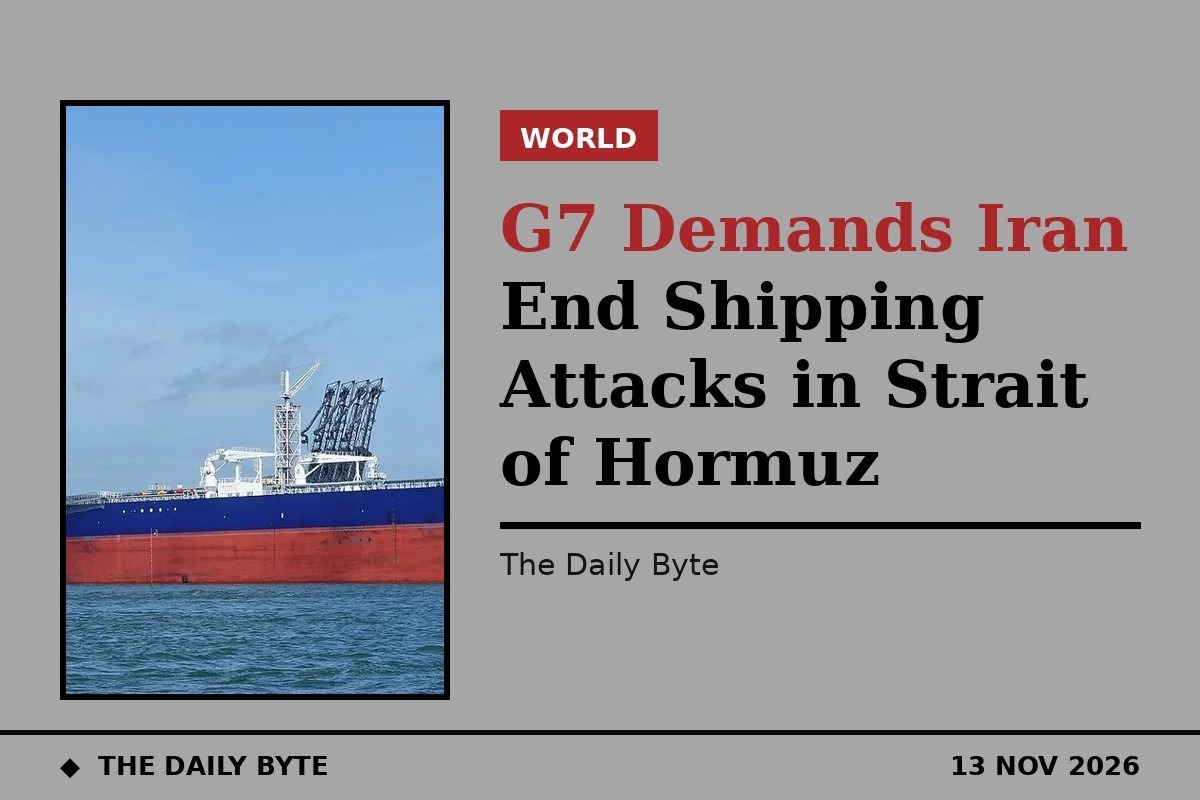
The declaration strongly condemned Iran's attacks on its neighbours and the disruption of trade, energy security and the global economy caused by obstructing transit through the Strait of Hormuz. The ministers called on Iran to stop its persistent attacks on civilian vessels in the strait, and reaffirmed the right of safe and free passage, opposing any tolls, fees, illegal costs, discrimination or other limits on maritime transit.
They underlined the value of US Central Command's defensive work in the strait to clear mines and escort civilian vessels. They also recognised that a multinational, independent and defensive initiative led by France and the United Kingdom can help maritime traffic resume, including by verifying that all mines have been removed.
The ministers reaffirmed their commitment to fully implement UN Security Council sanctions and restrictive measures reinstated in September 2025 through the snapback mechanism under Resolution 2231, and called on all UN member states to do the same. They urged Iran to return to compliance with its international obligations, in particular by resuming full cooperation with the International Atomic Energy Agency.
They also expressed grave concern over Iranian involvement in violent plots against their citizens and territories, and recognised the United Kingdom's attribution of Iran's involvement in the incident at RAF Fairford on 27 September.
Yemen and the Red Sea
On Yemen, the ministers condemned in the strongest terms the continued strikes carried out by the Houthis in Yemen and against Saudi Arabia, including those on civilians and civilian infrastructure. They called on the Houthis to immediately cease all military actions and threats and to refrain from further escalation, so that a return to an inclusive political process becomes possible.
The declaration expressed solidarity with the governments of Yemen and Saudi Arabia and their right to defend their security, sovereignty and territorial integrity under international law. It urged all actors, including Iran, to stop arming and supporting the Houthis, in breach of several UN Security Council resolutions.
The ministers expressed deep concern at the worsening humanitarian impact of the conflict and called for the protection of civilians, safe and unimpeded humanitarian access, and the urgent opening of a humanitarian corridor in Taiz. They repeated their call for the immediate and unconditional release of all humanitarian personnel, including the 70 UN staff who remain detained by the Houthis. They also recognised the contribution of the EU maritime defensive operations EUNAVFOR Aspides and EUNAVFOR Atalanta to restoring maritime security in the Bab al-Mandeb Strait, the Red Sea and the Gulf of Aden.
Lebanon, Gaza and Syria
On Lebanon, the ministers stressed the need for all parties to fully respect the ceasefire and expressed support for the Trilateral Framework and UN Security Council Resolution 1701. They said the disarmament of all non-state armed groups, foremost among them Hezbollah, remains essential to ensuring that all weapons are brought under the authority and control of the Lebanese state.
They called on Lebanon and Israel to advance pilot zones allowing full and verifiable Hezbollah disarmament and Israeli redeployment as the Lebanese Armed Forces deploy. With the UN Interim Force in Lebanon mandate expiring at the end of the year, they called for a robust, credible and long-lasting security architecture backing the Lebanese army, and welcomed the new EU Support Mission in Lebanon.
On Gaza, the ministers backed swift implementation of UN Security Council Resolution 2803 and faster humanitarian, recovery and reconstruction work. They said Hamas can have no role in Gaza's future and must decommission its weaponry, and that Israel must progressively withdraw under the resolution's conditions. On Syria, they backed a peaceful and inclusive political transition towards a united, sovereign and stable country.