G7 Demands Full Ukraine Ceasefire in Paris Pact
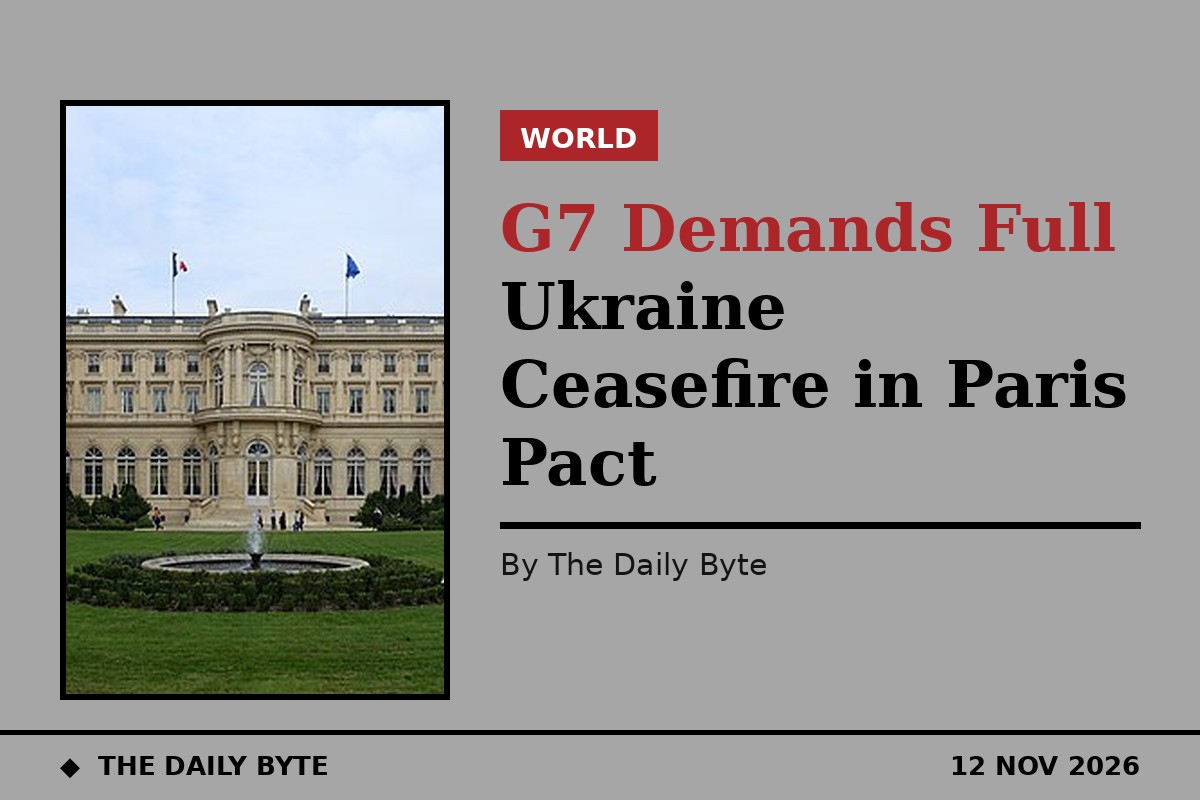
Foreign ministers from the Group of Seven leading democracies have called for a full and reciprocal ceasefire in Ukraine, in a joint declaration issued after two days of talks in Paris.
The ministers, from Canada, France, Germany, Italy, Japan, the United Kingdom and the United States, met on 9 and 10 November under France's presidency of the G7, alongside the European Union's foreign policy chief. Their declaration was published on 11 November.
Ceasefire first, then a lasting peace
The declaration said a mutual halt to attacks on energy infrastructure and in the Black Sea would be an important first step towards a just and lasting peace, protecting civilians and reducing disruption to heating, water, sanitation and food supplies.
The ministers also insisted that negotiations on the future security of Europe must include the Europeans, a point that has become central as Washington pursues direct talks with Moscow and Kyiv.
More weapons and winter help for Kyiv
The ministers took stock of progress on supplying Ukraine with air defence systems, interceptors and long-range weapons, as well as licences to expand the country's own military production. They pledged to continue and strengthen those efforts.
They also acknowledged the need to address Ukraine's pressing financing needs for 2027 and beyond, and decided to step up financial and material support to help the country through the winter. The declaration welcomed work to repair the Chornobyl New Safe Confinement, damaged in a Russian strike, and support for Ukraine's civilian cyber defences.
Warning to Russia's backers
The ministers condemned the supply of military assistance to Russia by North Korea and Iran, and the provision of weapons, military training and dual-use components by China. They said they intended to keep taking action against those countries.
They also agreed to increase pressure on Russia's war economy, including through sanctions, and to focus on ships using false flags or sailing without a flag, as well as the insurers, oil traders and intermediaries that help the shadow fleet evade restrictions.
Iran, Gaza and the wider world
On Iran, the ministers said Tehran must never be allowed to develop or acquire a nuclear weapon, condemned its attacks on neighbouring countries and its obstruction of shipping through the Strait of Hormuz, and backed the snapback sanctions reinstated in September. They also noted Britain's attribution of Iran's involvement in an incident at RAF Fairford on 27 September.
On Gaza, they backed swift implementation of United Nations Security Council Resolution 2803, condemned the Hamas attacks of 7 October, and said Hamas could have no role in Gaza's future. On Lebanon, they said the disarmament of Hezbollah and other non-state armed groups remained essential.
The declaration also covered the Indo-Pacific, where the ministers opposed unilateral attempts to change the status quo in the South and East China Seas and across the Taiwan Strait, condemned North Korea's nuclear and missile programmes, and voiced concern over the war in Sudan and the growing risk of famine in Darfur and Kordofan.
The Paris meeting was the second formal gathering of G7 foreign ministers under the French presidency, and its declaration showed the group still able to agree common positions on Ukraine, the Middle East and the Indo-Pacific despite the strains of a difficult year.