G7 Warns China Over Taiwan as Xi Presses Reunification
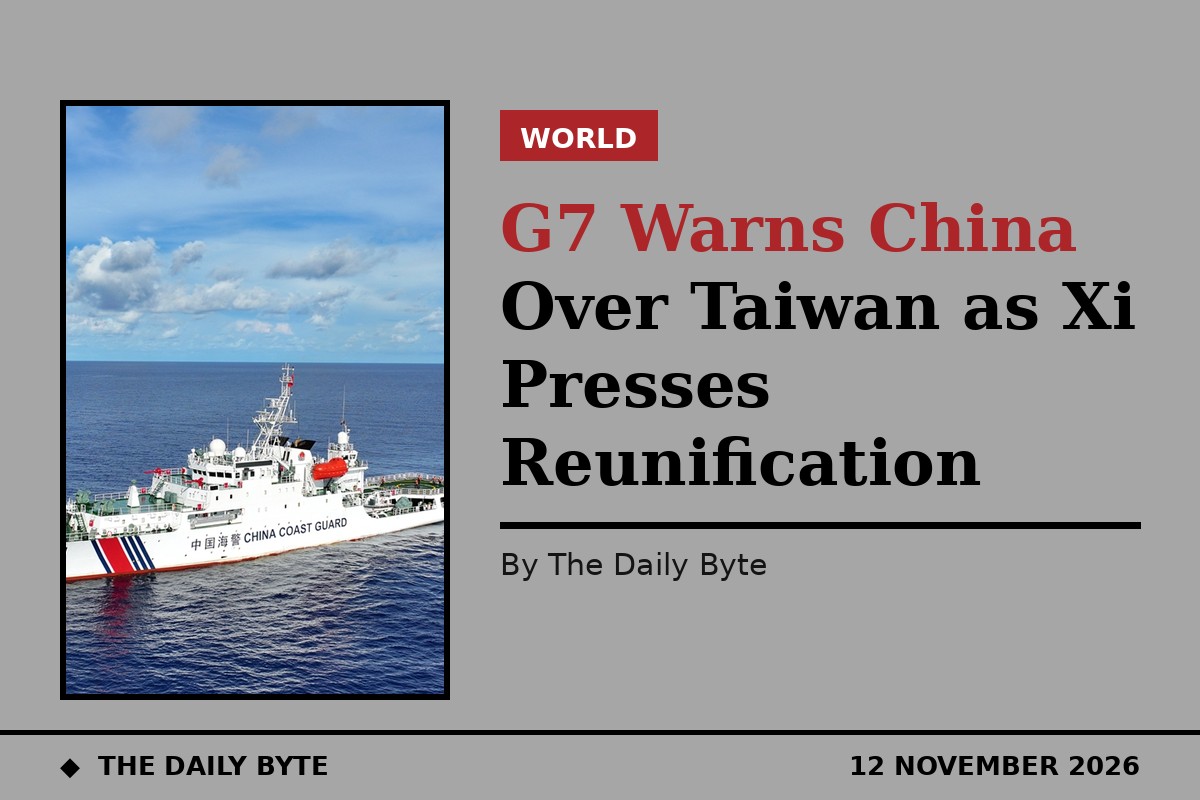
Foreign ministers of the G7 have warned that China's increasingly assertive actions in the waters east of Taiwan threaten regional stability and freedom of navigation, in their strongest joint statement yet on the issue.
The ministers issued the declaration late on Wednesday after meeting in Paris. They said China's activities east of Taiwan "threaten regional stability, freedom of navigation and the safety of international shipping", and added: "We reaffirmed our opposition to any unilateral attempts to change the status quo, particularly by force or coercion, or the threat thereof."
Patrols off Taiwan's east coast
China, which views Taiwan as its own territory, has stepped up activity off the island's east coast since June, with regular coast guard patrols. Officials in Taiwan, which rejects Beijing's sovereignty claims, say they believe China is practising for a potential maritime blockade, using overlapping military, paramilitary and civilian assets.
Taiwan's Defence Minister Wellington Koo said on Tuesday that China was carrying out "area denial" drills in the Western Pacific involving one of its aircraft carriers and other naval formations. Taiwan's defence ministry said on Thursday it had detected 29 Chinese military aircraft, including J-16 fighter jets and drones, carrying out a "joint combat readiness patrol" around Taiwan in conjunction with Chinese warships.
The United States, Britain, France and Germany had each previously raised concern about China's actions off Taiwan's east coast, but the G7 statement is the strongest unified expression of concern to date. Taiwan's presidential office welcomed the statement, saying peace and stability in the Taiwan Strait and the Indo-Pacific were vital to global security and prosperity. China's foreign ministry did not immediately respond to a request for comment.
Xi presses reunification
The warning came on the same day that Chinese President Xi Jinping urged complete "reunification" of Taiwan with the motherland, telling an audience in Beijing's Great Hall of the People that "the tide of history cannot be stopped" and that reunification "must be realised, and it will certainly be realised".
Xi was speaking to mark the 160th birthday of Sun Yat-sen, the revolutionary who helped lead the 1911 revolt that ended imperial rule in China. He said China adhered to "peaceful reunification and the policy of 'one country, two systems'" and was willing to talk to Taiwan while upholding the "one-China principle". He made no mention of the use of force, which China has never renounced for Taiwan.
Taiwan's government dismissed the remarks as nothing new. "As for the wording on Taiwan unification, it isn't much different from the past," said Liang Wen-chieh, spokesperson for Taiwan's Mainland Affairs Council.
The exchanges come a week before the APEC summit in the southern Chinese city of Shenzhen, where Xi is due to meet US President Donald Trump, and a little more than two weeks before important local elections in Taiwan.