German Industry Rises 0.7% in September as Carmakers Rebound
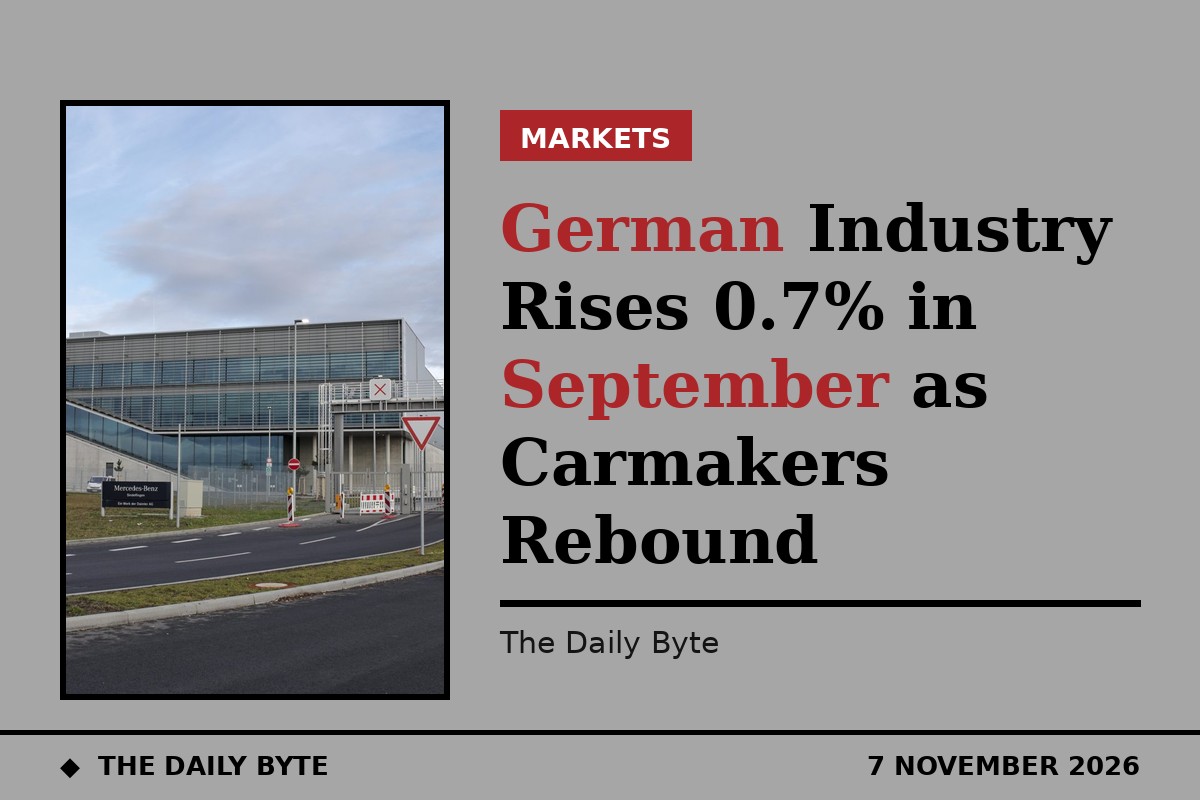
German industrial production rose unexpectedly in September, lifted by a sharp rebound in car manufacturing, although the wider picture for the quarter remained weak.
Destatis, Germany's federal statistics office, said on Friday 6 November that real production in industry rose 0.7% in September compared with August, after seasonal and calendar adjustment, beating economists' expectations. Production was 0.4% higher than in September 2025. The August figure was revised down to a 1.0% monthly rise, from a provisional reading of 2.0%, after construction firms supplied additional tax data.
The increase was driven mainly by the automotive industry, where production jumped 17.1% on the month after two weak months caused by production changeovers and factory holidays. Pharmaceutical output rose 8.0% after two weaker months. By contrast, construction output fell 2.6% and production of machinery and equipment dropped 6.5%, following a 5.8% rise in August.
Quarter still shrank
Despite the monthly gain, the less volatile three-month comparison showed production 0.4% lower in the third quarter of 2026 than in the second. Production in industry excluding energy and construction rose 1.7% in September, with capital goods up 3.0%, consumer goods up 0.8% and intermediate goods up 0.1%. Output in energy-intensive industries rose 0.8%.
"The September figures point to a stabilization of industrial production," said Dirk Schumacher, an economist at KfW. But Carsten Brzeski of ING cautioned that the month's strength was "better seen as a post-holiday bounce rather than evidence of a lasting improvement in German industry", pointing to structural headwinds including rising Chinese competition and higher interest rates.
There were some brighter signals: new factory orders jumped in September, and Germany's economy grew 0.2% in the third quarter, its fourth consecutive quarter of growth, helped by government investment in infrastructure and defence. The economy ministry said high order books could support a recovery towards the end of the year, but warned that geopolitics and higher world energy prices pose clear risks to the outlook.