Germany to Station 5,000 Troops in Lithuania by 2027
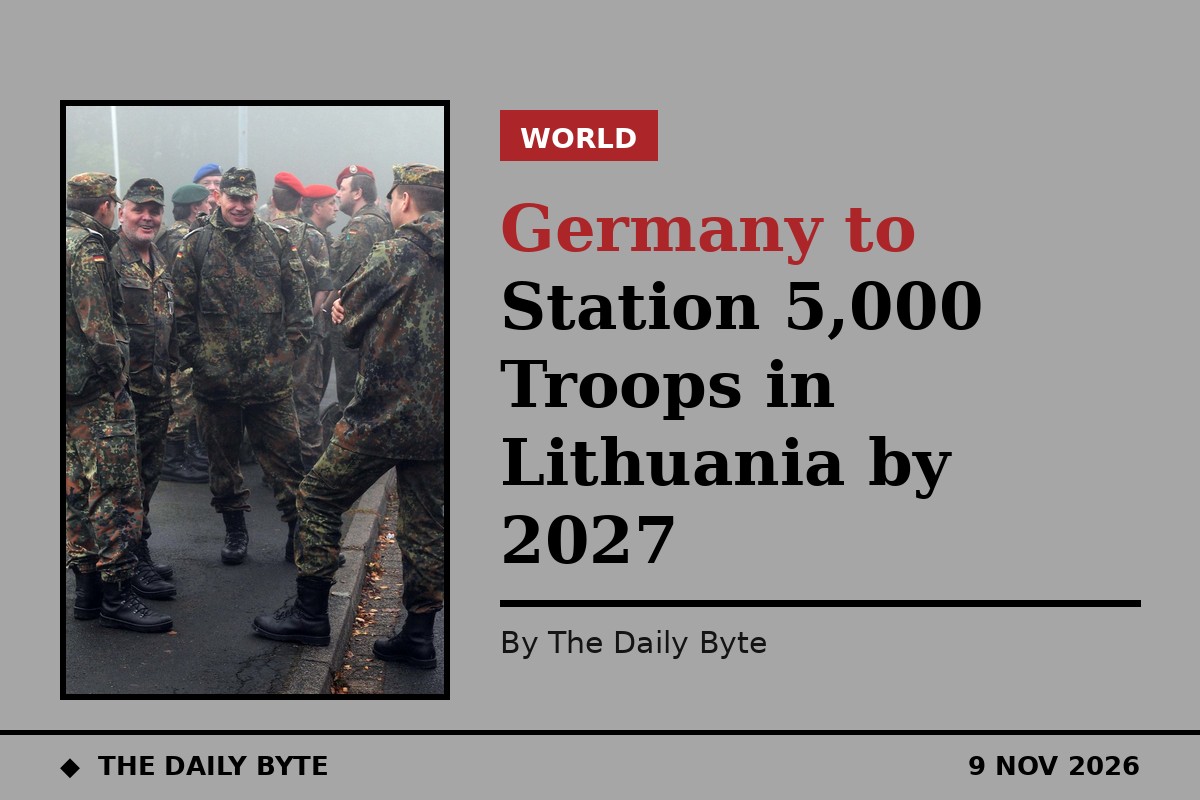
Germany is building a permanent military presence in Lithuania, with close to 5,000 Bundeswehr soldiers due to be stationed in the Baltic state under Panzerbrigade 45 by 2027, according to a POLITICO report published on 8 November.
The brigade will be positioned in territory squeezed between the Russian exclave of Kaliningrad and Belarus, a stretch of frontier that NATO planners describe as among the alliance's most exposed. The deployment is one of the largest permanent forward stationing commitments Germany has made since it began reshaping its armed forces after Russia's full-scale invasion of Ukraine in 2022, a shift known in Berlin as the Zeitenwende.
Lithuania's Defence Minister, Robertas Kaunas, told POLITICO that the threat from Russia was no longer theoretical. He pointed to drone incursions, disinformation campaigns and incidents of infrastructure fires as evidence that hybrid warfare tactics had already reached Lithuanian territory.
The POLITICO reporting also examines how the Baltic states are preparing their defences and what role European countries would need to play if the United States were to reduce its commitments as a security guarantor in the region. The underlying argument is that deterrence along NATO's eastern flank is tied directly to the security of the alliance as a whole, with the security of Vilnius described as inseparable from that of Berlin.
Lithuania's Ministry of National Defence said on 2 October that the stationing process was proceeding smoothly. At the 11th meeting of a joint working group, German representatives presented a draft brigade stationing plan covering logistics, infrastructure and other strategic work. The draft indicates that the bulk of the movement will take place in the second half of 2027, with the fully operationally capable brigade stationed in Lithuania completely by the end of next year.
The number of brigade personnel already moved to Lithuania is rising steadily and is expected to reach 2,000 military and civilian members serving under the brigade's flag by the end of this year. The number is planned to reach approximately 5,000 by the end of 2027.
The brigade will be stationed permanently at the Rudninkai Military Training Area, where construction of the required infrastructure is under way. A permanent staging area has already been completed in Rukla, and work on firing ranges, housing, utilities and other facilities is progressing alongside it.
Germany and Lithuania signed a new defence declaration on 4 November, during the Berlin Security Conference, covering air defence, counter-drone technology, electronic warfare, military mobility and closer defence industry cooperation. Lithuanian Defence Minister Robertas Kaunas and German Defence Minister Boris Pistorius signed the declaration, which sets priorities for closer integration of the two countries' armed forces and defence industries. The declaration does not itself constitute a new weapons purchase agreement; its commitments are expected to be implemented through a separate action plan.
The deployment is the first time Germany has stationed troops abroad on a long-term basis since the Second World War. Germany has had troops in Lithuania since 2017 as part of NATO's efforts to secure its eastern fringe, but the new brigade deepens that engagement significantly, turning a rotational presence into a permanent one.
Lithuania, along with Estonia and Latvia, has pressed NATO allies for a stronger forward presence given its proximity to Kaliningrad and Belarus. The German brigade, once at full strength, will stand at the heart of that presence, in the narrow corridor between the two Russian-aligned territories that military planners regard as vulnerable to both rapid conventional build-up and hybrid destabilisation.


