Ghana First in Africa to Unlock LEAF Climate Finance
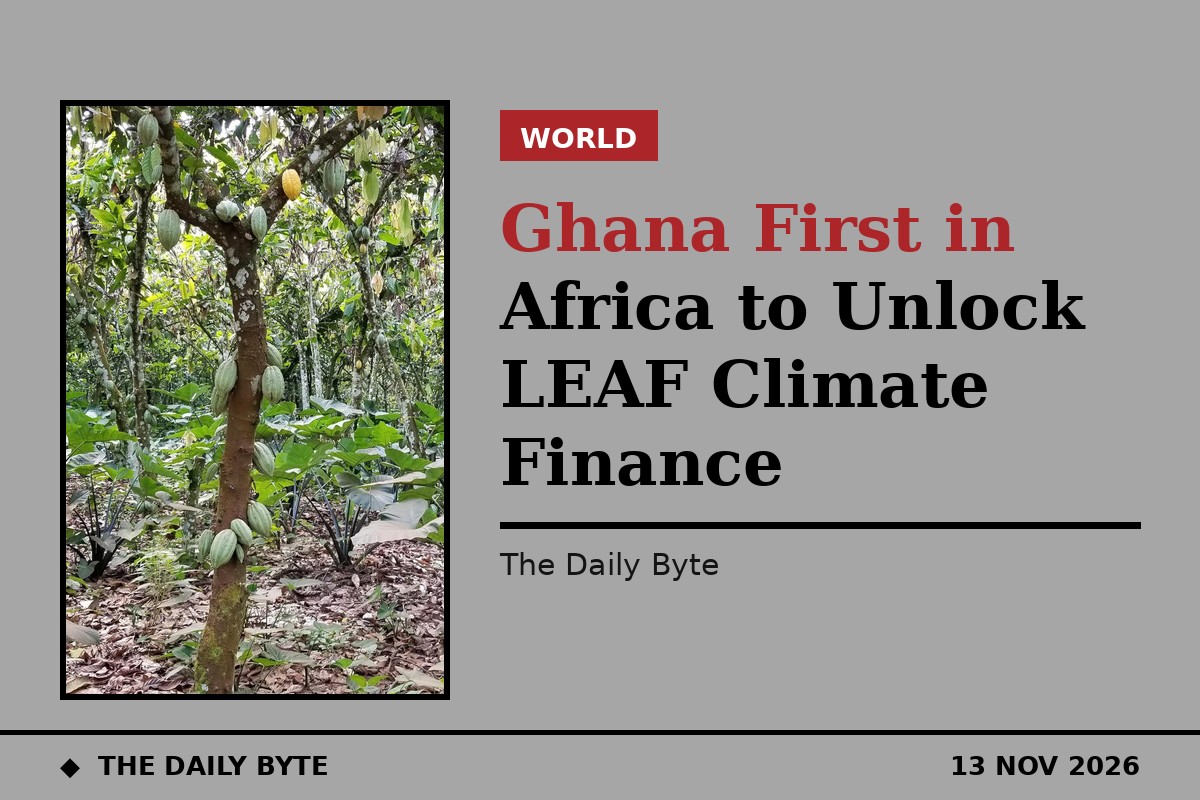
Ghana has become the first African country to access climate finance through the LEAF Coalition, after about 6.5 million forest carbon credits were issued under the Architecture for REDD+ Transactions (ART) TREES standard. The credits were announced at COP31 in Antalya, Türkiye, on 12 November 2026, and are expected to bring an initial US$43 million in payments from buyers including the LEAF Coalition.
The credits represent verified cuts in emissions from deforestation and forest degradation achieved between 2017 and 2021 under Ghana's nationwide forest programme, which measures results across large areas rather than single projects. Ghana is also the first country in the world to receive TREES credits that qualify for the Integrity Council for the Voluntary Carbon Market's Core Carbon Principles, according to reporting from the summit.
What the LEAF deal means for Ghana
The LEAF Coalition, short for Lowering Emissions by Accelerating Forest finance, buys high-integrity forest carbon credits from governments that can prove they have kept forests standing. Its public and private participants include the governments of the United Kingdom and Norway, as well as corporate buyers Amazon, Bayer, PwC and the Walmart Foundation.
Ghana's programme covers approximately 2.5 million hectares across 10 regions in southern and central Ghana, focused on the cocoa-forest landscape. By promoting sustainable agroforestry, including planting shade trees within cocoa farms, the initiative aims to strengthen farm productivity while restoring ecosystems and reducing deforestation.
Under an agreed benefit-sharing plan drawn up after public consultations, more than two-thirds of net proceeds are allocated directly to local stakeholders, including cocoa farmers, forest-fringe communities and traditional authorities. Ghana's Forestry Commission has more than 4,000 staff, with about 70 per cent working on the frontline protecting forests alongside forest-fringe communities.
Ministers welcome the milestone
Emmanuel Armah-Kofi Buah, Ghana's Minister of Lands and Natural Resources, described the development as a landmark achievement. "This is a landmark achievement that recognises the dedication of our communities, farmers and government to protecting Ghana's forests while pursuing sustainable development," he said.
Hugh C.A. Brown, chief executive of Ghana's Forestry Commission, said Ghana welcomed efforts through the Forest and Climate Leaders' Partnership to strengthen carbon markets and mobilise forest finance. The UK's Minister for Climate Transition, Katie White, called Ghana "a trailblazer in forest protection", saying the payments would scale up high-integrity forest finance and reward countries helping to stop deforestation.
Africa's forests move to centre stage at COP31
Ghana's announcement came at a high-level forest summit at COP31, where representatives from Nigeria, the Democratic Republic of Congo, the Republic of Congo and Ethiopia also outlined plans to expand carbon markets, attract private investment and restore damaged forests.
Earlier in November, Gabon struck a deal in London to sell forest carbon credits covering about six million tonnes of emissions to SEFE, an energy company owned by the German government. Gabon says it is the first African country to secure a sale of this kind involving aviation-eligible forest credits measured across its entire territory, with the first deliveries expected by the first quarter of 2027.
The Democratic Republic of Congo outlined plans to plant 100,000 hectares of forest, while the Republic of Congo reported planting more than 14 million trees under a national programme aiming to establish one million hectares of planted forests. Nigeria launched its Securing Nigeria's Forest Future Country Package, and Ethiopia, which will host COP32 in Addis Ababa next year, highlighted its Green Legacy Initiative.
According to figures presented by the Forest and Climate Leaders' Partnership, forests receive less than 1% of global climate finance, though they account for about a fifth of the world's cost-effective options for cutting emissions. At COP31, leaders renewed their pledge to halt and reverse deforestation and forest damage by 2030. Sources: Financial Fortune Media and Joseph Silali / ABOS Africa News Agency.