Gold posts best week since August despite jobs setback
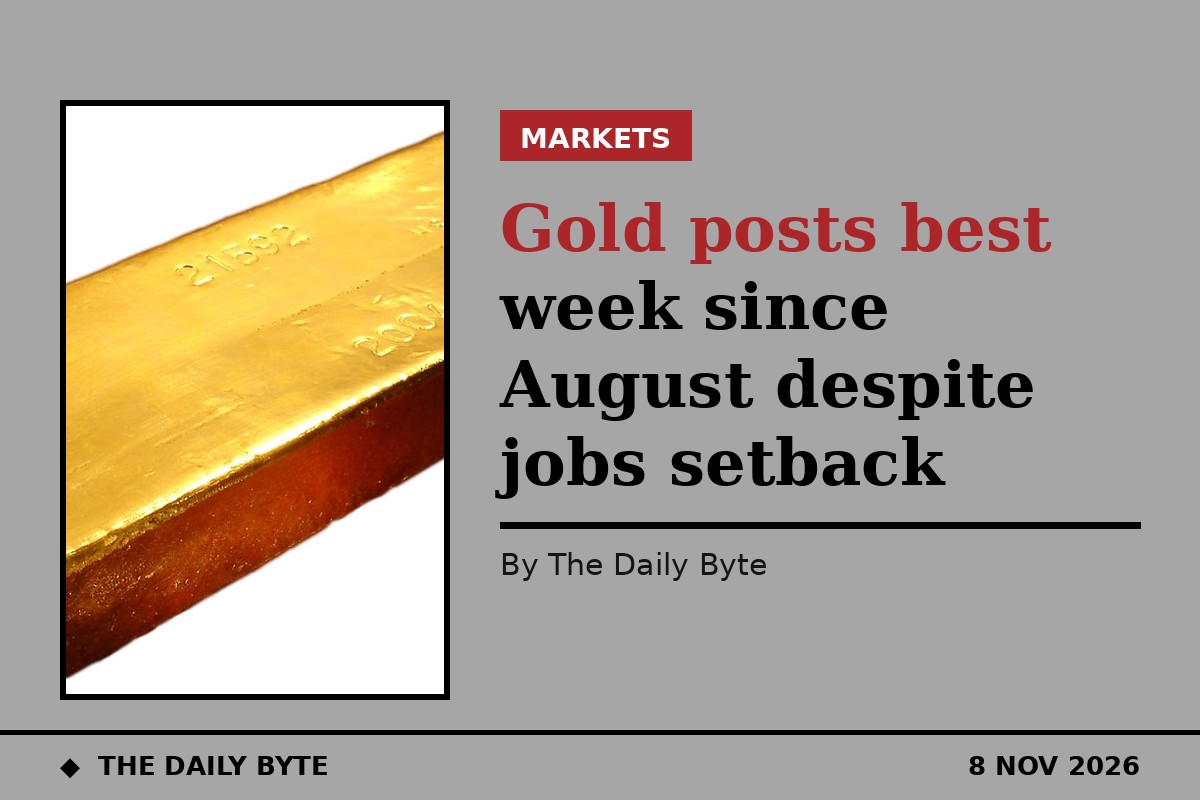
Gold posted its best week since August, gaining about 5% in the week to 6 November as a sharp fall in oil prices eased inflation fears and supported the metal, before a stronger-than-expected United States jobs report trimmed the rally on Friday.
The week began with gold near its one-year low of $3,869.85, set on 30 October. Spot gold rose about 1% to roughly $4,100 on Thursday, touching $4,146.63, its highest since 20 October, before easing on Friday to end at $4,063.65 an ounce, according to Reuters-based reports. Even after the recovery, gold remains well below its intraday record of about $5,595 set on 29 January 2026.
Oil's slump did most of the work. Brent crude fell about 17% over the week, its steepest weekly drop since the start of the Covid pandemic, according to Reuters, after the US midterm results raised hopes of de-escalation with Iran. Brent settled at $98.32 on Friday as tanker attacks in the Gulf kept a floor under prices. Lower oil eases fears of persistent inflation and reduces pressure for further rate rises, which supported gold for most of the week.
Friday's jobs report turned the mood. US payrolls rose by 165,000 in October, compared with a Reuters poll of 65,000, and unemployment fell to 4.1%. The dollar rose about 0.7% and the two-year Treasury yield climbed about 6 basis points, while the odds of a Federal Reserve rate rise in December climbed to about 80%, from about 67% on 5 November, according to CME FedWatch figures cited by Reuters. Higher yields and a stronger dollar raise the cost of holding gold, which pays no interest, for many buyers, and spot gold fell more than 1% at its low on Friday before recovering part of the loss.
Against that rate-driven headwind sits a more supportive demand picture. The World Gold Council reported worldwide gold demand including over-the-counter business of 1,369 tonnes in the third quarter, down 1% year on year. Within that total, central banks and other official institutions bought a net 321 tonnes, 42% more than a year earlier, while gold exchange-traded funds recorded inflows of 211 tonnes. The council raised its assessment of central bank purchases, but cut its forecast for growth in gold investment demand to around 200 tonnes for 2026, half the 400 tonnes previously expected, after weaker demand for bars and coins.
Fund flows offered further support in October. According to the World Gold Council, global gold ETFs took in $2.7 billion during the month, lifting holdings by 19 tonnes to a record 4,275 tonnes. Europe led the inflows with $1.8 billion, led by the United Kingdom, and Asia added $1.3 billion, led by China, while North America saw outflows of $512 million. Year-to-date inflows reached $41 billion. Positioning in the derivatives market was more cautious: COMEX net long positions fell by 94 tonnes in October to 560 tonnes.
Central bank buying continued into the autumn. The council reported net purchases of 61 tonnes in September, the highest monthly figure of 2026, led by Poland and China. Poland's central bank said it had reached its 700-tonne target and left room for more. In India, Reuters reported that demand picked up for Dhanteras as local prices fell to their lowest since March, with buyers favouring coins and bars.
Two scheduled releases now frame the debate. The US consumer price index for October is due on 10 November at 8:30 a.m. Eastern time. Because inflation shapes expectations for the Federal Reserve, and through them the dollar and Treasury yields, the print could either reinforce the case for further tightening or let some of the pressure off. The November employment report follows on 4 December. If US-Iran talks progress and oil keeps falling, inflation expectations could ease and support precious metals even with a hawkish Fed; if the inflation data is strong and December hike odds rise further, higher yields and a firmer dollar could weigh on gold.