Google AI Agents Help Prove 2013 Maths Conjecture
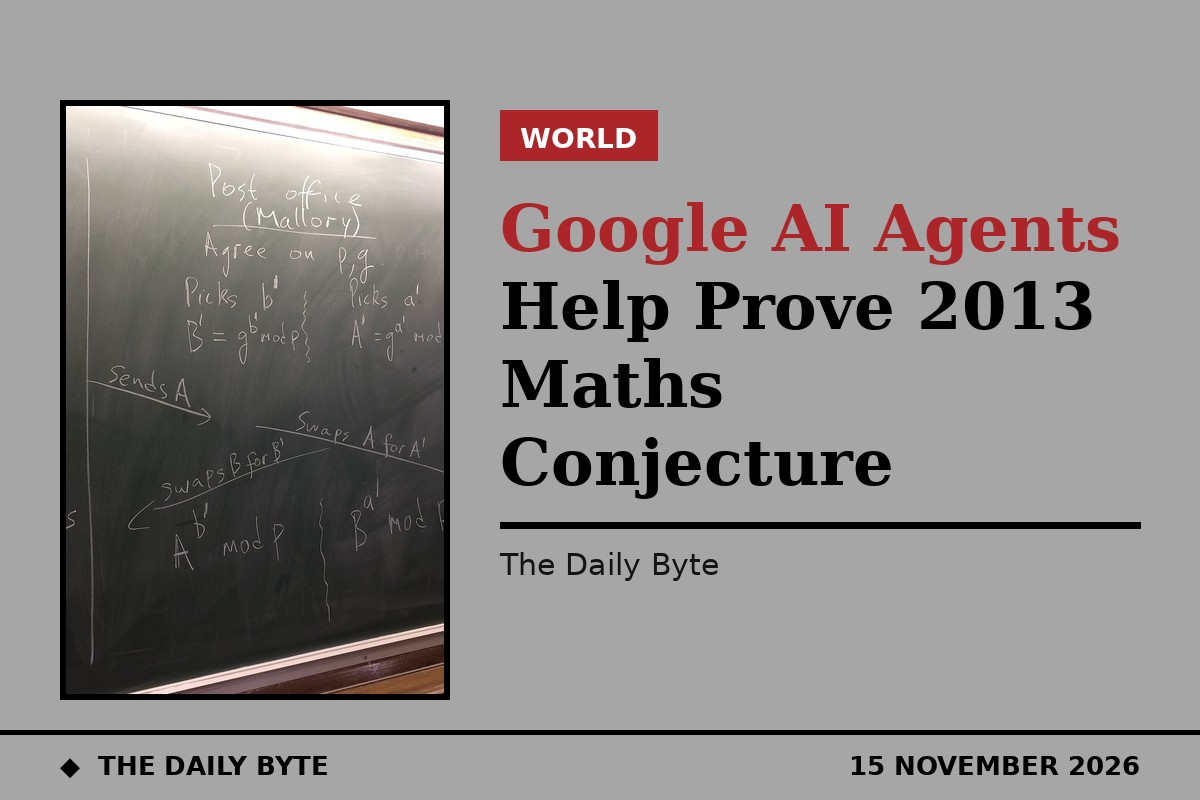
Google says its AI coding agents have moved from writing software to doing mathematics. In a research post published on Friday 13 November 2026, Google Research described how teams of specialist Gemini 4 agents working inside Antigravity, its AI coding environment, helped prove a conjecture that had stood open since 2013, and produced machine-checked formalisations of famous results in pure mathematics.
The system is called /teamwork. It splits a hard problem between agents with separate roles: producers that draft solutions, critics that look for flaws, and auditors that check the result from a clean context. Objective checkers, such as the Lean 4 proof language, verify each step automatically.
A 2013 conjecture, settled and machine-checked
The headline result is the Courtade-Kumar conjecture, posed in 2013. It concerns a classic question in information theory: when a string of bits passes through a noisy channel, can it be compressed to a single bit while preserving more information than the simplest possible method, just copying one input bit? The conjecture says no.
Researchers from Google, the Chinese University of Hong Kong, the University of Southern California and Carnegie Mellon University proved it in full generality, using /teamwork's Long Proof pattern, which splits a long argument across separate agents. The proof itself appeared as a preprint in September 2026. What the November post adds is the machine-checked formalisation: the whole argument translated into Lean 4, a language that lets a computer kernel verify every logical step. Google puts that formalisation at 50 million lines of code.
That number needs a closer look. An independent check confirmed the 50 million lines are real, but found only about 239,000 of them are proof a person could read. The rest is generated certificate data that the Lean kernel checks mechanically. The audit trail is still strong: the repository records a clean rebuild, acceptance by the Lean Foundation's external checker, and acceptance of all 22,107,215 declarations.
The Weil conjectures claim needs more evidence
Google also says a framework called /teamwork-LEAP, paired with Gemini 4 Argon, fully autonomously produced an end-to-end, machine-checked formalisation of the Weil conjectures, the landmark results on counting solutions of polynomial equations over finite fields, proved by Pierre Deligne in 1974. Google says the formalisation spans about 1.8 million lines of Lean, produced across 28,800 subagent invocations.
Here the verification story is thinner. Google's post links to Wikipedia pages for the Weil conjectures and Deligne, with no repository, no paper and no statement file, so the claim cannot yet be independently checked. A separate group, Axiom, published its own public formalisation of the Weil conjectures on 6 November, a week before Google's post.
Beyond mathematics
The same report card covers engineering work. Google says /teamwork rewrote its production libgav1 AV1 video decoder from C++ into about 170,000 lines of Rust, running 20 to 30 percent faster, and ported a microkernel into safe Rust. It also describes a drug-synthesis result completed in about an hour and fleet-wide memory savings at Google.
Google is also giving 10,000 academic researchers six months of free access to its top usage tier, so university labs can try the tools themselves. Developers with a paid subscription can already use /teamwork in Antigravity.
The through-line is not that agents can now do mathematics on their own. It is that teams of agents, checked at every step by tools that cannot be argued with, can take on problems that were previously out of reach, provided the results are published in a form others can verify.