Google launches Gemini 4 Hydrogen for Search and coding
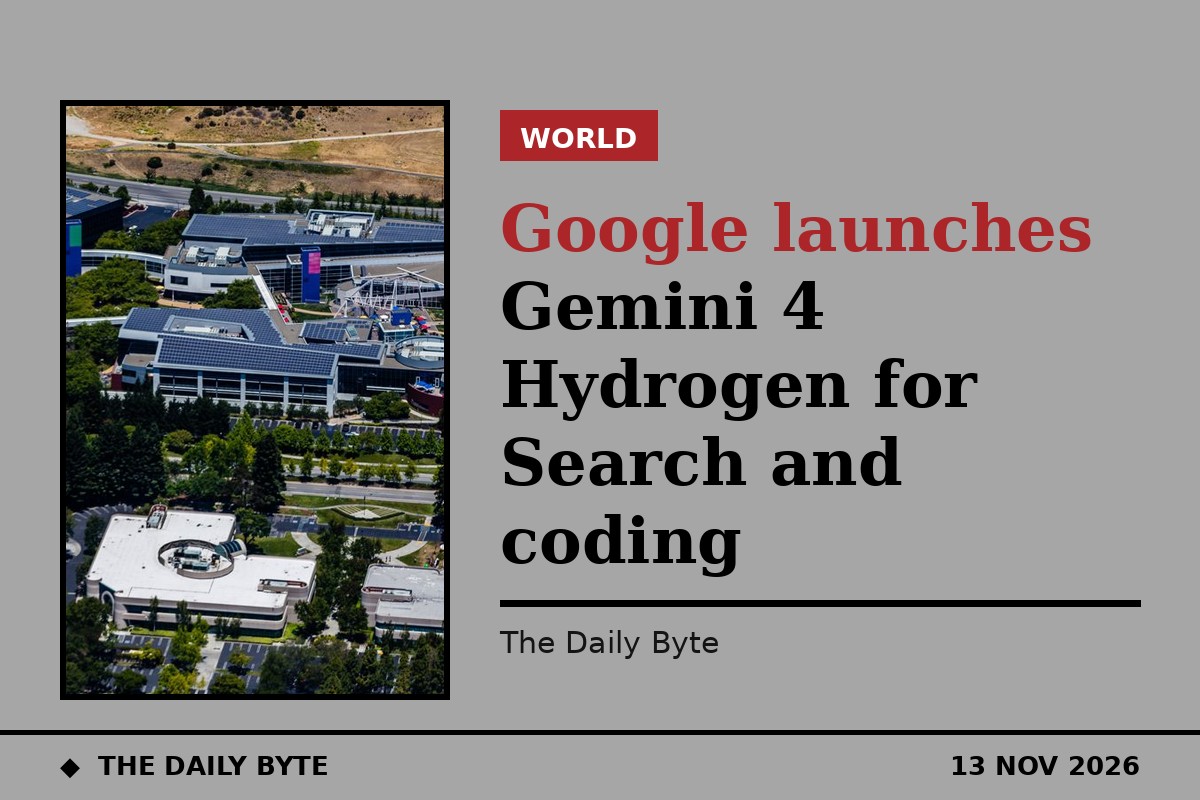
Google has launched Gemini 4 Hydrogen, a fast artificial intelligence model built for everyday coding and agentic work, and rolled it out across Google Search, the Gemini app and its developer tools. Google announced the model on 12 November, describing it as the version of Gemini 4 meant for everyone, rather than only for specialist researchers.
Hydrogen is the third model in the Gemini 4 family, following Carbon and Argon, which Google designed for deep, long-horizon reasoning on difficult problems. Hydrogen takes the opposite approach: it is built for rapid execution across tasks in which an AI carries out several steps on its own, such as writing and editing code, running research agents and answering everyday questions.
Google says Hydrogen completes tasks 2.5 times faster than Gemini 3.8 Flash, the model it replaces, at its default high thinking level. On Terminal-Bench 4.1, a test of real coding work, Google reports a score of 57 percent against 18.2 percent for Flash. On the Artificial Analysis Intelligence Index, Hydrogen scores 51 at its default setting, just ahead of Argon on 50, and reaches 54 at its highest thinking level. These are Google's own figures, and they have not been independently verified.
Four thinking levels and flat pricing
Hydrogen offers four thinking levels: low, medium, high, which is the default, and a new xhigh tier for harder work. Google says the levels let developers trade speed against quality, with fewer output tokens needed for routine tasks.
Pricing is flat across the model's one-million-token context window at $1.50 per million input tokens and $7.50 per million output tokens. That is the same price Google charged for Gemini 3.8 Flash, which Hydrogen replaces across the company's products.
The model is available now in all tiers of Google AI Studio, the Gemini API, Gemini for business, the Gemini app and Google Search, and in Google Antigravity for paid AI Pro and Ultra subscribers. Google also introduced Orchestrator in Antigravity, a feature that switches between Carbon and Hydrogen within a single session, with Carbon coordinating and Hydrogen running worker and verifier agents.
Biggest Search upgrade yet, Google says
The most visible change for ordinary users is in Search. Robby Stein, Google's vice president of product for Search, called Hydrogen "the biggest model upgrade to Search yet". It is now the default model in AI Mode and is used for the hardest questions in AI Overviews.
According to TechCrunch, Hydrogen is designed to give more helpful answers to complicated questions, including those with multiple parts, highly specific requests or confusing typing errors. Google says the model breaks a question down and addresses each part, and improves Search's fan-out technique, which splits one prompt into several related searches to find more sources.
Search answers powered by Hydrogen will also carry more visual responses, including images, comparison tables, graphs and maps. Google says the update is rolling out to all Search users globally, although access inside the Gemini app itself is tiered, with AI Pro and Ultra subscribers getting the model first.
Google says Hydrogen also ranks fifth on Agent Arena for multi-step work such as deep research, data analysis and navigating large codebases. For developers moving from Gemini 3.8 Flash, the company presents Hydrogen as a direct upgrade: faster, cheaper to run at scale, and available on every tier of its developer platform from day one.


